

Why This Common Household Spider Has Terrifying Eyes
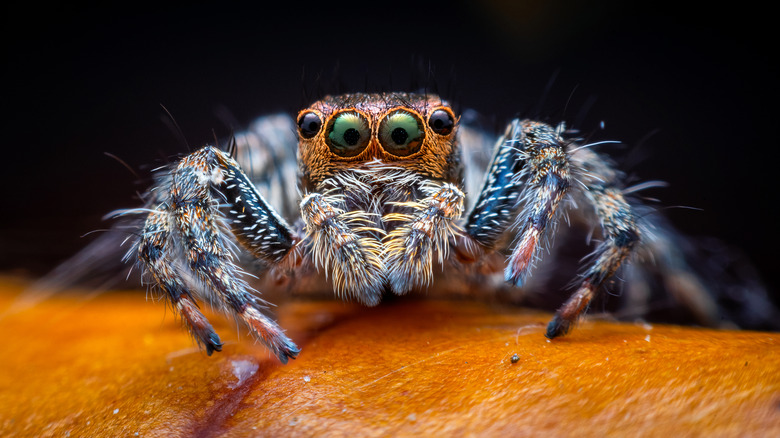
You might have heard that spiders are more afraid of us than we are of them. While true, such a thing likely won't reassure an arachnophobe, especially if we're talking spiders that are capable of seeing in almost 360 degrees with high definition eyes that aren't all that dissimilar to those of humans. The jumping spiders of the world, of which there are around 6,000 species across 600 genera, are known for multiple unique attributes and behaviors, including their ability to jump 40 times their own height and their elaborate mating dances. But they also happen to have two giant eyes on the front of their cephalothorax (the conjoined head and thorax section of their body), otherwise known as the carapace. At first, you might think these larger primary eyes make jumping spiders sort of cute, especially when combined with the species' fluffy appearance. But the more you look into it, the more unnerving (and impressive) the eyes become.
Jumping spiders are actually quite common, especially in the northeast United States, and belong to the scientific family Salticidae. They gained their name for their ability to leap at their prey, but that's arguably not what makes these spiders, known as salticids, so unique. Much more striking is the fact that their unrivaled eyesight has led experts to liken them to big cats in terms of their ability to see and assess their surroundings, using that information to guide their hunting behavior in much the same way as lions. Indeed, the vision of jumping spiders is similar to that of larger animals including cats and elephants and only falls short of human vision by about five to 10 times. That would be impressive by itself, but is especially so when you consider the forward-facing eyes of jumping spiders measure between just 0.08 to 0.8 inches in diameter.
Jumping spiders can see as well as much larger animals
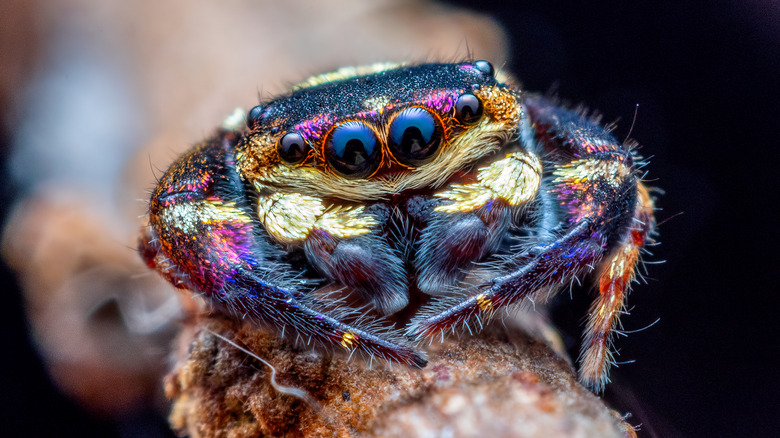
Like most arachnids, the jumping species have eight eyes. But unlike most spiders, they have excellent vision. Typically, arachnids rely on touch and sensations to navigate the world, with most species simply sensing changes in light levels. Salticids, however, have dramatically better eyesight thanks to their primary eyes, which also make it much easier to identify this spider species.
Jumping spiders have two primary and six secondary eyes. Of the secondary eyes, two (the anterior lateral eyes) sit either side of the main forward-facing pair, while two others (the posterior lateral eyes) sit on the rear of the carapace. Between these, on each side of the carapace, sit two smaller posterior medial eyes, which are actually thought to be vestigial in several jumping spider species. Different pairs of these eyes are thought to be specialized for certain things with the secondary eyes suited more to motion detection. That leaves the large anterior medial eyes (AME, or primary eyes) which face forward and, though they have a smaller field of vision, also have a much higher resolution.
Jumping spiders actually have what's known as camera eyes, which include a lens system and retina full of photoreceptors. This is fundamentally the same in humans, though jumping spider eyes differ in important ways. For one thing, humans have roughly 130 million photoreceptors while salticids have just a few thousand, which along with the small size of the primary eyes makes them even more fascinating due to the fact they have appear to have a startlingly high level of spacial acuity, or the ability to identify objects as separate elements and ascertain fine detail.
Jumping spiders are also known to see in color and are not only among the most visually capable arachnids, but have what might be the best eyesight of all arthropods (the family to which invertebrates like spiders, insects, and crustaceans belong).
Jumping spiders use their eyesight to hunt more effectively
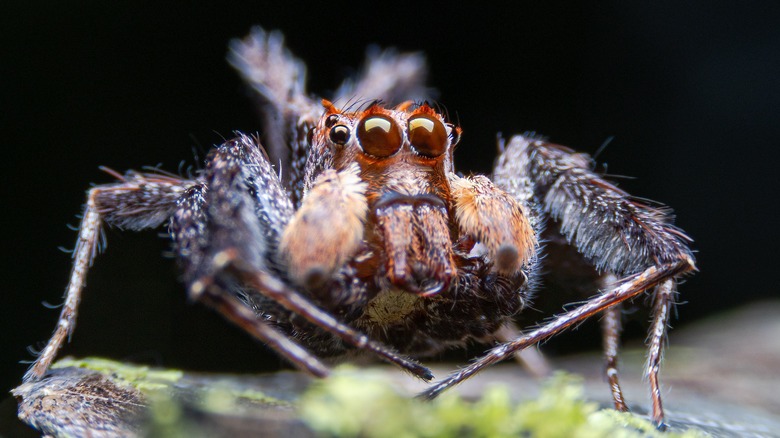
Having two terrifying but incredibly effective eyes is all well and good, but what does it mean in practical terms? Well, it means jumping spiders are incredibly good hunters, mimicking the predatorial styles of much larger animals. A 2006 study published in Animal Behavior, for example, looked at the behavior of a species known as Portia labiata, noting how — much like big cats — the arachnid appeared to plan detours ahead of time in order to intercept prey, initially moving away before returning at a later time to strike. But the researchers also found that the spider was able to make decisions on the fly as it moved towards its goal, suggesting it was using trial and error to survey possible routes and identifying intermediate goals on its way to reaching the ultimate end point. Without its high definition sight, such hunting practices simply wouldn't be possible while relying merely on changes in light and vibrations.
Elsewhere, a 2021 study published in PLoS Biology explored the ability of jumping spiders to discern biological and nonbiological motion. Researchers used a point-light display that mimicked biological and non-biological motion and found that the jumping spiders were clearly able to differentiate between the two, but that they actually showed a preference for the non-biological movement. The study was the first time biological motion recognition had been demonstrated in an invertebrate. Essentially, then, jumping spiders' visual capabilities go beyond being able to see things more clearly than other arachnids, and actually allow the spiders to evaluate the world in the way much larger creatures do. As cute as many jumping spiders look under a microscope, then, they're also simultaneously fascinating and sort of terrifying (though not quite as horrifying as the fossilized Australian spider that's pure nightmare fuel).