

The Ocean Used To Be A Different Color. Here's What Happened
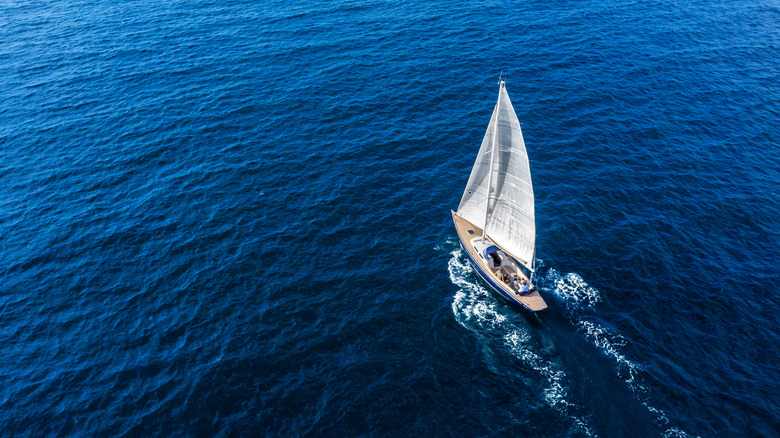
The ocean goes by many names — the high seas, the deep, Neptune's Realm — but its most famous moniker is the simple, iconic, Big Blue. The global ocean's deep blue hue is arguably Earth's greatest trademark, as it's one of the main causes of the way our planet looks from space. However, things weren't always this way. During the Archean Eon, which lasted from approximately 4 billion years ago to 2.5 billion years ago, conditions in the ocean were vastly different to what they are today. There was no oxygen gas in the sea or the air because the first organisms to perform photosynthesis were only just beginning to evolve. Multicellular life was billions of years away, and the ocean might have better been called the Big Green (or perhaps the Great Green, to keep the alliteration going).
It was long assumed that the oceans were always blue, but in 2021, a team of scientists at Nagoya University in Japan turned the scientific world on its head when they presented evidence that the ocean used to be green. Their extensive study, published in Nature Ecology & Evolution, combined field observations, laboratory experiments, and mathematical models to paint a picture of the Archean oceanscape. They found that the conditions of that period would have almost certainly turned the ocean green, thanks in part to the very earliest lifeforms that the planet ever knew. What's more, the knowledge that Earth's oceans changed color in the past raises an exciting possibility. Could they change color again?
How the oceans changed color
Earth's two most valuable assets, its atmosphere and oceans, formed right at the beginning of the Archean Eon, just after the planet's crust had solidified. Plate tectonics kicked into action shortly thereafter, with one consequence being the formation of hydrothermal vents along ridges in the ocean floor — one of the strangest places life is found today. Iron from the planet's metallic core began seeping out of these vents. At the same time, rain was falling from the newly formed atmosphere, dissolving iron from the barren continental rocks and carrying it via riverways into the ocean. Gradually, the water filled with iron. This iron was initially in ferrous form, meaning it was unoxidized.
These early Archean days brought another great change to the young Earth, when the earliest organisms capable of photosynthesis evolved. These primitive bacteria were unique in that they performed photosynthesis using electrons from iron rather than water. They feasted on the ferrous iron abundant in the Archean ocean, converting it into oxidized ferric iron. In its ferric form, iron absorbs blue and red light, but allows green light through.
The Nagoya University team made a key observation in the waters around the island of Iwo Jima, which appear green due to large amounts of oxidized iron. The scientists found that primitive bacteria are especially abundant in those waters, suggesting that green waters provided an evolutionary advantage to the planet's earliest lifeforms. One exciting implication of this observation is that the color green could be an indicator of early life forming on other planets, too.
The ocean could change color again
The ocean's color is clearly not a fixed thing. The green gave way to blue once all of the ferrous iron in the ocean had been converted into ferric iron. At that point, the oxygen produced by primitive bacteria had nothing left to oxidize, so it began entering the ocean as free oxygen (O2). This triggered arguably the most impactful moment in all of Earth's history: the Great Oxidation Event. The planet went from being a place virtually devoid of free oxygen to having a richly oxygenated atmosphere and oceans, in which aerobic life could develop. This brought an end to the Archean Eon, and ushered in the era of complex multicellular life. The ocean gained its (mostly) blue color as its contents changed and absorbed different life.
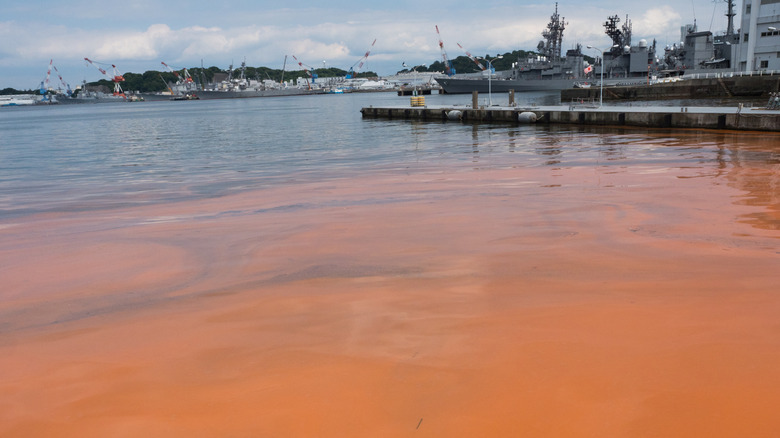
If the ocean changed color before, it could do so again, and there are a variety of possible outcomes for this. If levels of sulfur in the ocean were to rise particularly high, it could cause a surge in bacteria that would turn the water purple. High levels of nitrogen can bring red algae, and erosion can leech oxidized iron into the water, both of which could turn the seas red.
Interestingly, it's likely that the final color of the ocean will also be green. The sun is inevitably going to die, becoming brighter in the process and hitting Earth with more ultraviolet radiation. This will ultimately kill off the organisms in the ocean, taking away that beautiful deep blue color.