

Mystery Or Myth: Did Human Beings Evolve From Apes?
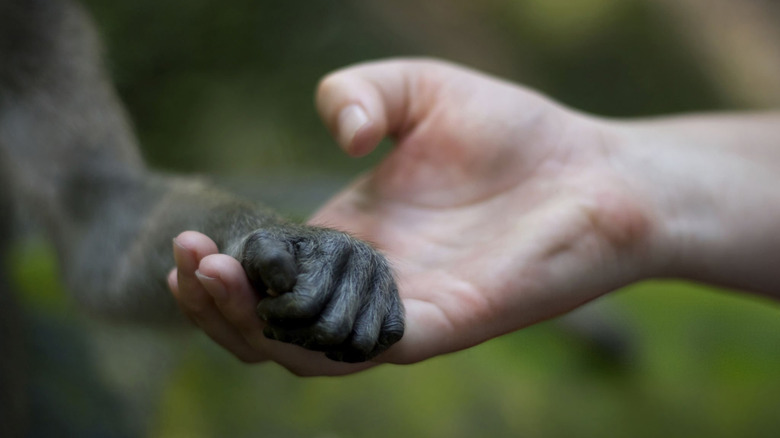
Yes, humans evolved from apes. But that's not the most accurate way to describe our place on the tree of life, and it certainly doesn't explain why apes still exist. The question stems from a common misconception about how evolution works, and how a species as exceptional as human beings could evolve to begin with. For starters, human beings both evolved from apes and continue to be apes. We are apes.
Human beings are part of a branch of the tree of life called Hominidae, a family of closely related species also referred to as "the great apes." Besides humans, Hominidae also includes chimpanzees, orangutans, bonobos, and gorillas. Yet, at a glance, human beings are quite different from chimps and gorillas, especially when you compare our brain sizes, behaviors, and our prowess for world domination. This dissimilarity leads many students of evolution to ask a follow-up question: If we evolved from apes, then why are there still other apes walking around?
There is a common misunderstanding of what scientists mean when they say that we are closely related to chimpanzees and other great ape species. It's true that human and chimp DNA is 98.8% identical, and the resulting similarities between our two species is obvious. Chimps are the most "human-like" species that aren't human beings: We're tailless mammals, grow similar body structures, eat everything from fruit to meat, and are highly social. Most importantly, we're highly intelligent. It's no coincidence that chimpanzees are some of the most intelligent creatures on Earth, second only to us humans. After all, chimps share with us an ancient common ancestor, making chimpanzees akin to our distant cousins.
Understanding common ancestors
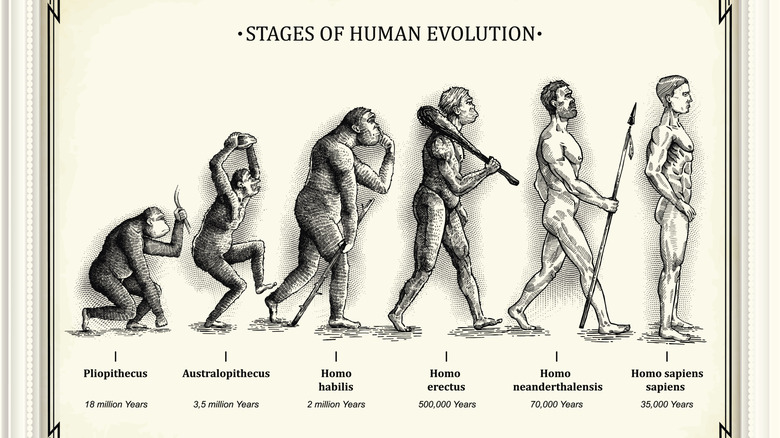
The reason we are so similar to chimpanzees is because we share a recent common ancestor with them, as we do with the rest of the great apes. That literally means that if it were possible to trace your family tree back far enough, and compare it to that of a modern chimpanzee's, you would eventually find that you share an extremely distant great-grandmother. How distant? It's estimated that humans and chimpanzees split into two separate species around 7 million years ago. That might seem like a lot, but the genome of life took an even more unimaginable amount of time to get there.
Genetic kinship can be found between every living creature on earth, including human beings. In fact, humans and bananas share more than 50% of our genes in common. To track these genetic relationships, biologists have worked for generations to collect evidence and construct an enormous family tree of life through a practice known as taxonomy. With the discovery of the process of evolution and innovations like carbon dating and genetics, the taxonomic tree of life has bloomed into greater and greater detail. As the evidence poured in, biologists eventually realized that every living thing shares a common ancestor with every other.
All living things on Earth originated from a single common ancestor roughly around 4 billion years ago. This mother of all mothers is referred to as the LUCA, or Last Universal Common Ancestor. It may be hard to believe that a single, simple cell evolved into the complex array of life on Earth as we know it. Yet, considering it took billions of years to evolve and diversify from a single cell, it's certainly a plausible (and demonstrated) origin story for life on earth.
We found the missing link, and it's us
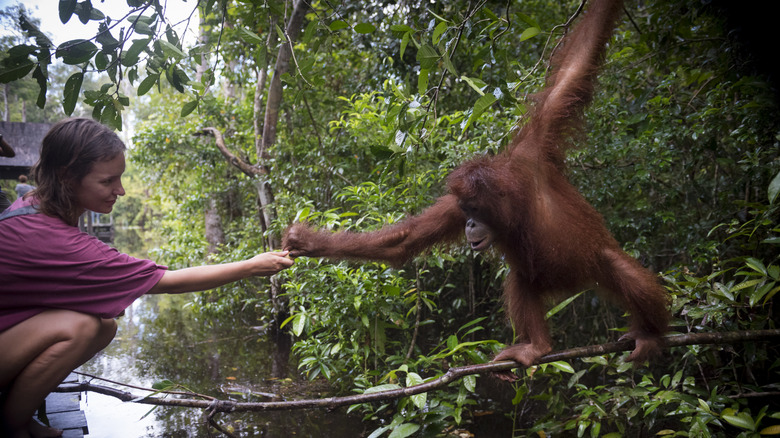
"The missing link" is a contentious buzz phrase that refers to a single piece of evidence that would prove our evolutionary connection to apes. The phrase makes for a grabbing headline, but it's not useful for science. Indeed, every new piece of evidence, be it a skull chip or an entire mummy, creates a collective link between us and our ape ancestors. Unsurprisingly, with every "missing link" found, there is always a new one to be found. In biological anthropology, there is no smoking gun, just new evidence.
It would be impossible to document every single organism that has ever lived and record their relationships with one another. The same is true when constructing a person's family tree: The further back in time you search for ancestry, the fewer documents are available to confirm members of the family. Perhaps a great-great aunt gets a question mark next to her name, or perhaps no one can remember what their second cousin looked like. In any case, cultural evidence of the past starts to fade after just a few hundred thousand years.
Fortunately, there are better ways to trace back our origins. Biologists turn to clues hidden in DNA, mtDNA, fossil records, and other disciplines to refine the tree of life into an impressively accurate timeline. And the most accurate section of all is our own. Human origins have been more closely analyzed and more accurately mapped than any other species on the planet. With every new piece of fossil evidence, artefact, gene sequencing, and morphological study, that map becomes even more refined. New discoveries constantly throw the details of human evolution into question, while also confirming the overall story of our shared origins with the rest of life on Earth.