

The Largest Seed In The World Looks Just Like A Human Butt
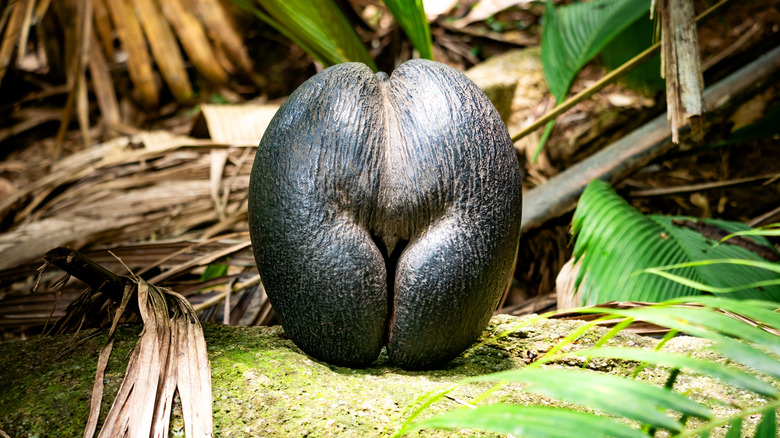
If Sir Mix-a-Lot studied botany, we think he'd be pretty stoked to learn about the seeds the double coconut palm (Lodoicea maldivica) produces. Also know as coco-de-mer, ("coconut of the sea") a name that comes from its giant seeds that would often wash up onto the shores of islands near its native Seychelles. But what makes it famous is that it produces the largest — and arguably the most suggestive — seeds in the world.
These seeds can weigh over 50 pounds and the butt-like shape is due to a dual-lobe composition. But before you start thinking this could be the best addition to your backyard, this is definitely not one of the fastest-germinating seeds. Coco-de-mer takes up to 20 years to reach maturity and another seven years to fruit. But, even if you're that patient, you'll also need to have a pretty high gardening budget because these seeds can run anywhere from $580 to $2,325 due to their rarity. Besides their dubious aphrodisiac properties and impressive, uh, form, these seeds are amazing because they're changing our understanding of what limits we thought the botanical world had — and showing us just how wrong we were.
This seed has more going for it than a shapely silhouette
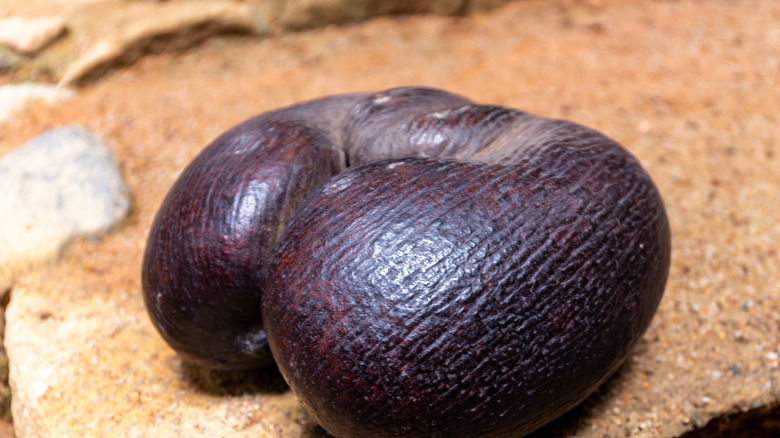
In its native region, coco-de-mer's seeds are important for the local fauna, housing geckos, parrots, and other native creatures, while indigenous peoples use them to store liquids, make baskets, and even as thatching for roofs. Also, it's said that sailors were especially pleased to find seeds with such a seductive shape after a long voyage, though we'll just leave it at that.
Over at the Royal Botanic Gardens, Kew, researchers are finding these seeds could be a significant key to understanding gigantism in botany and how a combination of low competition and lack of ability to disperse seeds easily could cause a tree like this to opt for producing fewer, yet larger seeds. We're not even sure if this butt-shaped seed is at its final form.
Sadly, time and climate change are not on its side. The IUCN Red List categorizes coco-de-mer as "Endangered" believing there are only around 8,200 trees left in the wild and those numbers are declining. If we lose this tree, we may never be able to recreate the precise conditions that could cause such a thicc seed to produce, leaving that unique evolutionary quirk we're only just learning about and a slew of our best butt-shaped botanical jokes to the history books.