

Science Fiction Vs. Science Fact: The Potential Of Starfield's Helium-3 As A Resource

Every good piece of science fiction has a healthy amount of colorful lore and scientific jargon to give its setting a nice splash of technologically advanced whimsy. Often, that includes some kind of fantastical source of power. "Star Wars" has its kyber crystals; "Star Trek" gives physicists pause over its phasers, as well as its dilithium crystals and warp cores. Meanwhile, Bethesda's 2023 release "Starfield" sees players mining helium-3 gas in order to power the ships that allow them to traverse the game's universe, known as the Settled Systems. And while the game referred to as "'Skyrim' in space" (via The Washington Post) by director Todd Howard sounds like it would have a power source as fictional as the Starborn, that's not entirely true. On the contrary, researchers are eyeballing helium-3 as a possible source for nuclear power – and they're setting their sights on the skies in the process.
Broadly speaking, real-life scientists are hoping to accomplish what "Starfield" players are doing as part of their regular gameplay loop. Not flying through space with a fictional space-warping grav drive – at least, not exactly, and not in this particular case – but rather, setting up mining operations on extraterrestrial bodies in order to collect this special helium isotope, and then using it to produce clean energy. Of course, that process is nowhere near as easy for us as it is for our videogame protagonists, and the plans for nuclear power plants using helium-3 still face a few obstacles. But "Starfield" does paint a surprisingly reasonable picture of a possible future.
Lunar mining of helium-3
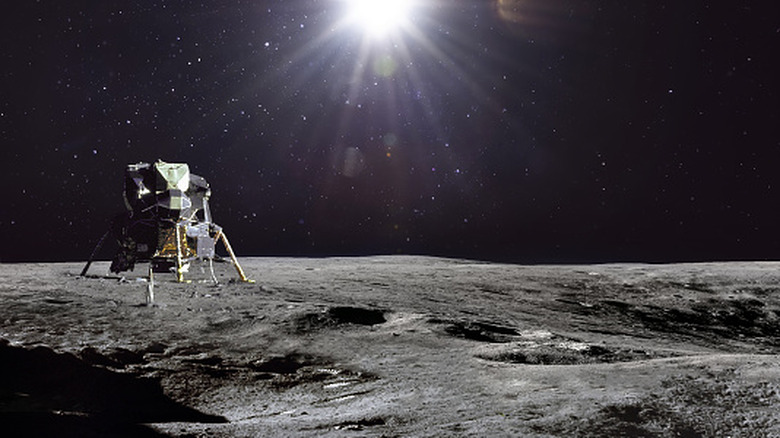
In "Starfield," players find themselves needing to mine helium-3 from a number of different locations, including some of Earth's neighbors, such as its own moon, the moons of Jupiter, and even Mercury. That idea didn't entirely originate from the developers at Bethesda, however; NASA had already discussed the idea decades earlier.
In general, the moon plays host to deposits of helium-3 in its surface, brought there regularly by the solar wind, completely uninhibited due to the moon's lack of both an atmosphere and strong magnetic field. According to a 2021 NASA report, researchers back in 1985 estimated that there could be a million tons of the stuff within just the top 3 meters of lunar soil. Within the next couple of years following that estimation, NASA was seriously looking into ways to mine lunar helium-3. In 1987, they formed the Wisconsin Center for Space Automation and Robotics to specifically create conceptual mining rigs that could one day be deployed on the moon, and in 1988, they held a workshop to discuss the feasibility of such operations and whether the potential nuclear power would be worth the cost. Ultimately, that conference determined that this would have to be a long-term endeavor that required huge advances in technology (as well as concrete plans for NASA to return humans to the moon), but even well into the 2000s, engineers were designing potential mining rigs, most of them based around the idea of heating batches of lunar soil (or regolith) so that it would release stored helium. That research has actually continued, with studies in the 2010s focused on better understanding the mechanics behind how that process works, and ways to make it more efficient.
The nuclear possibilities
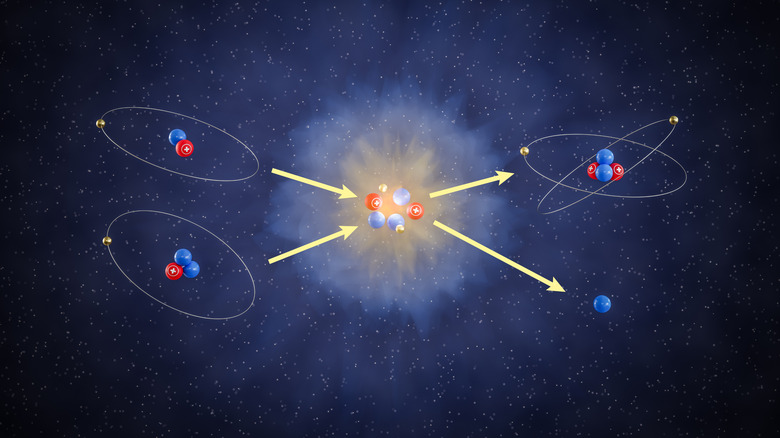
There are two different types of nuclear energy schemes: fission, or the splitting of large atoms, and fusion, the combination of two smaller atoms. Current commercial power plants make use of nuclear fission, but helium-3 comes into play regarding ongoing research on nuclear fusion.
As of right now, fusion research is largely focused on deuterium and tritium, two different heavy isotopes of hydrogen. They're fused together to create a normal helium atom and a high-energy neutron, with the latter being, essentially, the source of what we'd consider usable nuclear power. However, that energetic neutron also comes with engineering issues; it would require heavy-duty walls to absorb all that kinetic energy, and those walls would need to be disposed of as highly radioactive nuclear waste, potentially as often as every couple of years.
Helium-3 fusion just might be the solution for the problem of nuclear waste, though. Reactions involving helium-3 with deuterium would produce very few energetic neutrons and a large number of positively charged protons, which can be turned directly into electricity without needing to smack into hefty walls to dissipate their energy. In other words, there would only be a relatively small amount of low-level nuclear waste to deal with every few decades. Go a step further, and you'd find the idealized form of this reaction; the fusion of helium-3 with itself, creating helium-4, two protons, and no neutrons. In theory, that's a reaction that creates energy without any nuclear waste – though, realistically, that probably translates to marginal amounts of low-level radioactive waste – and which has been accomplished, albeit at a small, non-commercial scale. What's more, the helium-3 in just the top layer of lunar regolith could provide energy equal to a thousand times the world's annual consumption (via Joule). One of the biggest problems is just getting it back to Earth.