

NASA's 'Lost Asteroid' Didn't Hit Earth In 2024 - But What If It Did?
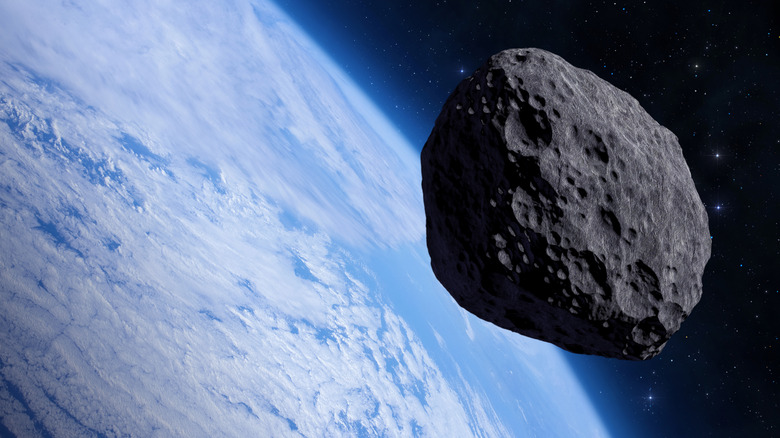
In late 2023 and early 2024, the news was peppered with stories about a "lost asteroid" that could hit Earth in October 2024. Stories about an impact by a space rock certainly grab everyone's attention, especially when it would strike with an estimated energy equal to 2.6 billion tons of TNT. We all know this asteroid didn't hit Earth in 2024, but what if it did?
Most of us understand just how devastating an asteroid strike can be. For example, the scientific consensus is that the dinosaurs were wiped out by an asteroid impact around 66 million years ago. Calculations show that while an impact by this "lost asteroid" would be a disaster, it wouldn't be the kind of cataclysm that occurred at the end of the Cretaceous. The Chicxulub asteroid, one of the biggest asteroids that ever hit planet Earth, released energy equivalent to an estimated 72 trillion tons of TNT. Experts think the impact of this asteroid would cause massive regional damage, though humanity experienced a volcanic eruption just over 200 years ago that released more energy than this "lost asteroid" would.
Watching the Skies for Threats
The asteroid in question is better known by its official designation, 2007 FT3. The 1,030-foot, 54 million-ton space rock was first observed by scientists in 2007. However, after only 1.2 days, the asteroid passed out of view, becoming too dim to track anymore. Researchers are continuing to look for 2007 FT3, but they were able to collect enough data during their short observation window to plot its orbits for many years. Its next close pass to Earth comes in 2030, though it has a roughly one in 10 million chance of hitting us then, which is similar to the odds in 2024.
Scientists track the orbits of more than 32,000 near-Earth asteroids, with most being monitored by NASA's Center for Near Earth Object Studies. Researchers closely watch any objects 460 feet across or larger as an impact of anything this size can cause severe damage. By observing an asteroid, scientists can calculate its orbits up to about 100 years into the future. After even the short observation window they had with 2007 FT3, scientists were able to calculate 89 close encounters between the asteroid and Earth. This may sound more threatening than it actually is, though, as scientists define any asteroid passing within 30 million miles of Earth's orbit as a close encounter. To put this into context, the moon orbits at an average distance of 240,000 miles.
A Very Bad Day, but Not the End of the World
An impact by 2007 FT3 would be devastating, releasing around 45 times more energy than Tsar Bomba, the largest nuclear bomb ever tested at an equivalent of 57 million tons of TNT, and which destroyed everything within a 22-mile radius. An impact in the water, which is likely considering how much of Earth's surface is covered with oceans, could cause a tsunami. If 2007 FT3 hit land, it would kick dust, debris, and smoke high into the atmosphere. An impact would cause immediate damage and loss of life, and there could be climate effects that last for years.
The long-term effects might look something like the period of cooling known as the Year without a Summer in 1816. This followed the 1815 eruption of the Indonesian volcano Tambora. Dust and ash from this eruption — which released around 10 times more energy than an impact by 2007 FT3 would – darkened skies around the world, cooling the planet and causing crop failures, famine, and social upheaval. An impact by 2007 FT3 could lead to similar, though perhaps less intense, climate disruptions.
Fortunately the "lost asteroid" didn't hit Earth in 2024 and is unlikely to do so at its next close pass in 2030. However, if it had done so, the effects would been devastating. This is why scientists continue to closely watch the skies.