

What It Means When An Egg Has Double Yolks
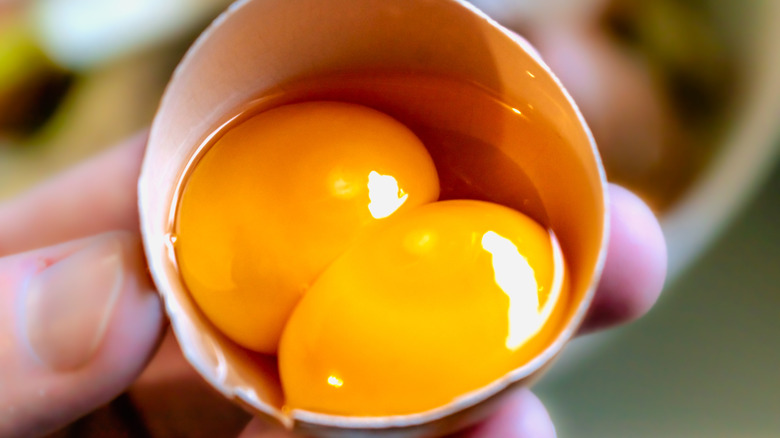
Cracking open an egg to find two yolks instead of the usual one can be a strangely exciting moment, and some consider it to be a sign of abundance and good fortune. From a scientific perspective, there is a simple explanation for this 1-in-1000 occurrence, and it's closely linked to the hormones of the laying hen.
In a normal laying cycle, a hen will release one egg during ovulation, which will be wrapped in a shell as it moves down the oviduct. In the case of a double-yolk egg, however, two eggs are released within a short time frame, meaning they both end up in the same shell. While this may seem similar to the process of twins being created in mammals, twin chicks hatching is incredibly unlikely. Even if the egg were fertilized, there is not enough space or oxygen within the single egg to fully sustain both chicks to the stage of hatching.
Age plays a big part in the likelihood of a double yolk
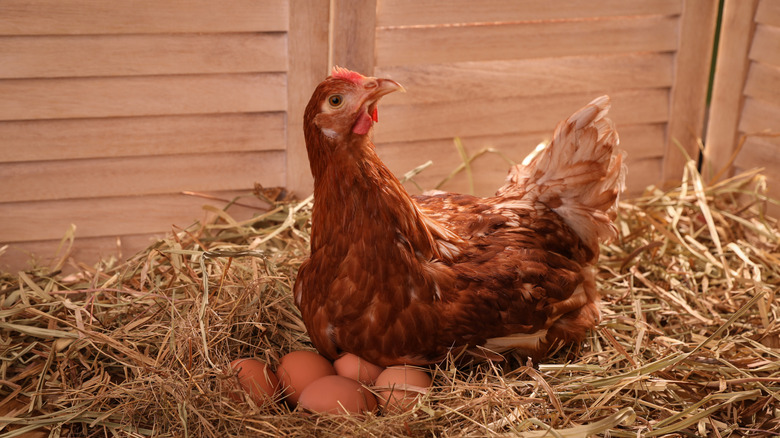
In a regular cycle, only one yolk should be released at a time, so double yolkers tend to be produced by hens whose cycle is slightly erratic. In most cases, these are pullets (young hens) who are just beginning to lay, usually from around 15–18 weeks old. Until their systems get the hormones fully under control, aberrations in yolk release can be expected, resulting in the rare twin yolk. Once the laying cycle is more settled, the instances of double yolks will decrease dramatically.
Hens with a very high laying rate can also be prone to releasing two yolks at once, and in this age of selective breeding, certain breeds such as the Rhode Island Red, are more likely to regularly lay two yolks. Statistically, the chance of a double-yolk egg is around 1 in every 1000, but this is across all ages and breeds of laying hens, meaning the chances from a young hen are much greater (around 1 in 100).
Double yolk means more nutrition
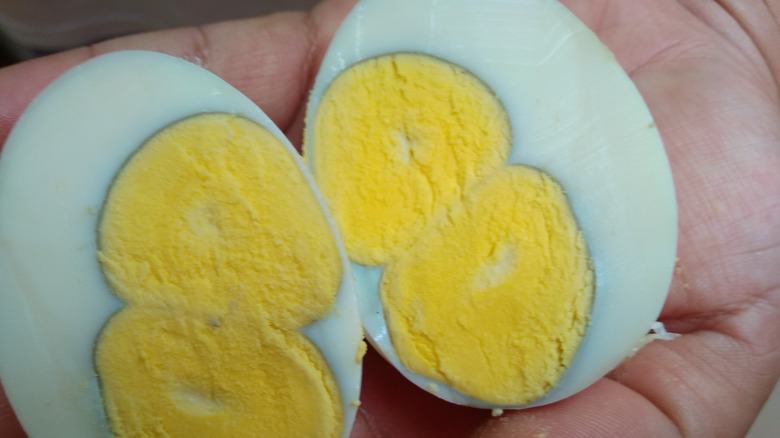
Despite being vilified during the '90s low-fat craze, when we didn't know as much about cholesterol, eggs are now considered incredibly healthy, and the vast majority of their nutrition is crammed into the yolk. This means that a double-yolked egg has more nutrition compared to a standard egg: Omega-3 fatty acids, vitamins A, B, and D, and choline are all present in higher quantities in a double yolker.
Naturally, double-yolk eggs tend to be larger than single-yolk, so if you are on the hunt for some, buying large eggs may increase your chance. The process of candling — shining a light through an whole egg to see inside — can often be used to prevent double-yolk eggs hitting the supermarket shelves, but if you pick your eggs up from a farmers market, there may be a chance, albeit a slim one that you'll find this rarity. Whether your double-yolk eggs are brown or white, they are perfectly safe to eat, and extra delicious thanks to the double hit of the rich yolk.