

Mystery Or Myth: Are People Really Left-Brained Or Right-Brained?
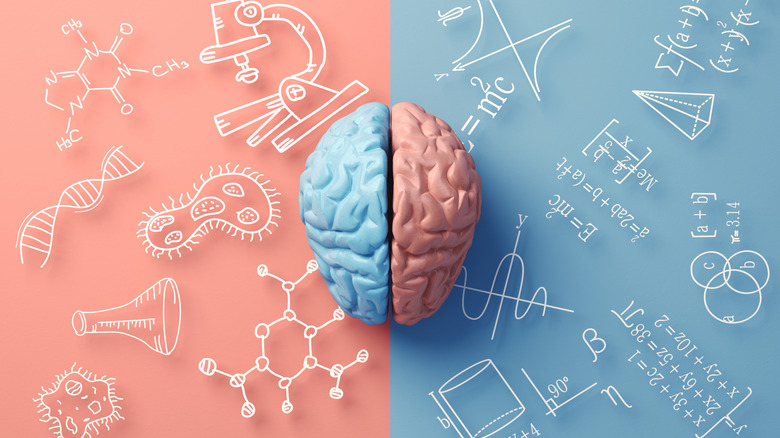
Most likely, you have heard someone refer to themselves as "right-brained" to suggest they are more creatively than logically inclined, or say they are "left-brained" to convey the opposite self-conception. Personality traits and learning style varieties abound, and it makes sense that we want to understand both our differences and similarities to others. Of course, as we try to categorize and define ourselves, neuroscience makes an appearance. But are our natures that simple? Do our brains rely on one hemisphere over the other, and does this explain the way that we think and approach problems? While it might appear straightforward to view the sides of our brain the same way we view handedness, the truth is much more complex, and this concept is a myth.
Like most myths, this one originated with a grain of truth. Scientists began to realize that there were certain neurological functions that relied on one hemisphere over the other, beginning in the 19th century. In 1861, Paul Broca discovered that an area within the left frontal lobe was vital for language production. Nearly two centuries later, Roger Sperry would examine patients for whom the white matter tracts connecting both hemispheres were severed in an effort to treat severe epilepsy. He found even more functional specialization, such as the right hemisphere being involved in spatial and nonverbal reasoning, while the left hemisphere is responsible for most language functions and arithmetic.
The personality premise

Although these experiments did indeed reveal that certain functions are specialized to one hemisphere as opposed to the other — a concept known in neuroscience as lateralization — to suggest that one hemisphere was responsible for logical thinking and the other creative would be a stretch. Nonetheless, it's a stretch that was made when a New York Times article covered Sperry's experiments in 1973. Within the first paragraph of the article, the hemispheres were oversimplified with the description, "One of them is verbal, analytic, dominant. The other is artistic but mute, and still almost totally mysterious." And from there, the concept spiraled, as we turned to the notion of being right-brained or left-brained as a way to explain our individualistic proclivities for logic or creativity.
Now, you might think that, although this was a leap in logic from Broca's and Sperry's findings, that does not necessarily make the idea incorrect. However, after the widespread popularization of such a theory, researchers were able to investigate it further through brain imaging studies. In 2013, Jared A. Nielsen and colleagues published a large-scale test of this hypothesis. They examined functional magnetic resonance imaging data from 1,011 subjects ranging in age from 7 to 29. While supporting that certain functions exhibit lateralization (specific activities taking place in a particular part of the brain on the right or left side), their findings demonstrated that there is no widespread usage of one hemisphere above the other among individuals. This debunks the hemispheric dominance myth.
A neuronal symphony
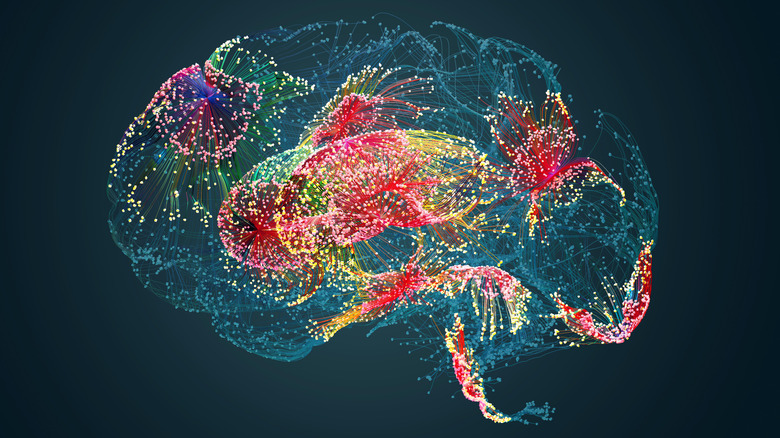
Many parts of the brain must constantly work in concert in order for us to adequately perceive and interact with our world. Even when we consider the lateralization of language, although many functions might primarily occur on the left side, both hemispheres have some involvement. For instance, although language production primarily occurs through the left hemisphere, some aspects of language, like understanding idioms and recognizing the meaning of tone, are generally reliant on the right hemisphere.
Similarly, although the left hemisphere is normally more involved in certain aspects of arithmetic, the right hemisphere plays an important role as well. While simple functions might more heavily stem from the left side of the brain, the right hemisphere is useful in spatial dimensions and understanding numbers that involve zero. Moreover, a study from 2012 revealed that activity between hemispheres was heavily coordinated during arithmetic problem-solving, particularly in the case of subtraction. They also found that individuals who exhibited the most connectivity between hemispheres solved subtraction problems at a faster rate.
This goes to show that the hemispheres of our brain consistently work together. While logic has been attributed to the left side of the brain in pop culture, stereotypically logical activities, like mathematics, involve both hemispheres. Although many studies have refuted these popular notions, they are still widely held. In fact, approximately 80% of educators think that we are right- or left-brained, but it's a brain myth scientists want you to stop believing.