

The 'Doorway Effect' Phenomenon Can Explain Why You Walk Into A Room And Immediately Forget Why
Have you ever experienced walking into a room and forgetting why you are there? Maybe you are getting ready and realize that you need to grab a coat from your bedroom. But when you walk into the bedroom, suddenly you can't remember your task and look around confused, racking your brain in an attempt to recall what it is exactly that you are forgetting. This behavior is generally considered relatable, and maybe you chastise yourself in this state of forgetfulness and feel foolish looking around the room to recall the intentions you knew clearly mere seconds ago. But it turns out there is a psychological theory as to why this might happen, and even studies to back those theories up. It is referred to as the "doorway effect" and is guided by the Event Horizon Model, which suggests that a change in environmental context might trigger a lapse in memory.
In order to understand this theory, we first need a basic grasp of the different types of memory and how they work. You have probably heard of short-term and long-term memory. Short-term memory refers to a very temporary store of information. For instance, someone might tell you their address, and you remember it long enough to type it into your phone, but in a day or even an hour, you will be unable to recall that information. Long-term memory is the information that we hold onto for extended durations, such as a parent's phone number.
New event models
There is a third type of memory that has some overlap with short-term memory but maintains some important distinctions: Working memory is information that we can temporarily use to solve a problem or conduct a behavior, and is important for things like performance in mathematics. Essentially, this is the information that we can manipulate in our minds, almost like mental scratch paper. Many theories suggest that there is a limit to our working memory capacity at any given time. This might explain why our brains seemingly dump information when it is no longer considered useful.
The Horizon Event Model suggests that ongoing processes are divided into multiple events, such that a change in salient features, like our surroundings, triggers an update to the event model. These triggers are known as event boundaries. The Horizon Event Model framework also relies on the principle that the event model we are currently perceiving is the only one that exists in our working memory. Another component of the theory is that we have difficulty retrieving information when it was involved in a previous event.
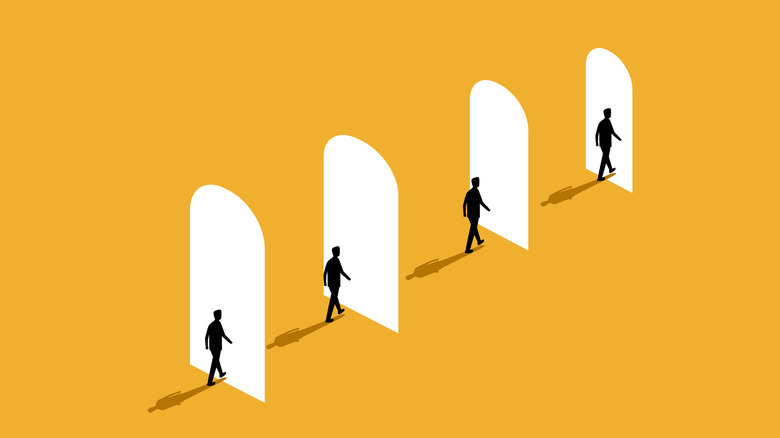
The doorway effect posits that a doorway acts as an event boundary. Returning to the example earlier, let's say you are in your living room when you realize that you are cold and will need to grab a coat. This is one event model. However, when you pass the doorway to enter the room in which you planned to grab your coat, a new event model begins.
A door by any other name

Scientists have actually managed to show that passing through a literal doorway does impair memory retrieval. Gabriel A Radvansky and colleagues introduced participants to a covered box that contained a set of blocks of varied shapes and colors. After lifting the cover and examining the contents, they were then asked to place the cover back and move the box to another table. At the second table, they first were tasked with some math questions before they were prompted to identify whether each object described was in the box they carried. For instance, "red cube" would appear on a screen in front of the participants, and they had to recall whether they had seen a red cube in the box. Radvansky et al. found that participants who had to cross a doorway to reach the second table were less accurate than those who simply walked the same distance but remained in one room.
Interestingly, this effect isn't limited to literal doorways. In fact, originally Radvansky and colleagues had shown that a similar task performed virtually — carrying a concealed object into another room in a video game — generated similar results. In another paper, they even showed that imagining walking through a doorway worsened memory. Additional studies have even demonstrated that these results occur virtually without a door, by teleporting or using a portal in a video game. So, if we ever learn to teleport, we still might need tips to improve our memory.