

Science Says This Is How Long Your DNA Will Last After You Die
The rate of DNA's decay depends on many factors. Cremation destroys the body's DNA, ensuring it can never be recovered by science. If you elect for a burial at sea, your DNA would likely be consumed by sea creatures and broken down within a couple of days. On the other hand, those who choose cryogenic freezing or get their DNA sequenced could potentially extend their genetic signature for centuries or more. But if you go the common route, which is burial underground, your DNA could last anywhere from decades to up to 45,000 years — it all depends on how your remains are left behind.
Throughout history, the majority of humans who have lived and died were inhumed, buried in the ground. The practice is largely due to the reverence and health concerns surrounding the deceased. When a cadaver is left on the ground to decay in the open air, it's soon picked apart by predators and decomposes. Such a sight would be disturbing for the loved ones of the deceased, and religious beliefs may also inform the decision to bury the dead. Once underground, a body had better chances of preservation if it was kept dry, a practice that also led to intentional mummification, such as in ancient Egypt and Chile. For genetic longevity, the drier, the better.
Most of us, however, will not be mummified. The majority of people alive today are destined for either cremation or burial in a wooden casket. In a coffin, DNA decays over time as moisture permeates the coffin and allows decomposers to consume cell tissues. No matter how your body is left to rest, time will eventually degrade your genetic signature to the point where even the best technologies can't revive it.
Most DNA lasts just a few days or years after death, while some can last millennia
Around 6,000 years ago, a female human chewed a wad of sap from a birch tree to clean her palette after a meal of duck and nuts. She then spat it out into a sandy area, and went on living her life. We know this occurred because archaeologists found her gum at an excavation site in Denmark and analyzed it. Because the sap killed bacteria, the DNA from the girl's mouth survived, along with other contents. Based on the extracted gene sequence, scientists determined that the girl (posthumously named "Lola") likely had dark skin, blue eyes, and dark hair.
Lola's DNA had survived through the ages in the resin of a birch tree, yet her human DNA isn't even the oldest. The oldest modern human DNA ever recovered comes from bone remains dating back 45,000 years. Scientists were able to piece together the DNA from thousands of bone fragments, revealing a family genome with mothers, daughters, and cousins. The ancient DNA also demonstrated genetic links between prehistoric Europeans and Neanderthals.
Yet, such archaeological finds are exceptionally rare, and the majority of your body's trillions and trillions of cells (and the DNA contained within them) break apart and die. Some tissues may remain active for a short time after death, causing some bodies to move for as much as two days or more. As bodies decompose, DNA is consumed and dissolved by enzymes and microbes. DNA's half-life is roughly 500 years, so after a millennium, only around 25% remains. After 6.8 million years, it's unlikely that any genetic base pair will survive the toll of time.
How to extract ancient DNA from ancient human remains
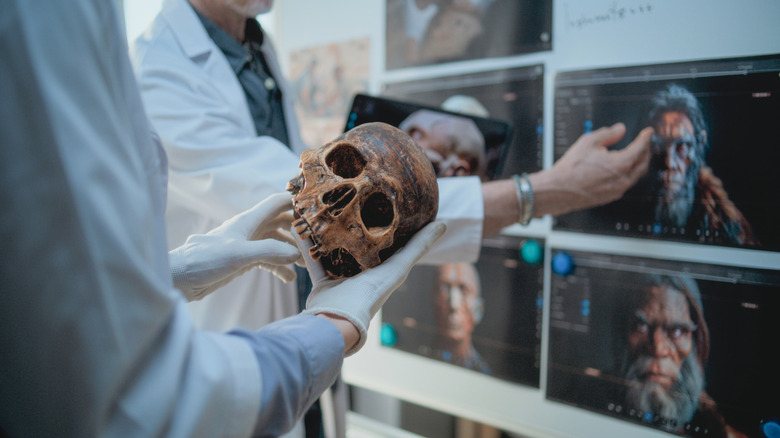
Scientists detailed their ancient-DNA discovery in a 2024 study. Extracting the 45,000-year-old DNA required some seriously cutting-edge technology, since the DNA was almost entirely degraded. Instead of hoping to find complete DNA molecules, the scientists used a process called destructive sampling, which involves pulverizing the bone fragments into a powder. This powder was then dissolved and treated with chemicals to strip away the calcium and other materials, leaving behind a soup of broken bits of DNA.
The leftover genetic material was then stitched together using advanced next-generation sequencing machines, which try to compile a complete genome by comparing genes from incomplete samples. It's kind of like using a computer to solve a jigsaw puzzle, only many of the pieces are the same. Many DNA fragments are from family members, so no one individual was sequenced.
While 45,000 years is the age of the oldest Homo sapiens DNA ever discovered, in 2024 scientists from Germany and the U.K. extracted DNA from Neanderthals with an approximate age of nearly half a million years. The 430,000-year-old DNA was also in bits and pieces and came from 28 individuals. The findings also reveal links between modern humans and their Neanderthal cousins. In fact, many genetic links between human beings and other, extinct human species have been discovered. Considering scientists have found a genetic kinship between human beings, Neanderthals, chimpanzees, and even the rest of the animal kingdom, it's possible our DNA can live on through other animals.