

Not Mars, Not Europa: Scientists Say This Moon Could Be The Best Place To Find Life

For ages humanity has grappled with the question of whether we are alone in the universe. While Earth is the only place where we have confirmed the existence of life, the cosmos is a big place. Scientists have even found a few worlds where extraterrestrial life could be hiding, including planets and moons in our solar system that have conditions that might support life. However, while Mars and Jupiter's moon Europa feature heavily in our collective imagination, scientists have identified one moon that could be the best place in the solar system other than Earth to find life: Enceladus.
At first glance, Saturn's moon Enceladus seems an unlikely candidate for life. The surface is covered in ice and the sun is only a fraction as bright as seen from Earth. Mars has seemed like a more likely candidate, with evidence of the planet having a thicker atmosphere and liquid surface water in the distant past. Europa has also been the subject of study because of its suspected subsurface ocean of liquid water thanks to heating from Jupiter's gravitational forces. However, high-resolution images and other scientific evidence point to Enceladus having many of the conditions needed to support life.
A liquid ocean beneath an icy shell
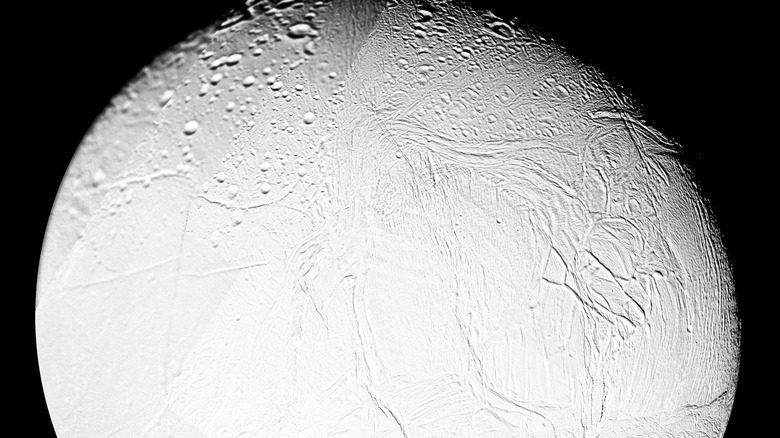
Enceladus is one of the most reflective, and thus brightest, bodies in the entire solar system. This is because the moon's surface is a thick shell of ice. Enceladus experiences tidal forces from Saturn's gravity pulling on the moon, which creates heat beneath the surface, making it possible that an ocean of liquid water exists beneath the moon's icy surface. By measuring tiny shifts in the moon's path as it orbits Saturn, scientists have estimated that Enceladus has an ocean six miles deep beneath the southern polar region under a shell of ice between 19 and 25 miles thick.
An ocean of liquid water in contact with rock could contain materials needed for life. Studies of Europa's magnetic field and other indirect measurements show that the Jovian moon might have a salty ocean, hinting at water contacting a rocky seabed. However, scientists will be unable to confirm the presence of an ocean until NASA's Europa Clipper mission arrives in 2030.
While indirect measurements suggest a liquid subsurface ocean on Enceladus, there is additional evidence supporting this hypothesis. High-resolution images of the moon's south pole from NASA's Cassini spacecraft show young ice and fissures likely created by tidal forces. These fissures allow jets of icy materials to spew hundreds of miles above the moon's surface at around 800 miles per hour. Some of the material in Enceladus' plumes falls back to the moon's surface, and some forms the particles in Saturn's E ring.
Icy particles hint at possibility of life
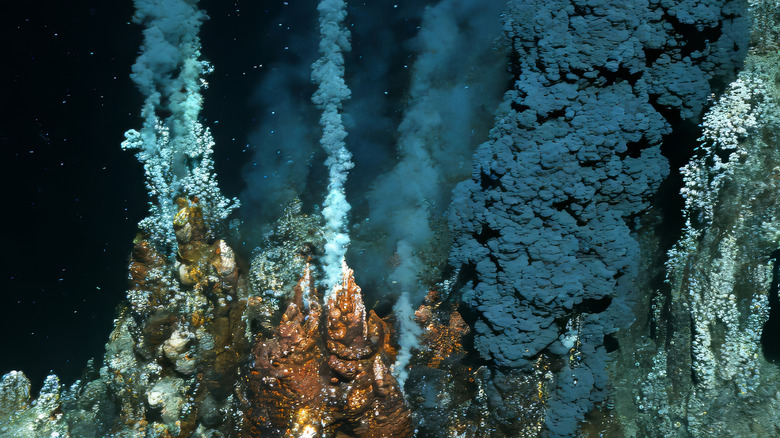
Cassini sampled plume particles during close flybys of Enceladus in 2008 and 2015. Instruments aboard the spacecraft analyzed the plume particles, finding water vapor, volatile gases, carbon dioxide, and phosphorous, a key building block of amino acids. Analysis of E ring particles also found tiny grains of silica that can only be made when liquid water and rock interact at high temperatures. This suggests that the moon not only has a rocky seafloor, but also has hydrothermal vents beneath the surface. On Earth, hydrothermal vents at the bottom of the ocean are a strange place scientists have found life, thanks to chemicals the vents release.
The findings from Cassini point to Enceladus being a high-ranking candidate in the search for life in our solar system. However, while the moon has the necessary ingredients it may not be home to living organisms. The same goes for Europa, Mars, and other locations in the solar system like Saturn's largest moon, Titan. Scientists are planning to gather more data with missions like the Europa Clipper, which was launched in 2024, and NASA's Dragonfly mission to Titan scheduled to launch in 2028. Additionally, researchers are working on a mission concept called the Enceladus Life Finder, which will look for direct signs of life in the moon's icy plumes. Future missions throughout our solar system will keep collecting data with the ultimate goal of finding evidence of life somewhere other than on Earth.