

Drinking Alcohol Has A Disturbing Long-Term Effect On Your Brain Health
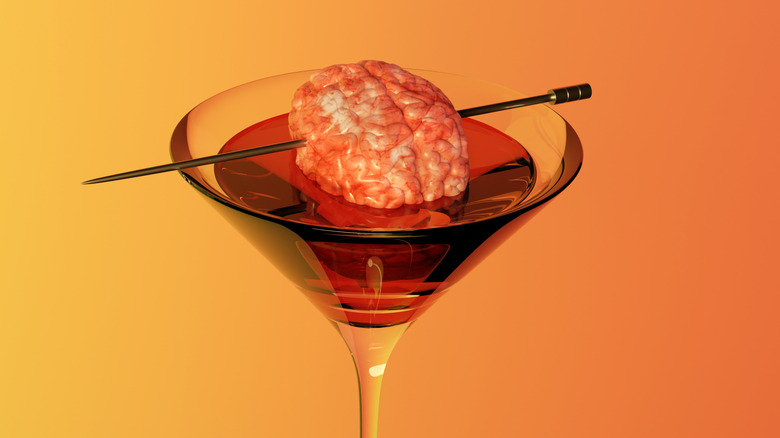
Many of us have familiarized ourselves with the short-term effects of alcohol. Based on the amount and type of alcohol that has been consumed, effects can vary from general feelings of relaxation to poor balance and, further, to losing consciousness. Research shows that the brain releases endorphins in response to alcohol, which is responsible for that feeling of happiness you might get after a drink or two. This reinforces a neurological drive to drink. But alcohol has numerous systemic effects that extend beyond reward, and excessive use can lead to inflammation in the brain, a reduction in brain tissue, and memory loss. While these effects are most pronounced for chronic heavy drinking, deleterious impacts can be seen in individuals who consume as little as one drink a day.
Perhaps the most studied aspect of alcohol use and neurological outcomes is the relationship between drinking and brain volume — likely because these studies can be performed through brain imaging, which is a non-invasive technique. For decades, studies have shown that chronic excessive drinking is associated with a reduction in brain volume. This has been found for both grey matter (the tissue that contains brain cells) and white matter (the tissue that forms connections between cells). Additionally, alcohol dependence has been linked specifically to shrinkage of the amygdala (a structure important for emotional regulation) and hippocampus (the part of your brain responsible for memory). However, the effects that these changes in brain structure might have on behavior and cognitive performance are still unknown.
Alcohol's effect on memory

One of the most concerning aspects of excessive alcohol consumption is the effect it has on memory. We know that an episode of binge drinking can affect memory, appearing to inhibit the ability of the brain to form long-term and short-term memories and generating what we colloquially refer to as a blackout. Chronic alcohol misuse can lead to long-term effects and even specific neurological disorders that are characterized by memory impairment. While some studies have alluded to a reduction in dementia risk for light and moderate drinkers, others have shown that any amount of regular alcohol consumption increases the risk of later dementia.
Alcohol-related brain damage (ARBD) is alternatively referred to as alcohol-related dementia and is thought to be the cause of up to 10% of early-onset dementia cases. Roughly one-third of individuals who exhibit alcohol dependence, which is characterized by a need to keep drinking to avoid negative symptoms during withdrawal, develop some level of ARBD. Early symptoms can include minor impairment, such as difficulty remembering seemingly important information, but ARBD can grow in severity and result in the need for constant care.
One of the most serious conditions that can develop from chronic heavy drinking is Wernicke-Korsakoff syndrome. This is the combination of Wernicke's encephalopathy and Korsakoff's psychosis and results from extreme vitamin B1 (thiamine) deficiency, as alcohol inhibits its absorption. Wernicke-Korsakoff syndrome can lead to severe confusion and an inability to form new memories. Approximately 12–14% of people who chronically drink in excess develop the syndrome.
Treatments for alcohol-induced afflictions

Fortunately, some of these long-term neurological effects can occasionally be reversed when a patient significantly reduces alcohol intake. However, this requires quick action and treatment when symptoms emerge. One aspect that might hinder this timely treatment is the underdiagnosis of some of the described disorders. For instance, research indicates that roughly 80% of Wernicke-Korsakoff syndrome cases go undiagnosed. Partially, this could be due to the wide range of symptoms that are present. Additionally, some symptoms overlap with alcohol intoxication and alcohol withdrawal.
Much of what has been detailed thus far indicates that heavy drinking should be avoided, although it is important to consider that many of the detrimental neurological effects of alcohol are studied in situations of alcohol dependence. Therefore, we might be missing some valuable insight into the long-term effects of mild and moderate drinking, which have shown variability in the literature.
Some recent guidelines, such as those from the World Health Organization, suggest that any amount of alcohol is harmful. Largely, this is due to its association with an increased cancer risk. Alcohol is classified as a Group 1 carcinogen (cancer-causing agent). Some other notable members of Group 1 are asbestos and tobacco.
The acute effects of alcohol consumption are influenced by many different factors, such as age and medication usage. So, it is best to consult your physician to know how you should approach alcohol. Additionally, if you or a loved one is experiencing alcohol dependence, resources are available, such as the SAMHSA Helpline.