

Science Fiction Vs. Science Fact: Alien Life Might Be Just As Strange As Project Hail Mary Makes It Out To Be
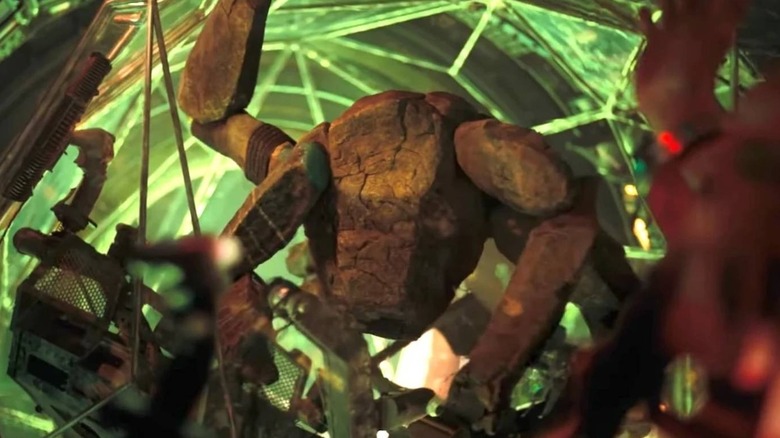
Sometimes, even the wildest stories turn out to be true, as evidenced by the fact that many real-life inventions come from science fiction. That's why it's fascinating to find out that Phil Lord and Christopher Miller's hit sci-fi movie "Project Hail Mary" might feature a surprisingly plausible sci-fi concept: Rocky (voiced and primarily puppeteered by James Ortiz), the small but capable extraterrestrial engineer who resembles a faceless, five-legged spider made of rock.
As an utterly outlandish extraterrestrial creature who bears no resemblance to carbon-based lifeforms and communicates with chords, Rocky is a far cry from the humanoid aliens from Star Wars, Star Trek, and the Marvel Cinematic Universe. Interestingly enough, the character's very weirdness could also make him one of the more accurate depictions of alien life that we have seen on the big screen.
"People are now starting to talk about sentient plasmas as a potential lifeform," astrophysicist Jacqueline McCleary told Northeastern Global News, discussing Rocky's oddball depiction in the movie. "The notion of a completely different biology, completely different body chemistry adapted to different conditions is very clever."
Extraterrestrial life could be based around a truly strange element
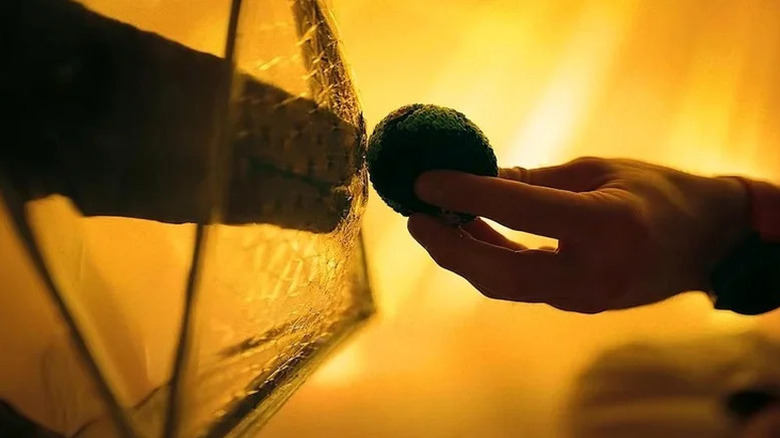
With a real-life astrophysicist praising Rocky as a potential example of what alien life might be like, it's worth digging deeper — especially since we already know several worlds where extraterrestrial life could be hiding in some shape or form. According to one 2023 study, whatever life we may one day find out there could indeed be very different from our carbon-based Earth life.
This idea is based on the study of autocatalysis, a chemical reaction that accelerates as it goes, due to one of the reaction's products also acting as its catalyst. On Earth, it's a crucial step on the road to life. Researchers have discovered that potentially life-creating autocatalysis isn't limited to carbon, but can in fact involve all sorts of elements and compounds. They've found no fewer than 270 autocatalysis cycles, some of which involve truly outlandish elements like the noble gas xenon and the dense liquid metal mercury. This may indicate that life on other planets could potentially be based on just about anything — so there really is no telling what it might be like.
That being said, there's also a chance that regardless of its chemical makeup, an alien lifeform could look far less impressive than you might assume. Even on Earth, single-celled organisms are by far the most prominent form of life, so that's what we might most likely encounter on other planets, too.
Even Project Hail Mary author Andy Weir didn't fully comprehend Rocky before he saw the film's design
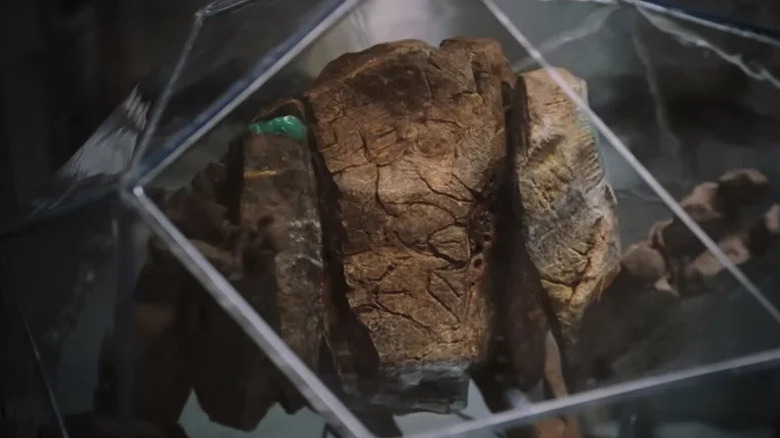
"Project Hail Mary" is based on "The Martian" author Andy Weir's 2021 novel of the same name. The writer landed on Rocky's unique physiology by determining the kind of planet Erid was, and what kind of creature could live on a pitch-black rock planet with a high-pressure ammonia atmosphere. "How do I make a water-based lifeform on a planet that is closer to its sun than Mercury is to ours?" Weir described his process in an interview with LA Review of Books. "How do they tell what's going on in their environment?"
The solution was a faceless, stony creature who relies on echolocation, and is thus uniquely suited to live in the rough conditions of Erid. The idea was so alien that Weir found it difficult to actually imagine what Rocky looks like before he saw the film's version. "I knew he was like a thorax with like five legs," Weir told Radio Times. "I couldn't have told you if his legs were thin or fat, or if they were lumpy or smooth."
The universe is a big place. There's no telling what kind of lifeforms it might hide. While we may be unlikely to encounter an alien that looks exactly like Rocky, it's an interesting notion that scientists feel his sheer strangeness is indicative of what might really exist somewhere out there.