

Quicksand Isn't As Dangerous As You Think - But Scientists Discovered A Version That Is

For decades, movie audiences have watched both heroes and villains struggle with the dangers of quicksand. So much so that it can sometimes seem like we were being prepared for a threat that wasn't real. While quicksand is indeed a real phenomenon, the odds of someone vanishing into the ground are virtually zero. Conventional quicksand can be a minor hazard for the unwary adventurer, though it isn't as dangerous as you think. But scientists discovered dry quicksand, a version yet to be seen in the wild that could be as dangerous as B-movies have led us to believe.
Quicksand is nothing more than a type of sand that is saturated with water, giving it liquid-like properties. Water usually seeps into a layer of sand from underground, often leaving a dry surface that conceals an area of quicksand. Someone who steps onto a patch of quicksand would start sinking and their feet could quickly get stuck. However, the human body is much less dense than quicksand, so while your legs might get stuck, you won't sink much deeper.
Not so Quick
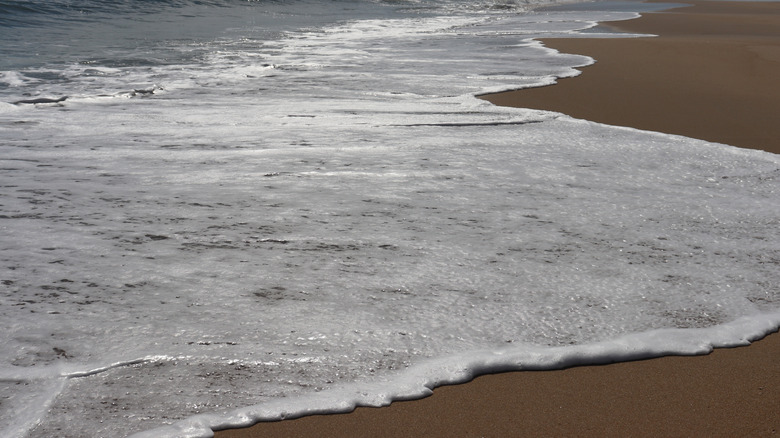
While you may not sink all the way down, the reason you sink in quicksand at all comes down to physics. In dry conditions, there is a large amount of friction between grains of sand. This creates a force chain that distributes weight across a large area. This is why sand can support a lot of weight.
When sand becomes saturated, the sand particles float in the water to form a heterogenous mixture (not a homogenous one — there's a difference) called a suspension. This dramatically reduces the friction between the particles, breaking the force chain and decreasing how much weight the sand can hold. This suspension is what we call quicksand. The decreased friction between sand particles is why the unlucky film adventurer gets stuck.
Another way that movies and reality differ is in the silver screen advice that moving will cause someone to sink deeper. In reality, leaning back increases the area weight is distributed over. At the same time, you can pull your legs out gradually by using a back and forth movement. Movement creates voids that fill with water, making it possible to move a small amount. However, the process of pulling yourself out of quicksand is slow and takes a lot of energy. The real dangers are not sinking under the surface, but rather becoming exhausted or being stuck on a beach with a rising tide.
When Air and Sand Mix

Quicksand in the real world can be a annoyance but nowhere near as dangerous as Hollywood told us. But a type of quicksand formed with air rather than water is possible and far more hazardous. Sand in a very loose structure with air spaces between particles would have so little friction between grains that it would barely be able to hold its own weight — let alone that of a human body. This so-called dry quicksand has never been observed in nature, but a 2004 study published in the journal Nature showed how it's possible.
In that study, scientists blew air through a membrane into a column of very fine sand. The resulting fluffy mixture of air and sand ended up being only about 41% sand by volume. Next the researchers tested how much weight their dry quicksand could support by setting weighted ping pong balls directly on the sand surface. The balls quickly sank beneath the surface, with heavier balls sinking deeper, and the heaviest ones displacing so much sand and air that they sent a plume of sand upward like a kid doing a cannonball in a pool.
Dry quicksand is possible, but it has not been confirmed in the real world. However, similar conditions could occur during the hazards of a desert sandstorm, with fine blown sand settling on the surface. Fortunately the chances of encountering dry quicksand seem to be even lower than those of meeting regular quicksand.