

Scientists Found A 23 Million-Year-Old Species In Canada In The '80s – Now It's Rewriting History
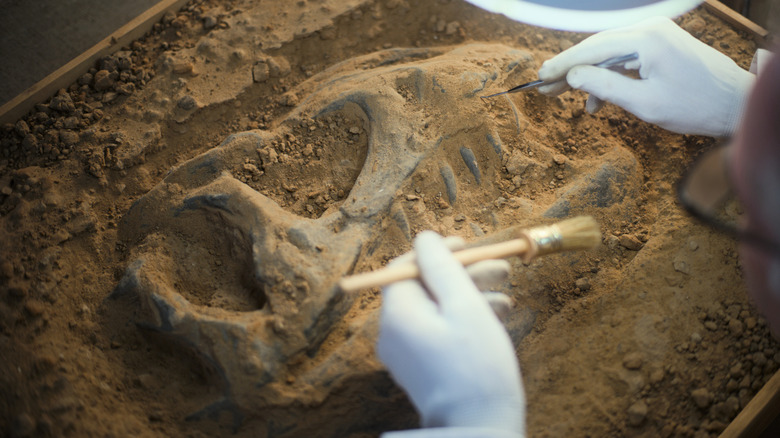
In 1986, in a cold, inhospitable area of the Arctic Archipelago (also referred to as the Canadian Arctic), the paleontologist Dr. Mary Dawson located some peculiar fossilized bones. These bones were found in a Haughton Crater — a space formed over 23 million years ago by an asteroid hit. Dawson found teeth, skull fragments, and pieces of a jaw. Although many pieces were yet to be discovered, she knew that these particular bones belonged to a rhinoceros. That meant that Dawson had identified the northernmost rhinoceros fossils to ever be seen, at 600 miles north of the Arctic Circle. Further expeditions would uncover most of the other fossil pieces in the 2010s, but it wasn't until a publication in Nature Ecology and Evolution in 2025 that scientists would suggest this was a newly classified species: Epiaceratherium itjilik.
While today there are only five species of rhinoceroses — and they are only found in Africa and Asia — there used to be many more, some of which were from Europe and North America. In fact, according to the fossils that have been uncovered, there once were over 50 different rhinoceros species. These rhinoceroses also varied a bit more in appearance than you might think. For instance, some weren't large compared to what we would typically see now. But perhaps the most noticeable outward difference was that many of these early species lacked horns. The newly identified E. itjilik is one such hornless rhinoceros.
A frosty fossil finding
Epiaceratherium is a rhinocerotid genus that is now extinct, previously found in Europe and western Asia, and itjilik (pronounced eet-jee-look) is an Inukitut word meaning "frosty" or "frost." The newly classified species has many anatomical similarities to other species within this genus, however, there are some standout distinctions. First, E. itjilik has four toes, while other rhinoceroses generally have three toes.
Moreover, E. itjilik is small in comparison to the average rhinoceros. Analysis of the bones suggests that it was three feet tall and relatively slight, making it roughly the same size as a small pony. The small build and lack of a stereotypical rhinoceros horn might cause you to wonder how Dawson knew in 1986 that this was some type of rhinoceros. Well, the answer lies in its teeth. Rhinocerotids have unique bands on their teeth that enable paleobiologists to differentiate them from other mammals.
Scientists are unsure how exactly these particular rhinoceroses would have survived in such a cold climate. The climate of the Miocene period was very different from today, and the Arctic Archipelago would have been more temperate. However, there still would have been many months of cold winter, like modern-day New York. This has led some to hypothesize that they had a fur coat. While more evidence is necessary in order to test this hypothesis, it is certainly not unheard of. There is evidence that other extinct rhinoceroses, such as the woolly rhinoceros, had fur.
The journey
There is one extra element to these findings that makes the E. itjilik even more odd: its location. As mentioned before, the Epiaceratherium were found in what is now Europe and western Asia, so how would this particular species end up in Canada? It is commonly believed that there was land that formed a bridge between Europe and North America. The problem is, the North Atlantic Land Bridge was thought to have disappeared in the early Eocene period, and E. itjilik would not have been in Canada until the Early Miocene. That's a difference of about 30 million years.
There are a few possibilities that could explain this discrepancy. First, perhaps the North Atlantic Land Bridge wasn't entirely submerged, but had become many islands. In this case, the rhinoceroses might have been able to cross the bridge by swimming certain portions of the journey between the islands. Another possibility that the authors of the paper identifying the E. itjilik suggest is that seasonal ice formed between broken-up portions of the bridge, allowing them to walk the entire distance.
These suggestions are not without their controversies, and some other researchers strongly oppose them. Hopefully, future studies will be able to provide clarification, but for now, these findings are opening up new possibilities for our understanding of the evolutionary and migratory patterns of mammals. These findings also suggest that the Arctic is a more important region for mammalian evolution than previously thought.