

The Rare Science Occupation That's Even Riskier Than You Thought

When it comes to unusual science related careers, pyrotechnics technician may be one that isn't on your radar. A colorful and exciting job undoubtedly, it comes with some pretty obvious dangers. The possibility of a firework exploding in your face is only the start of it, however, since this unconventional job comes with more risks than you may have realized.
A career as a pyrotechnic engineer is a job that sits at the crossroads between science and art. The aim is to put on a fantastic display full of color and drama, but getting to that point takes some serious science behind the scenes. Any slip-ups or errors in preparation can have serious consequences, not only for the engineer, but for the audience, too. Each firework going off is essentially a miniature controlled explosion, and the effects if something goes wrong can be catastrophic.
To keep pyrotechnic engineers and the general public safe at firework displays, the Occupational Safety and Health Administration (OSHA) has strict guidelines that must be followed. These include obtaining a permit for the location, no naked flames within 50 feet of the site, and a thorough search of the area afterward to prevent the chance of unexploded shells causing harm to the public. The regulations show how much preparation and care is needed in the planning of such events, with a sound knowledge of chemical composition, weather awareness, and crowd safety required — not simply setting off some pretty fireworks and enjoying the spectacle.
Dangers from firework smoke and residue
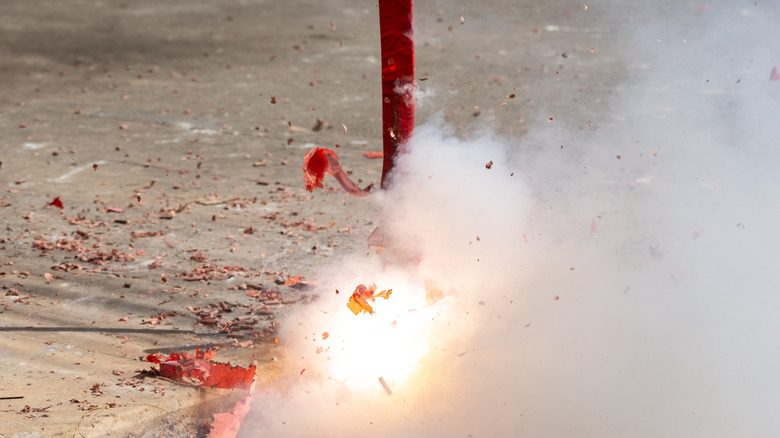
In addition to the risk of explosion, working with fireworks involves exposure to chemicals that aren't ideal for your health. Fireworks take part in intense chemical reactions, and while they may seem to disappear in the sky with an attractive flourish, they leave behind fumes and residue that can be toxic.
The American Lung Association warns that fireworks produce numerous dangerous gases, including sulfur dioxide and carbon monoxide, and if firework technicians are breathing these in regularly, they can cause irritation and flare up conditions such as asthma. They also state that air pollution increases by more than 40% on Independence Day, meaning that the increase in dangerous gases is not limited to the immediate area around the display.
The beautiful colors from the fireworks are created using metal compounds, some of which can leave behind toxic particulates when they explode. These particles are small enough to be inhaled and enter the body, and long-term exposure to particulates has been linked to serious health issues such as asthma and lung cancer. Being on site for clean up long after the display has ended means that pyrotechnic engineers spend more time in the areas where particulates may still remain, increasing the chances of inhalation.
Weather and noise add to the risk
Storage, transportation, and handling of fireworks and related equipment can pose further hazards that pyrotechnic engineers need to consider. They are responsible for transporting these hazardous objects to the venue, which means keeping them well away from naked flames and potential sparks. Once at the location, they need to assess the weather, as rain, wind, and extreme heat can pose problems and affect the safety of the display. Setting up the display itself can also be a very physical job, and with the clean up afterward, it can be a tiring process.
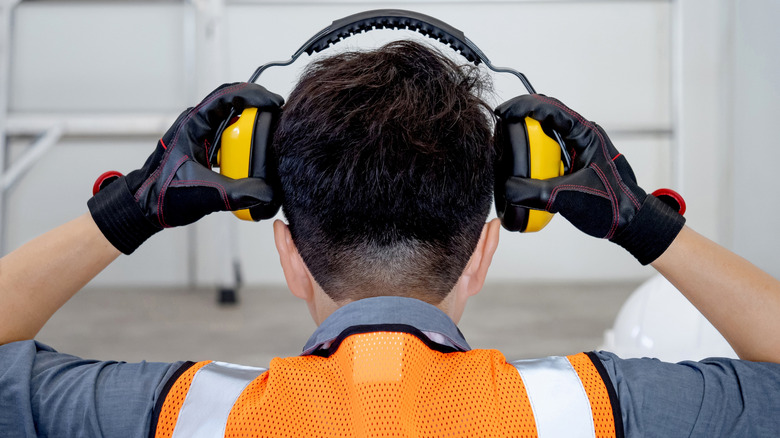
Another danger to pyrotechnic engineers comes with the noise level. The explosions from fireworks fall at the top of the typical decibel range, with professional fireworks, reaching up to 170 decibels — for context, the decibel level of a jet plane is between 120 and 140 decibels. Considering the National Institute for Occupational Safety and Health (NIOSH) recommends using ear protection above 85 decibels, and 130 decibels is considered "painful and dangerous," there is no doubt that even short term exposure to fireworks can be bad news for your hearing. Since fireworks engineers are close to the noise and exposed regularly, long-term hearing problems such as tinnitus and hearing loss are possible.
While the danger of explosion is an obvious hazard for pyrotechnic engineers, the list of potential issues is much longer than it may seem at first. Between exposure to incredible noise, toxic particulates, and the physical labor, there is a lot to consider beyond how fun it would be to set off fireworks and watch them explode into pretty colors in the sky.