

The Difference Between Apple Varieties Is Easily Explained By Science
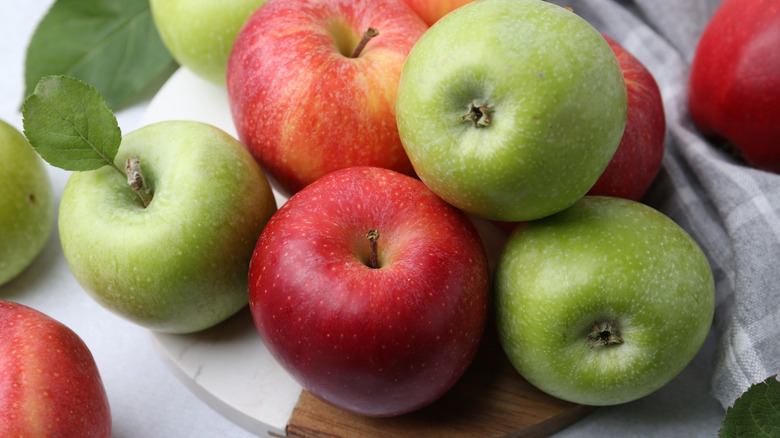
There are at least 7,500 varieties of apples out there, so it probably won't come as a surprise that we eat over 100 million tons of them every year. But, have you ever wondered what's hiding under that colorful peel that's giving us so much variety? And is there a "superior" variety that you can use to optimize your diet. Luckily, science is here to explain what's going on and how we've utilized it to make such a diverse fruit.
First, let's start with tartness. The main components that affect an apple's taste come down to its levels of malic acid and fructose. Malic acid, also known as "apple acid," is the main designator for how tart an apple tastes while fructose — or sugars — are responsible for its level of sweetness. These two work together to affect its overall taste profile; when the malic acid is much higher than the fructose, you get your Granny Smith level of tartness with little sweetness. On the other hand, when the scales tip to sugar's favor, you get a sweet apple without much bite to its flavor, like Fuji or Gala apples.
Tartness is only the beginning of the crazy chemistry inside an apple
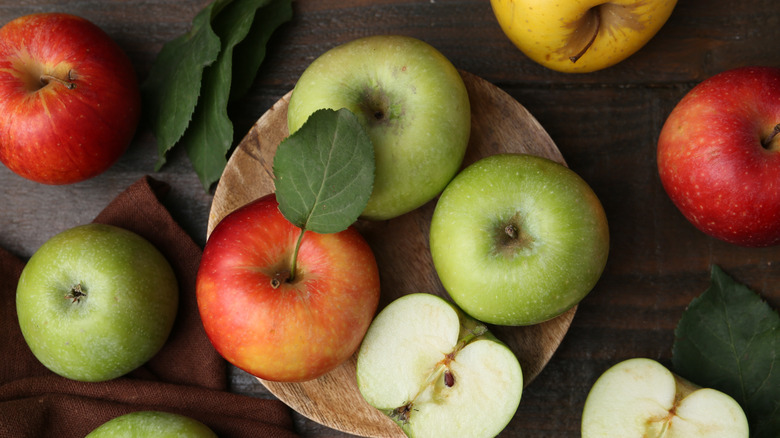
Next comes the more complex batch of volatile aroma compounds that refine an apple's flavor, which is different than taste. Apples have over 300 compounds in their flavor profile, but the primary ones are aldehydes, esters, and alcohols. Aldehydes have an aroma that can range from grass to citrus and starts out strong in unripened apples, but as the fruit ripens, its aldehyde level decreases while alcohols and esters increase. That's why an apple picked too early can taste a little weird or pungent.
Alcohols are mostly dominant in the middle between an apple's unripe and ripe phase, and range from smelling like wine to caramel to musty, depending on the variety. Esters are the most dominant when the apple is ripe and give your favorite apple type its aroma, with some described as smelling like bananas, pineapples, cucumbers, or pears when isolated. Its that mix that gives every apple its trademark taste.
But what about the skin color? Researchers have linked that to anthocyanins, chlorophylls, and cartenoids found in the skin's epidermis and hypodermis (the layer under the epidermis). Their ratios affect how red, green, or yellow, respectively, a variety's color profile is, so a Macintosh has higher anthocyanins, a Golden Delicious leans heavier on cartenoids, and a Crispin on chlorophyll.
How we're utilizing the chemistry of apples to better our health
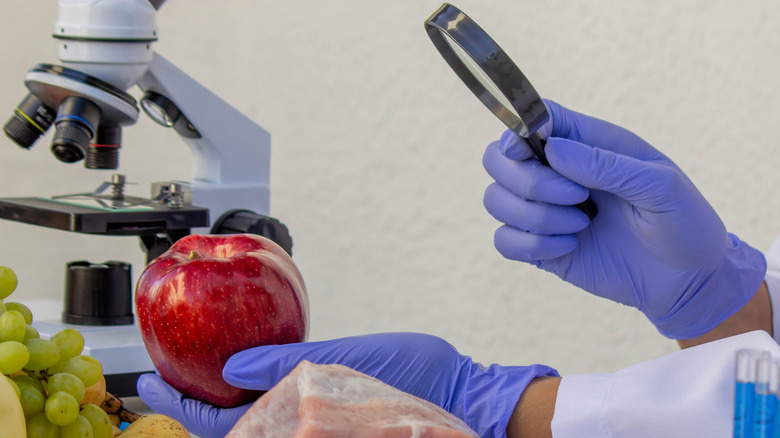
So, how can we use this information to our advantage? Much like the science we've done on the difference in the color of eggshells and egg yolks, the more we learn about how these molecules affect an apple's composition, the more we can tweak those compounds to produce better tasting and longer lasting fruits. We've looked at aldehydes, for example, and found that monitoring them with non-invasive sensors can let us accurately predict an apple's shelf life, decreasing the number of apples contributing to our rising food waste.
We've even used the chemistry from ancient apples via gene sequencing to help us create new hybrids with specific tastes, skin colors, and improve mealiness levels. A perfect example is the Arctic apple , a variety that shows the positive effect GMOs can have on our food supply because it's engineered to resist browning and bruising longer.
And the more we optimize our sequencing technology the faster we can create varieties that have better resistance to disease, longer shelf lives, or whatever new trait we want emphasized while digging into an apple's chemistry. Because of all of this, the likelihood of the apple industry ending up in the precarious position the banana industry finds itself in with the Cavendish gets smaller every time we look in the microscope.