

Scientists Didn't Expect To Find This Puzzling Earth Mineral In A Martian Meteorite
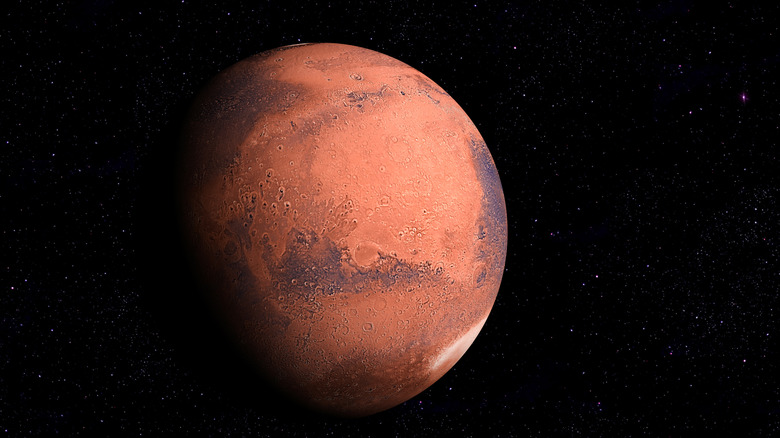
Mars has long been the focus of scientific curiosity and human imagination. Early speculation about the presence of canals on Mars' surface has given way to a more systematic study of the planet and its history. While probes have collected a great deal of information, much of what we've learned about Mars has come from Martian meteorites collected on Earth. Scientists have been analyzing these rocks, but were recently surprised to find garnet in a Martian meteorite.
Garnet is a mineral that is relatively common on Earth, however, it has never before been observed in rocks from Mars, making this find noteworthy. Garnet is often found in metamorphic rocks, which are formed by the high heat and pressure that transforms igneous or sedimentary rock. Because of the way they are formed, garnets hold clues to the pressure and temperature conditions in which they were formed, and the presence of trace elements in garnets can provide evidence of the chemistry of the environment they were created in.
Minerals in a Martian Meteorite
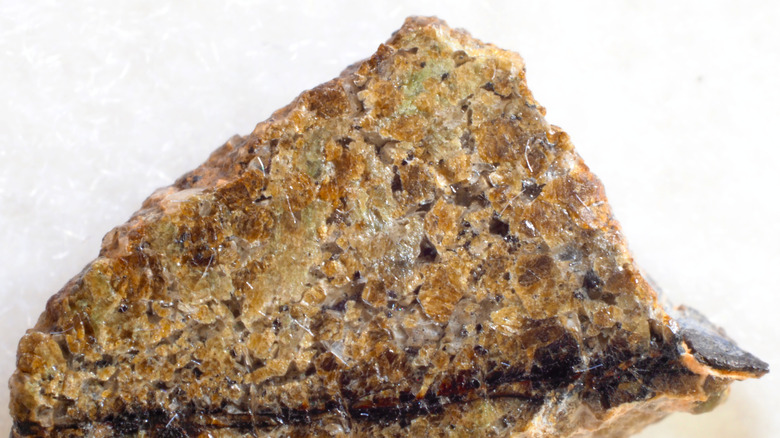
Scientists from Canada, the United Kingdom, and Italy found the tiny grains of garnet in a Martian meteorite known as NWA 8171. This meteorite, thought to be from 4.4-billion-year-old source rocks in Mars' southern highlands, was likely formed during an impact event around 1.5 billion years ago. NWA 8171 is a type of rock known as a basaltic breccia made when rock melts and then cools and hardens around existing chunks of mineral. This means that meteorites like NWA 8171 can contain many different minerals that can provide a lot of information on what Mars was like in the past.
The garnet the researchers found is an iron-rich variety of the mineral known as andradite. This variety is a yellow-green color, not the deep red that semi precious stone collectors seek in garnets, meaning the researchers initially thought it was a different mineral. The presence of garnet in a rock from Mars is interesting because Mars hasn't undergone plate tectonics for billions of years. To form on Mars, garnet would result from a rising body of magma or heating from a meteorite impact.
Meteorite Can Tell About Ancient Mars
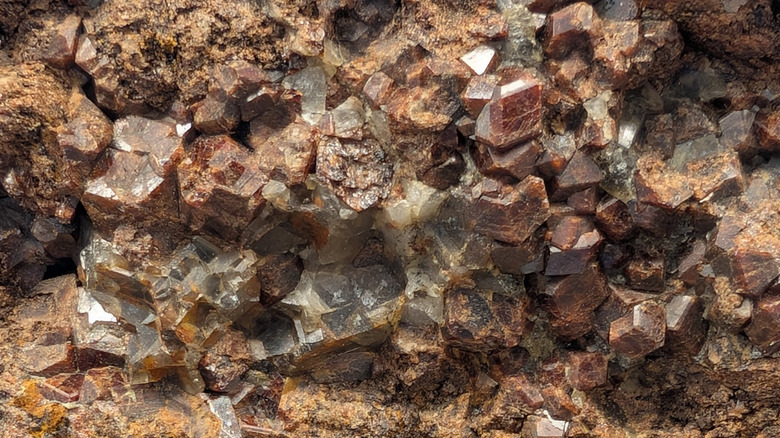
While this sample of garnet could have arisen from the presence of magma or an impact, the researchers note that it may have come from another source and was incorporated in NWA 8171 during impact. Further analysis of this sample, including a comparison of isotopes present with those known to exist in Martian rocks, could yield insights into past conditions on Mars. Similarities in chemical composition would suggest that this garnet is Martian in origin.
Insights gleaned from studying this meteorite may add to a growing body of knowledge on Mars' past. To date scientists have found or predicted the presence of only around 200 minerals on Mars. This contrasts starkly with the roughly 6,000 minerals known to exist on Earth. This could be due to differences in the two planets' processes, but it could also come down to a limited amount of data.
Minerals and the rocks they make up are influenced by geologic processes as well as interactions between rock and water, the atmosphere, and even organisms. If the garnet found in NWA 8171 proves to be of Martian origin, it would shed light on the dynamics of the red planet in the distant past.