

Scientists May Have Solved The Mystery Behind Why 90% Of People Are Right-Handed

If you're left-handed, you have to deal with a lot of annoyances that righties would never even think of. From struggling with can openers to bumping elbows with your deskmates in school, it can feel like the world is designed against you. Right-handed people are in such a majority — only about 10% of all humans across the globe favor their left hand — that everything in which handedness might matter defaults to them. If you've ever wondered why things have to be this way, you aren't alone. Scientists have long puzzled over why humans even have handedness at all, especially because other primates don't appear to. Though they are animals that share DNA with humans, apes and monkeys use both hands equally, but a recent study suggests that human handedness is largely the product of a different defining trait: Our ability to walk on two legs.
Research published in the journal PLOS Biology in April 2026 presents a case for why almost all humans favor one hand over the other. The study's authors used computer models to compare Homo sapiens to 41 other primate species. They ultimately identified two factors — bipedalism and brain size — that they believe triggered the evolution of handedness. Simply put, when humans began to walk upright, it freed our forelimbs up for other purposes. Large brains brought about more complex tasks like tool use, which depend on using each hand for different purposes. Holding something only takes one hand, unlike walking on four limbs or climbing trees, and over a long period, the majority of people came to favor their right.
How handedness evolved

Fossil evidence suggests that throughout many of the seven stages of early man, the earliest hominids did not favor one hand over the other as strongly as we do now, but over time, a preference for the right hand steadily increased. This coincided with another change in human evolution. As we began to walk upright, the ratio between our arms and legs changed, with our legs becoming much longer than our arms. It got to the point that it became more challenging to walk on four limbs than two. This left the hands exclusively to use for grasping and gesturing, tasks that grew more complex as our brains grew. This is when handedness really takes off in the fossil record.
While the research presents a compelling case for why handedness developed in humans and not other primates, the question of why we so predominantly favor the right hand remains. Some researchers have argued that it begins before birth, with fetuses showing some evidence of right-handedness, although that evidence is considered questionable. It is clearly evident at an early age though, and researchers have identified upwards of 40 genes that could potentially be involved in hand preference. It could be that the way these genes encode the brain simply defaults to the right hand, leaving left-handedness as a random variation in embryonic brain development. In other words, it might be a mutation, but it does not appear to be genetically passed amongst families.
An alternative (and grim) theory of handedness
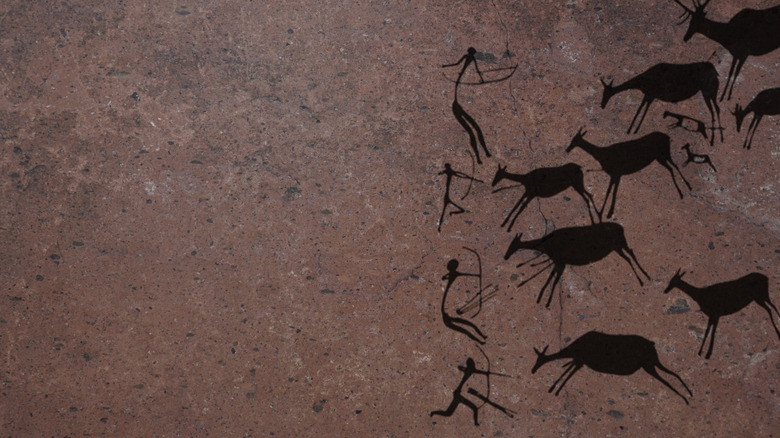
While many scientists have argued that handedness is wholly determined by gene variations, others argue that it was a product of nurture, not nature. Many cultures associate the left with maleficence, and force children to write with their right hands. Although there is indeed a lower rate of left-handedness in these cultures, it doesn't explain why the right-hand trend is seen across the globe. That's why most scientists believe there has to be a genetic component. However, some have argued that the genetic roots of handedness may lie in the experiences of our ancient ancestors, evolving from a modeled behavior into something concrete. One theory explaining this evolution argues that it comes from fighting to the death.
The fighting hypothesis, as detailed in a 2023 study published in the journal Symmetry, presents a strategic case for why early hominids gradually developed a proclivity for right-handedness. It notes that wielding a weapon in your left hand also opens the left side of the chest to your enemy. Since some of the organs that make up the circulatory system, namely the heart and aorta, are positioned towards the left, this increases the risk of sustaining a mortal wound. Fighting with your right hand allows you to close your left side off, shielding the most vulnerable spot on your chest, meaning righties would be at an evolutionary advantage when it comes to surviving hand-to-hand combat. It's a bit of a grizzly notion, but it's also about as good of an explanation as scientists have come up with to this point.