

These Were Popular In The '80s. Science Explains Why They Were Surprisingly Good For Learning
The home, office, and classroom of today are in many ways quite different from their '80s counterparts. Giant wooden console televisions, ashtrays, typewriters, and landline phones have all but disappeared outside of the realm of collectors; however, one popular item that stands to make a comeback is the humble globe. Even with today's connected classrooms and smart devices, scientists have found that globes are surprisingly good for learning.
For decades, it was common to find a set of encyclopedias and a globe in many homes. While these items have a certain aesthetic value, where they really shone was in education. However, the spread of home internet access and devices like smart phones and tablets have made these features less likely to be encountered in the average home. But while internet access can give us access to the kinds of information that used to take up an entire shelf, globes have properties that cannot be replicated. At the same time, research is finding that the old-fashioned globe may be more effective for teaching and learning than any video or app. There are things that people can do with a physical globe that are simply not possible with other learning tools.
What Makes Globes Unique
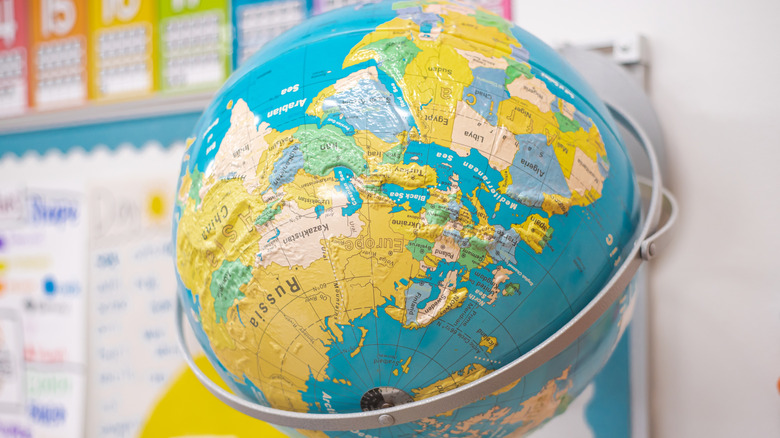
Globes are uniquely suited for teaching because of their tactile and three-dimensional nature. Portraying Earth's surface as a two-dimensional map is a challenge that is hard to overcome. The best known way of doing this is the Mercator projection, developed by 16th-century mapmaker Gerardus Mercator. This map is useful for navigation as it lays out lines of latitude and longitude intersecting at 90-degree angles, forming the geographic grid. However, this projection heavily distorts landmasses, making countries far to the north and south look larger than they are.
In contrast, a globe shows the correct relative sizes and positions of landmasses. For example, Europe and North America are farther north and smaller than some map projections might show. Students can also gain a better understanding of latitude and longitude, how the tilt of Earth on its axis influences seasons, and the ways that surface features like mountains, deserts, and oceans affect the way humans live. Raised relief globes, which have bumpy surfaces representing Earth's surface terrain, can also help students better understand the characteristics of landforms like mountain ranges. A physical globe can also make learning about geography more interactive than looking at a map, either on paper or on a screen.
Globes Can Shape Minds
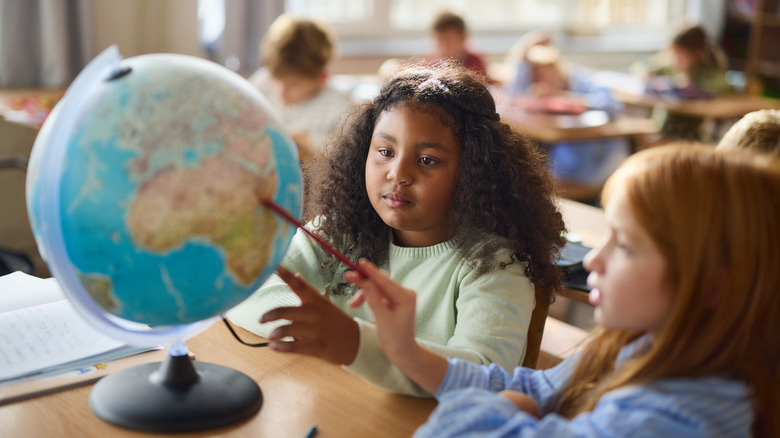
Scientists think this interactivity is part of the reason why globes are great for learning. One study of students in Indonesia found that students taught with a globe had better learning outcomes than those who used other methods. The researchers tested two groups, totaling 30 students, and tested different aspects of social science literacy. They found that students who were taught with globes had significantly higher scores, greater map literacy, and better understanding of spatial relationships than those who didn't use a globe.
While learning geography is helpful in its own right, geography education may also improve people's ability to mentally visualize the world. In a 2023 study, scientists conducted experiments on undergraduate students to see how they performed four tasks linked to spatial ability. The researchers separated students based on what they studied. In addition to analyzing how well the participants performed their assigned tasks, they also monitored the brain activity of some of them during the tests. They found that students who had taken more geography classes had better spatial recognition and reasoning, as well as greater activation and connectivity of brain regions linked to spatial reference and memory.
Globes have been around for thousands of years, becoming more accurate as humanity learned more about the world. While paper maps and smart devices are more portable than a globe, it seems that these items that were popular through the '80s have unique advantages in teaching and learning.