

Scientists Say A Long-Standing Alzheimer's Mystery May Finally Be Solved

Alzheimer's disease is a complex neurological illness that leads to severe memory loss and impaired thinking. Although the exact cause of these devastating symptoms remains unclear, there are certain aspects of the disease that are consistently correlated with cognitive decline. One of the main hallmarks of the disease is the buildup of misfolded proteins called tau. When these misshapen proteins clump together (form aggregates) in a neuron, eventually the cell will die. However, the problems of tau aggregates do not stop there, as misfolded tau can spread from damaged cells to healthy ones, progressing the neurodegeneration that is characteristic of Alzheimer's. Until recently, researchers were unsure how tau could be transferred between cells, but a recent publication from Cell revealed that one little protein called Arc is a big player in this phenomenon.
All of our neurons contain tau, and it is not inherently damaging to the brain. However, as we age, tau is more prone to a chemical process called hyperphosphorylation. This essentially alters chemical bonds, causing these proteins to fold in abnormal ways and stick together. Eventually, they form large, sticky clumps that damage the neuron, causing it to die. Unfortunately, these damaging aggregates can infect other neurons. Misfolded tau aggregates can break off little pieces known as tau seeds, which are small enough to be packaged and shipped to nearby neurons. These seeds corrupt healthy tau in the corresponding neuron, resulting in the formation of more sticky tau clumps and eventual cell death.
Toxic tau is out for delivery
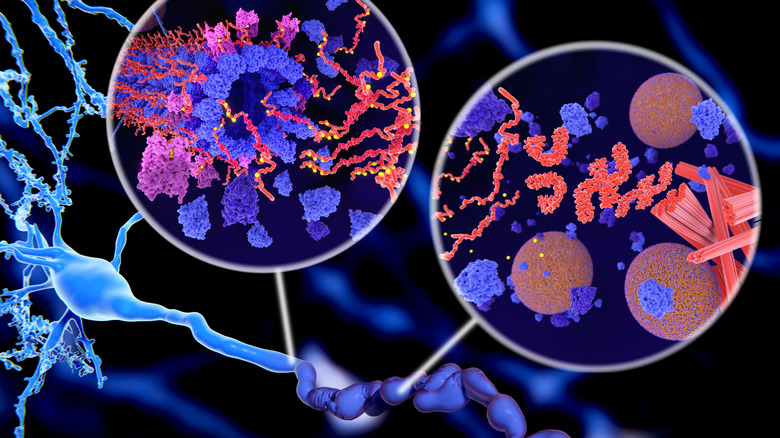
Researchers from the University of Utah homed in on a protein that generally aids communication between neurons. While some tau proteins float freely, others are packaged up in order to efficiently pass through the extracellular space that lies between neurons. These packages are membrane-bound structures, known as extracellular vesicles, sent out into the extracellular space with their biological cargo. Arc proteins form little shells that typically hold some RNA to be carried in extracellular vesicles. When a neuron is activated, these extracellular vesicles are shipped out with the help of a particular protein that also happens to interact with tau.
The authors hypothesized that tau seeds were essentially hitching a ride from Arc to travel between cells. To investigate this, they generated a mouse model for Alzheimer's that lacked the Arc gene. Without the genetic code, these animals would be unable to produce Arc, which would allow the authors to observe what might happen without it. The researchers found that mice without the Arc gene had significantly less mutated tau in their extracellular vesicles compared to mice with the Arc gene. In line with their hypothesis, they also saw that there was much less tau delivery overall. Actually, there was almost no tau transfer. Such a finding could prove incredibly useful in Alzheimer's treatment, offering a potential new target for therapeutics. However, there are some possible downsides to reducing Arc as well.
Arc might be an anti-hero

As mentioned above, Arc is a very useful protein for communication between cells. Although the presence of Arc might increase the transfer of misfolded tau, it could also have some benefits in slowing the progression of Alzheimer's disease. For instance, by bringing tau into the extracellular vesicle, Arc is helping clear hyperphosphorylated tau from the original cell. This could slow the buildup of the protein and, therefore, allow the neuron to survive a bit longer than it might otherwise. Indeed, the researchers found that the affected cells in mice without Arc died more quickly than those in the mice with Arc. So, while targeting Arc might reduce the spread of toxic tau, it could also lead specific neurons to die faster.
Importantly, this work was done in a mouse model, and we do not know how this will translate to human pathology. However, the researchers did investigate the presence of both Arc and tau in extracellular vesicles from the post-mortem tissue of Alzheimer's patients. Similar to animal models, the extracellular vesicles of these patients did contain Arc and tau, which would indicate that this method of transfer between cells is the same in humans. Although targeting these extracellular vesicles presents an interesting and novel avenue of treatment, much more research is necessary to understand whether this would be beneficial and what potential side effects might emerge. Hopefully, more clues will surface to help treat the enigmatic disease of Alzheimer's and lead to improved patient outcomes.