

The Difference Between Bird And Reptile Eggs Is More Than Just What's Inside
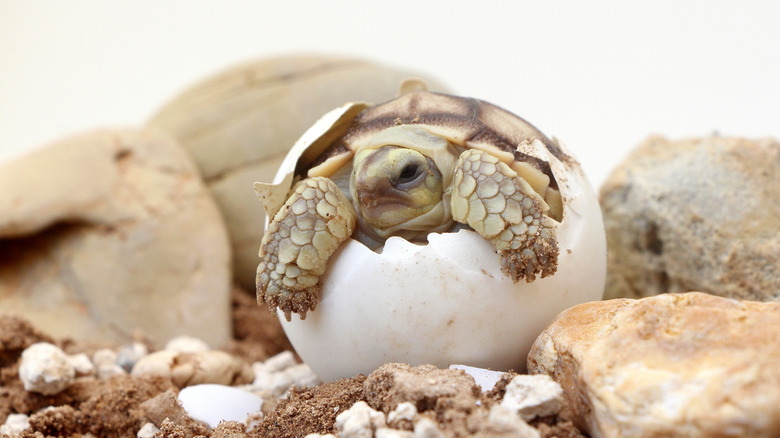
Because they are the ancestors of the avian dinosaurs, scientifically speaking, birds are closely related to reptiles. This kinship between birds and modern reptiles is evident in their eggs, which uniquely have watertight shells that allow them to lay their clutches on land. Compare the developing embryo of a bird egg with a reptile egg, and you might not even be able to tell them apart. Nonetheless, while birds and reptiles share the same evolutionary origins, there are some glaring differences among their eggshells.
Ultimately, eggshell shapes, sizes, and compositions evolve according to the environmental pressures and survival strategies of the individual species. Because birds lay their eggs in nests above the ground (usually), they've evolved hard shells to protect them from falls and predators. Their shape is also telling of life in the open air: Bird eggs are pear-shaped to prevent them from rolling out of the nest. Bird eggs are also often pigmented for camouflage, which gives paleontologists clues about what dinosaur eggs actually looked like, as well.
Reptiles live on the ground (usually), so the majority have evolved to lay their eggs underground in soil, sand, rocks, or holes. This allows the natural warmth of the earth to help incubate the eggs, as well as protect them from predators. Hidden out of sight, most reptile eggs are white, since they don't require pigmentation for camouflage. They're also typically oval or spherical, since there's little risk of them rolling away from their underground nests. But to truly understand the differences and similarities between bird and reptile eggs, it's best to forget the concept of a "bird" all together.
The common egg-laying ancestor of birds, reptiles, and human beings
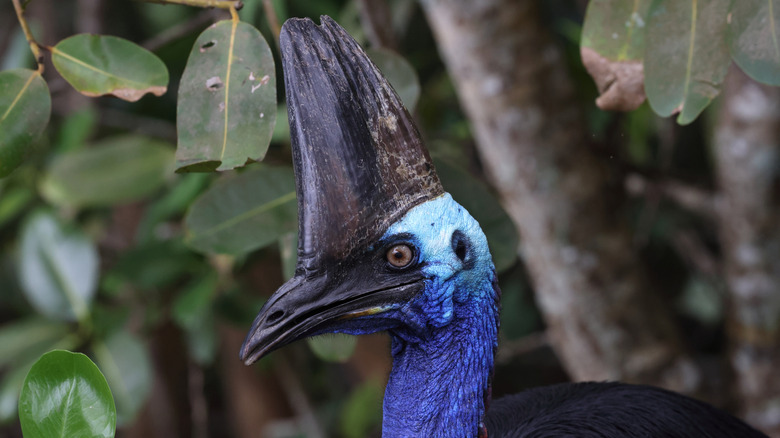
Mammals are unlike most vertebrates in that we give live birth. Most vertebrates, however, are oviparous, meaning they reproduce by laying eggs. The only exception to the rule is a handful of egg-laying mammal species called monotremes, such as the platypus, which split from the rest of their mammalian cousins during the age of the dinosaurs.
Amphibians and fish lay jelly, tapioca-like eggs in water, sometimes by the hundreds of millions in one spawn. Birds and reptiles, on the other hand, lay comparatively small clutches of hard-shelled eggs, usually on the land. The reason for their shared "eggshell strategy" is a genetic kinship to a recent common ancestor.
The "invention" of the eggshell traces back over 300 million years, when amniotes first adapted to laying eggs on land by producing an extra degree of protection around their egg. On land, the eggshell evolved as a way to provide offspring a protective, self-contained life support system that didn't dry out or expose the growing embryo to external hazards. This seemingly minor adaptation of the ancient amniotes proved so successful that it helped give rise to a new branch of animal life. Today, the surviving descendants of the original egg-laying amniote are the modern mammals, reptiles, and birds.
While mammals have since evolved to give live birth, birds and reptiles still carry on the tradition of laying eggs with shells. The rest of their egg-laying reptile relatives have gone extinct, the dinosaurs being the most well-known example. Today, bird and reptile eggs appear nearly identical on the inside, while the pressures of surviving without breaking or getting eaten give them their beautiful variety of shapes, sizes, and colors.