

Science Fiction Vs. Fact: Surviving On The Red Planet In The Martian

As the likely next step for humankind's space exploration, Mars has fascinated us for quite a while now. Humans have found many strange things on Mars while studying the planet, and there's even some evidence that a NASA experiment might have destroyed a sample of life on Mars. However, the big question on everyone's lips is what a trip to Mars would actually look like for humans, and how people might survive on the red planet. Fortunately, Hollywood has made an entire movie about the scientific intricacies of this very subject — namely, Ridley Scott's 2015 survival space drama "The Martian."
Based on the debut novel of Andy Weir (who also wrote "Project Hail Mary"), "The Martian" tells the story of Dr. Mark Watney (Matt Damon). The character becomes stranded during a mission to Mars after a massive dust storm causes his crew to think that he's dead and leave him behind. Watney's struggle for survival and the daring rescue mission his crewmates aboard the spaceship Hermes decide to attempt form the backbone of the movie, which is filled to the brim with neat scientific details.
As it happens, much of the science of surviving the red planet in "The Martian" is surprisingly viable. Let's take a closer look at how the story lines up with reality.
The Martian nails many things about surviving on Mars

Much of Mark Watney's survival story is surprisingly realistic, courtesy of Andy Weir's devotion to scientific accuracy and making the time frames of Watney, Earth, and the Hermes line up. Watney's "Hab" habitat gets the basics of survival largely right. Scientists believe that food plants can be grown in Martian soil, so it's perfectly possible that Watney — a skilled botanist — would have managed to grow his potatoes. Likewise, his method of making oxygen from the carbon dioxide in Mars' atmosphere is so viable that NASA has done it in real life during a Perseverance rover experiment called MOXIE (Mars Oxygen In-Situ Resource Utilization Experiment).
Impressively, what might be the most amazing sci-fi aspect of "The Martian" is also based on real science. The slingshot maneuver that the Hermes uses to propel itself back toward Mars is very similar to the one developed in the 1960s by Michael Minovitch, a NASA Jet Propulsion Laboratory analyst. Minovitch tackled the "three-body problem" of calculating the way the gravities of the sun and a planet affect a third, smaller object, and managed to solve it to a degree that allowed the Voyager program to use planetary orbits to propel its spacecrafts to the outer reaches of solar system — and eventually beyond.
There are also less bombastic but still important details that the film gets right. For instance, the temperature differences on Mars range from 70 to -225 degrees Fahrenheit, which can be seen in Watney's thermal discomfort despite his EVA suit. Since messages sent between Earth and Mars have an up to 22-minute delay, the protagonist's method of using the Mars Pathfinder probe's camera and alphabet stones to communicate with NASA is also a clever form of non-verbal communication.
The movie doesn't get everything right
Of course, you wouldn't expect a Hollywood movie to get every scientific detail right. As such, "The Martian" has some inaccuracies — or at the very least, things that Watney could do differently.
For one, the way Watney makes water from rocket fuel hydrazine is scientifically sound, but he'd have a far easier time using the soil's ice and permafrost. Likewise, NASA might make the call to keep the Hermes crew in the dark about the fact that Watney is still alive. However, this is public knowledge on Earth, and a real Hermes would likely have access to communications channels outside the NASA command center, so the cat would be out of the bag fairly soon. It's also debatable whether Mars crews would store their fecal matter to the extent that would offer Watney enough manure to grow his potatoes, and the portrayal of Mars' gravity doesn't always make Watney seem like he's on a planet where he's 62% lighter than on Earth.
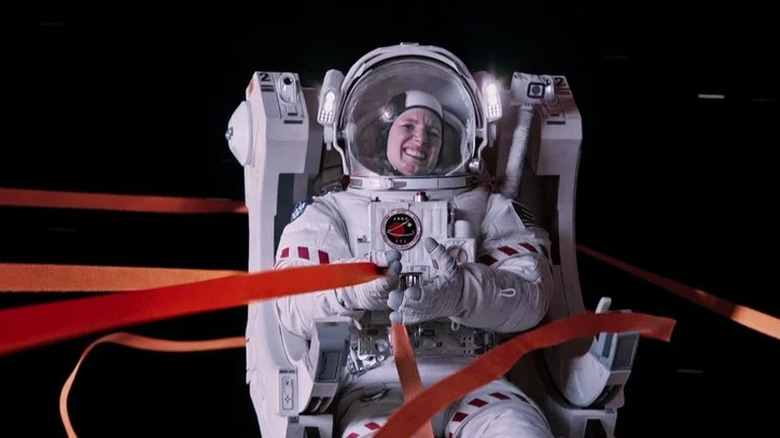
There are also certain things in "The Martian" that are just plain wrong. For one, the huge dust storm in the beginning couldn't actually happen, given the thinness of the planet's atmosphere. Another big action beat in the film — Watney's "Iron Man" propulsion method to cut a hole in his spacesuit glove and use the escaping air to propel himself to Commander Melissa Lewis' (Jessica Chastain) Manned Maneuvering Unit — doesn't seem plausible, either. This could either depressurize his suit and leave him for dead, or his hand would be sucked against the hole to seal it, which would leave him with no means of propulsion. Still, despite a handful of less than factual science, it's pretty clear that "The Martian" gets a lot of things right.