

Scientists Found This Unusual Prehistoric Creature In The '50s – They're Still Confused
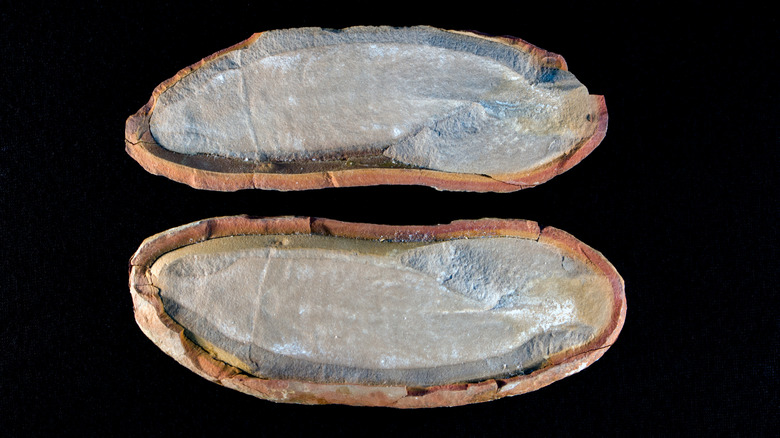
Mazon Creek, located in Illinois, is rich with fossils. The swampy, shallow saltwaters of the Sea of Illinois, which covered Mazon Creek approximately 90 million years before dinosaurs, created the perfect setting in which to preserve fossils. In 1955, amateur explorer and fossil hunter by the name of Francis Tully uncovered a strange fossil. According to Discover Magazine, after realizing the organism captured in the fossilized imprint did not match anything he had ever seen, Tully passed it off to a museum "to see if they could find out what the devil it was." His discovery would go on to be called the Tully monster, and it has left scientists scratching their heads for decades.
The Tully monster looks like what you would get if you asked a kindergarten class to draw their favorite sea creature and you turned those depictions into a collage. The organism has a long body that resembles a fish and eyes that protrude from two long stems on either side of its weird body, characteristic of some snails. Perhaps most strikingly, the Tully monster has a proboscis, an elongated mouthpiece like you might see on a butterfly, except this particular proboscis is lined with sharp teeth that are shaped into a claw. Many attempts have been made to classify this remarkable organism, and have resulted in strong disagreements among paleontologists. Was the Tully monster an arthropod, like the beautiful trilobite? Or was it a gastropod? Maybe none of the above.
A league of its own
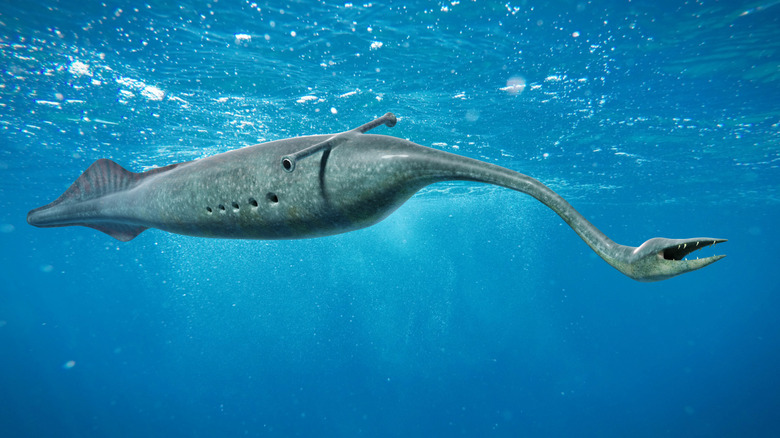
Classification of the Tully monster has remained elusive since its discovery. Initially, the organism was simply referred to as "Tully's monster" in honor of its serendipitous discoverer. Generally, scientific names are written as the genus and species. However, the Tully's genus is unknown. After over a decade of mystery, the museum curator Eugene S. Richardson Jr. deemed the creature Tullimonstrum gregarium in 1966. Although a name had been bestowed, researchers were not any closer to unraveling its history.
Interestingly, this would not be the only Tully monster uncovered, and though Tully's discovery was novel, it wouldn't turn out to be entirely unique. Today, over 2,000 specimens have been examined. Initial examinations would cause scientists to speculate that the species was a soft-bodied invertebrate (an organism lacking a backbone), similar to a worm. Some even suggested that it was some sort of snail without a shell. But in 2016, a paper published in Nature declared it to be a vertebrate (an organism with a backbone).
The paper's authors examined a medial structure that had previously been thought of as a "gut trace." They noted that a fossilized digestive tract usually ends shortly ahead of a tail and is preserved in 3D, while the structure in the Tully monster specimens continued into the tail and was preserved in 2D. This, the researchers posited, was more similar to a notochord, which is a skeletal structure composed of cartilage. But did they actually solve the mystery of the enigmatic Tully monster?
Is the Tully monster mystery solved?
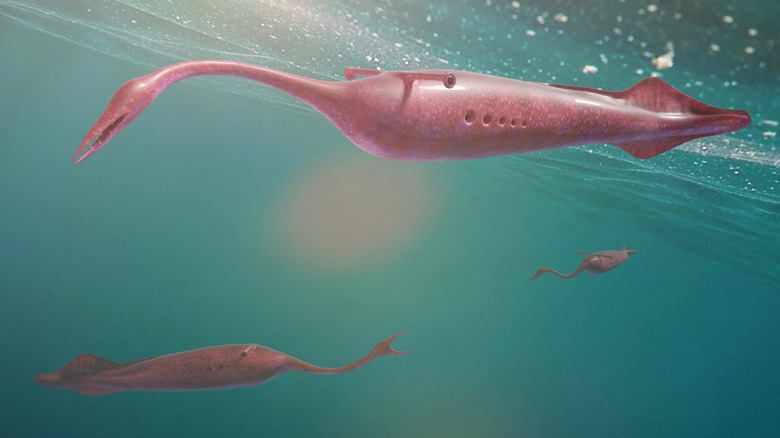
The authors of the 2016 paper asserted that the Tully monster is a jawless fish, like a lamprey or hagfish. However, as with many novel findings, this one has not been immune to controversy. Some supporting evidence appeared in another 2016 publication from Nature. In this paper, the authors revealed pigments in the retinas of the Tully monster that resemble a pattern only before seen in vertebrates. However, a paper published in 2019 in Proceedings of the Royal Society Biological Sciences refuted this observation, suggesting that these pigments more closely resembled those found in cephalopods, like an octopus, after some decay.
Things got even messier with a 2023 publication in the journal Paleontology. These researchers used a laser 3D scanner to investigate the structures of many Tully monsters. Based on their analysis, the authors suggested that the structures pointed to in the original 2016 paper did not actually resemble those of vertebrates. They suggest that the Tully monster might have had a notochord without a true backbone. Such morphology would make the Tully monster an invertebrate chordate, like a lancelet.
Intrigue, confusion, and controversy have surrounded the Tully monster for nearly 70 years. While some stand firmly on the side of their being vertebrates, others are certain they are invertebrates. One thing is for sure: the Tully monster is not easily boxed in, and though some clues have emerged, the mystery remains afoot.