

Mystery Or Myth: How Did Human Consciousness Come To Be?
We may receive a commission on purchases made from links.
Even though science has studied a great many things about humanity and how we came to be, there are certain things we have a tough time finding out. There are plenty of big unanswered questions about how life began on Earth, and new human evolution discoveries can turn up to stun scientists. In other words, we definitely don't know everything about ourselves and how we ended up on this planet. As it turns out, we can't even be sure about how our minds developed the consciousness that you're using right now to read and comprehend this.
Here's the one thing we're fairly sure about human consciousness, aka the awareness of our own mind and what's going on in it. It was part of our evolutionary process, and its basic ingredients are things that far more primitive organisms also possess: senses, behavioral responses, ability to learn, and memory. As humans evolved, we developed a more advanced brain recipe that enabled us to plan ahead and modify our behavior, among many other things.
It's thought that consciousness came to be as a part of that evolution. Still, at the end of the day, all of the aforementioned are just basic means to observe and react to our surroundings. Consciousness is a whole different layer in our awareness cake, and there are still many mysteries surrounding it. Let's take a look at what we know about how human consciousness got its start.
The human consciousness is difficult to study for several reasons
One problem with studying consciousness is the difficulty of defining what consciousness is in the first place, as noted in the book "Picturing the Mind: Consciousness through the Lens of Evolution" by evolutionary biologists Simona Ginsburg and Eva Jablonka. There are many definitions of consciousness out there, and accordingly, several theories on how it came to be. Ginsburg and Jablonka's own theory suggests that the benchmark of consciousness is unlimited associative learning, which enables us to use our experiences to learn about both ourselves and the world around us for as long as we're alive and operational.
Elsewhere, Dr. Ralph Lewis, associate professor in the Department of Psychiatry at the University of Toronto, has suggested on Psychology Today that consciousness may effectively be an evolutionary step up from reflexive response — a way to respond to our environment in more nuanced ways than animals without consciousness can. However, this, like every other theory of consciousness, is currently just that: a theory.
Apart from the plethora of definitions and theories out there, another major issue is that consciousness is a personal state of experiencing things that is difficult– if not outright impossible — to observe. While aspects of the physical world can be seen and studied, there simply is no way to do that with consciousness. "I observe your behavior. I observe your brain if I do an intracranial EEG [electroencephalography] study. But I don't ever observe your experience," consciousness researcher Robert Chis-Ciure from the University of Sussex described the issue for Scientific American.
There are two major neuroscientific theories about the origin of consciousness
Since it focuses on the study of the nervous system, neuroscience knows that the brain may surprise you in many ways, and is understandably interested in the study of consciousness. Over time, two big neuroscientific theories about consciousness have emerged, which is nice. The problem is that they're very different from each other, and there's no way of knowing which one (if either) is correct.
The first one is the integrated information theory, which suggests that consciousness is effectively an ability to process information, and there are levels to the game: The more information something can process, the more conscious it is. The other one is the global neuronal workspace theory, which has its roots in psychology and sees consciousness as a vast neural system that's able to fully focus on particular stimuli when needed.
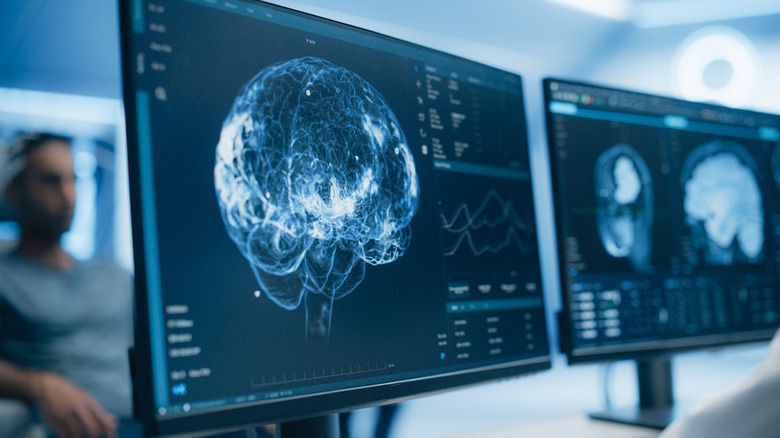
Both of those descriptions are very simplified, of course, and fairly conceptual. Still, their positive side is that both the integrated information theory and the global neuronal workspace theory can be studied with brain imaging, and even compared with each other. As such, there's a chance that we may one day be able to nail down a single, solid theory of how consciousness came to be — but for now, all that can be said for sure is that science is on the case.