

Scientists Thought The Sun's Death Would End The World – A New Study Says Otherwise

For the past 4.6 billion years, the sun has shone brightly at the center of our solar system. However, all good things must come to an end, and in about 5 billion years, the sun will start dying. The sun won't go out in a massive supernova like more massive stars, but scientists predict that it will expand dramatically in its final stages. For years, the expectation has been that the sun would eventually swell large enough to swallow Earth, and possibly even Mars. But a new study published in Astronomy & Astrophysics proposes that this may not actually be the case.
The study modeled changes to Earth's orbit and the evolution of the sun as it enters the final stages of its life. The scientists looked at the expansion of the sun, changes in gravitational forces resulting from changes in mass and distance, and how the sun might lose mass as it ages. What's more, over the years, researchers have gained a more detailed understanding of how tidal forces behave in stars and between stars and planets. With these new details and mass-loss rates obtained by observing a nearby sun-like star the models in the study predicted that Earth would not be engulfed by the sun as it died.
How stars like the sun die
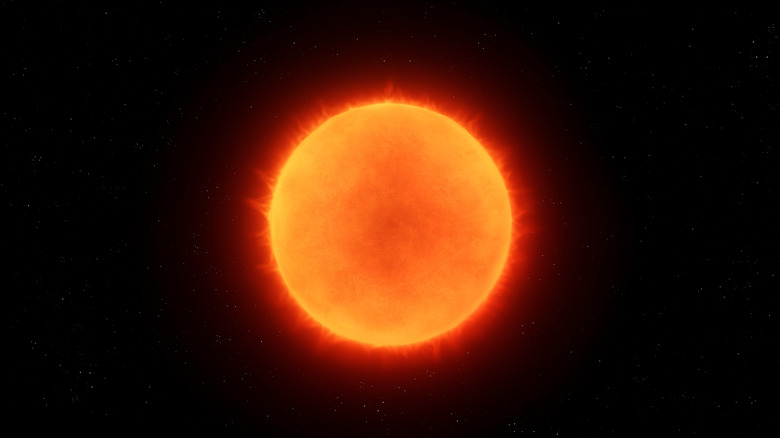
As a main sequence star, the sun creates energy by fusing atoms of hydrogen into helium in its core. The sun has about half of its original supply of hydrogen remaining, giving it another roughly 5 billion years. Once this supply of hydrogen is exhausted, the sun will enter the final stages of its life. Without hydrogen to fuse, the sun will start fusing atoms of helium into carbon. During this stage, the sun will expand and cool to form a red giant. As the sun expands, it will engulf Mercury and Venus. At the same time, the sun's gravitational pull on Earth will increase, causing Earth's rotation to slow.
After the sun exhausts the supply of helium in its core, it will enter the next stage where it becomes an asymptotic giant branch star, transitioning into the final phase of its life. In this stage, the sun would have an inert core of carbon and oxygen surrounded by shells of hydrogen and helium which keep undergoing fusion. During this phase, the sun's surface becomes even cooler, but much brighter than the sun is today. While this happens, the sun loses mass as matter is sent out into space through a stellar wind. As the sun loses mass, its gravitational force decreases and Earth's orbit could actually drift farther out.
Tidal forces and mass changes
Predictions of how Earth will fare as the sun depend on how tidal forces and mass loss balance out. In the past, models showed that the sun would expand well beyond Earth's orbit. However, early models used fairly simple calculations of gravitational forces. Over the past 15 years or so, researchers have developed new and more complex tidal models.
At the same time, mass loss in asymptotic giant branch stars has also been poorly understood. To refine their model, the study's authors analyzed a nearby star named L2 Puppis. This star is in the asymptotic giant branch stage and had an original mass close to that of the sun. Studying L2 Puppis shed light on how much mass the sun is likely to lose as it ages. With this new mass-loss data and detailed tidal models, scientists determined that Earth may indeed not be engulfed by the sun.
The researchers note that there are a lot of uncertainties with their predictions and that more work is needed to better understand how the sun might act in its final stages. Observations of red giant and white dwarf stars, especially those with orbiting planets, would help improve our understanding of tidal and mass-loss forces. Even so, while these findings show that the sun might not swallow up Earth after all, it's likely that life on Earth wouldn't survive the changes that take place at the end of the sun's life.