

The Pregnant Endangered Sea Creature That Was Killed By A Cruise Ship In Alaska
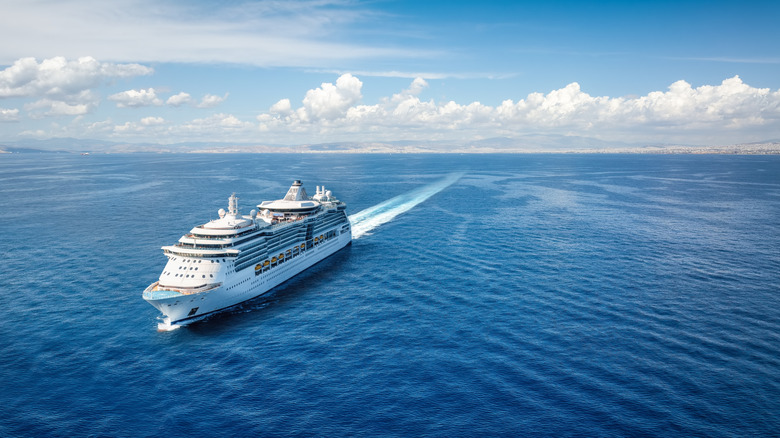
On June 19, 2026, a Royal Caribbean cruise ship sailed into Seward, Alaska, with the dead body of a 61-foot fin whale on the bulbous bow of the ship. The National Oceanic and Atmospheric Administration (NOAA) performed a necropsy, an important task to investigate the potential cause of death in such cases, as fin whales are an endangered species, and understanding how one perished can be useful in creating measures to prevent future deaths. However, over the course of the necropsy, NOAA and Alaska SeaLife Center officials realized something particularly concerning: this whale had been pregnant.
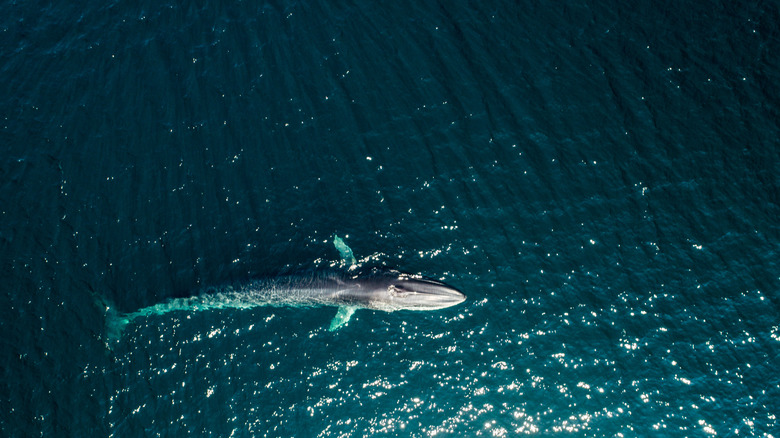
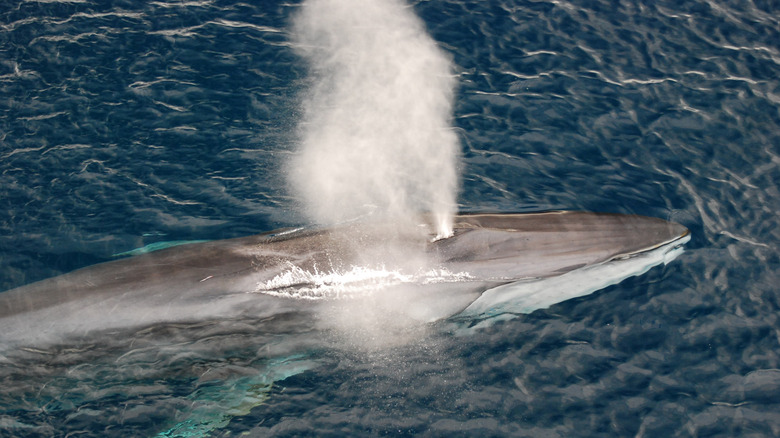
Fin whales (Balaenoptera physalus) are incredibly big, ranking second in size to the blue whales, which are the largest whales in the world, weighing more than thousands of people combined. They can grow up to 85 feet and weigh as much as 80 tons. Under normal conditions, they can also live a relatively long life, with a general lifespan between 80 and 90 years. Also referred to as "razorbacks," these baleen whales have a very distinct ridge that runs the length between the dorsal fin (small fin on the top of their bodies) and the tail. This allows them to move easily through the water, which is an important skill for such migratory creatures. But perhaps their most defining feature is the asymmetrical coloring on the underside of their faces. The right side of their lower jaw is white, while the left side is black.
Environmental threats
While they can live long lives, many unfortunate fin whales' time on Earth has been cut short. Initially, their quick swimming abilities protected them from commercial whaling, but hunting methods advanced and swiftly brought their populations down. In the mid-20th century, the Southern Hemisphere lost roughly 725,000 fin whales to the whaling industry. Fortunately, this practice was brought to an end in the 1980s, but significant damage had already been done. Some estimates suggest that the breeding population of fin whales in the Eastern North Pacific was reduced by as much as 99% during the 1900s, while whaling thrived.
Additional threats have emerged to the population, namely collisions with vessels like cruise ships and large cargo vessels. Researchers estimate that nearly 10 fin whales were killed annually during the summer and fall of 2012 through 2018. However, the exact number of deaths from such incidents is difficult to determine, as fin whales typically sink upon dying, and some suggest that the data we have are likely underestimates the casualties.
The necropsy performed on the pregnant, recently killed fin whale indicated that the cause of death had been blunt force trauma, resulting in damage to its ribs, spine, and jaw. Those who conducted the procedure pointed out that these injuries are consistent with being hit by a ship, such as the one on which it was found. Although an official cause of death has yet to be announced, the examiners did note that the whale appeared otherwise healthy.
Conservation efforts
Cruise and container ships travel through areas populated by whales and take approximately 200 million trips annually. Some researchers suggest that the threat to whales is only growing due to greater numbers of ships moving through spaces where these large creatures often feed. Although the task is daunting, many conservationists are advocating for policies that could reduce or prevent such accidents from occurring.
One suggestion is that shipping containers and cruise ships alter their routes so as not to overlap with large whale habitats. Approximately 92% of whale ranges overlap with shipping routes. Some researchers have pointed out that the risk of vessel strikes could be reduced by 95% by shifting routes 15 miles offshore.
However, altering routes is not always possible, as some channels are simply too narrow. Under these circumstances, conservationists recommend that the ships reduce their speed. The cruise ship that hit this particular fin whale is thought to have been traveling at a speed of 15 to 20 knots (17 to 23 miles per hour). A study from 2006 showed that each 1-knot (1.2 miles per hour) speed increase raises the odds of deadly injury by a factor of 1.5. Experts recommend lowering vessel speeds to 10 knots (11.5 miles per hour) when traveling through heavily populated areas. Some policy advisors have likened this to speed limit restrictions in school zones. While the death of this pregnant fin whale cannot be reversed, future measures can hopefully reduce the odds of such an event happening again.