

Your Eyes Start Aging Faster When You Reach This Age
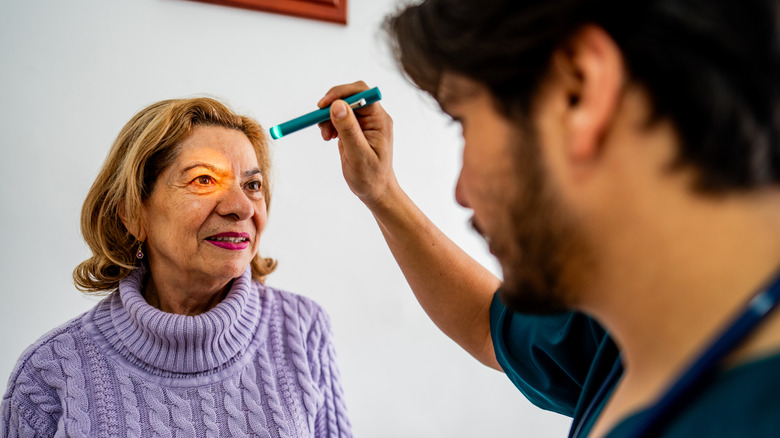
It might start with having to hold your phone at arm's length to read your texts, or maybe a menu will look a little blurry. You might start to get headaches after reading a book. Perhaps you even find yourself taking off your prescription glasses to see things near to you. These are all symptoms of a normal visual development that accompanies aging called presbyopia. Generally, these symptoms start in middle age, after you enter your 40s. Fortunately, it is a well-characterized phenomenon, and there are ways to compensate for these changes in vision, such as bifocals.
To understand how presbyopia occurs, it is important to know a bit about how the eye is structured. The first stop on the path of light through the eye is the cornea — a domed, clear structure. In addition to helping filter out UV rays and providing a layer of protection against germs, the fixed shape of the cornea affects the bend of light on its way to the retina. Behind the cornea is the pupil, which is the dark circle in the middle of your iris and changes size to alter the amount of light let in. The lens rests behind this structure and serves to focus that light. Unlike the cornea, the lens is relatively flexible, contracting to view near objects and relaxing to better see those in the distance. From here, light can reach the retina, which contains specialized cells that translate such visual information into the language of the brain.
Presbyopia

The flexibility of the lens reduces over time, leading to presbyopia. Early in life, this portion of the eye is highly flexible, optimizing its shape at any given moment to focus on whatever is in view. However, past the age of 40, the lens starts to harden, which makes it more difficult to focus on a given point near the eye. While it can be annoying, this is actually a perfectly normal part of aging. In general, the body starts aging faster during middle age, and something like presbyopia cannot be reversed. However, there are ways to compensate for this age-related vision loss: artificial lenses.
Similar to those in our eyes, the type of lens that we utilize in glasses uses its shape to bend the light in a specific way to provide focus. Because the lens in our eye becomes stiff, it is more difficult for the muscle surrounding the lens to induce the rounded shape that would provide clarity to something near to the eye. Thus, someone with presbyopia has difficulty focusing on something up close. Reading glasses can counteract this issue by refracting the light before it reaches your eyes. If you already rely on prescription lenses, bifocals add a portion to the glasses that corrects for close visual impairment. Therefore, if you notice these symptoms developing, speak to your optometrist to find the best option for you.