

The Sound Astronauts Can't Make In Space
For decades the public has been treated to the sights and sounds of astronauts talking, reading children's books, and even playing the guitar and singing in zero gravity. Thanks to audio and video linkups, we can hear what astronauts have to say as they live and work in space. However, there are some sounds that astronauts can't make. The famous movie tagline states that nobody can hear you scream, but the sound in question is less terrifying. It turns out that in some situations, astronauts can't whistle.
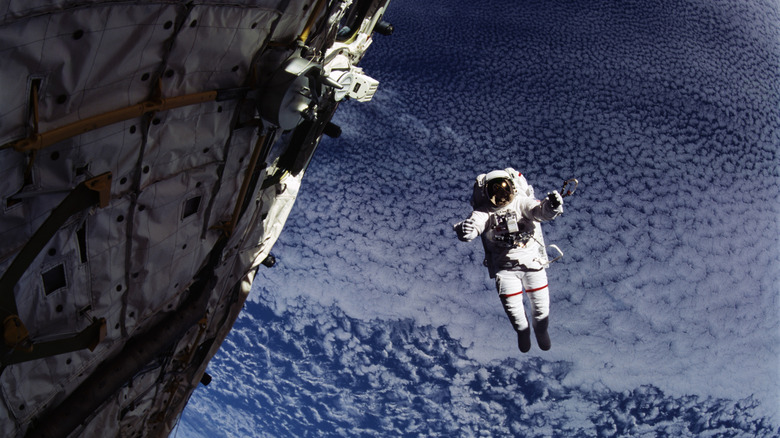
While in space, astronauts work tirelessly, running experiments and carrying out any number of maintenance tasks. Some of these tasks take astronauts outside the cozy confines of the International Space Station, something known as extravehicular activity (EVA). On an EVA, more commonly known as a space walk, astronauts wear spacesuits to protect them from the harsh environment of space. These suits protect them from the vacuum and extreme temperature changes of space, and supply climate control and oxygen to breathe. However, no matter how hard they try, astronauts can't whistle while the work on an EVA. The reason for this is a matter of air pressure.
Under pressure
Modern spacesuits are the result of decades of engineering design and trial-and-error. However, early in humanity's foray into space, we learned something important. You need air pressure inside a spacesuit to counteract the vacuum of space, but if there's too much pressure inside, the suit can become rigid, making it impossible for an astronaut to bend their arms and legs. On the first spacewalk, Russian cosmonaut Alexey Leonov left his capsule only to find that his fully inflated suit made it impossible to re-enter the spacecraft. Leonov manually depressurized his suit, an incredibly risky act, so he could get back inside his capsule.
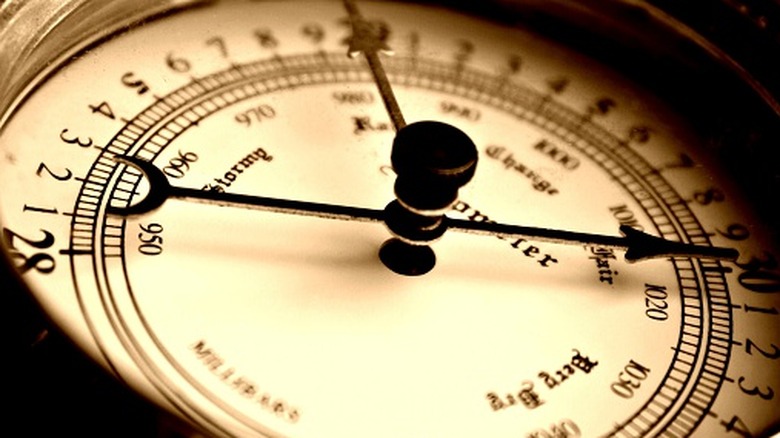
Because of this, spacesuits are pressurized at a small fraction of what we would consider a normal pressure. For instance, barometric pressure at sea level is 14.7 pounds per square inch, but spacesuits are pressurized to 4.3 pounds per square inch. For comparison, that's less than the 4.89 pound per square inch average pressure at the peak of Mount Everest (29,032 feet above sea level). In fact, mountaineers on Everest need supplemental oxygen because they can't get enough from the air at this altitude, which is one reason why the death toll on Everest is so high. On top of that, regular air is a mix of nitrogen, oxygen, and other gases, but the air inside a spacesuit is 100% oxygen. This means astronauts can breathe freely even at such a low pressure.
How to whistle

While astronauts can breathe, talk, and even hum just fine during an EVA, they can't whistle. On a space shuttle mission in 1999, former astronaut Dan Berry tried whistling and found it impossible. The reason for this is simple physics. When a person whistles, they move their tongue up to the roof of the mouth and pucker their lips. This creates a small space that works as a resonance chamber. Air passing through this chamber causes vibrations that make the sound of whistling. Moving the tongue and lips and changing the speed and pressure of airflow is how people control the pitch to whistle a tune. However, in a spacesuit (and probably on top of Everest) there aren't enough air molecules moving to create a sound.
NASA has been working on a new spacesuit design that uses a higher pressure of 8.2 psi, which is roughly equivalent to the pressure at 15,000 feet. Instead of pure oxygen, though, the spacesuit will use a mix of 34% oxygen and 66% nitrogen (normal air is 21% oxygen). Whether this pressure will make whistling possible is something astronauts will have to try out. For the time being though, astronauts will have to be content with humming while they work.