

Why Death By Black Mamba Venom Is One Of The Worst Ways To Die
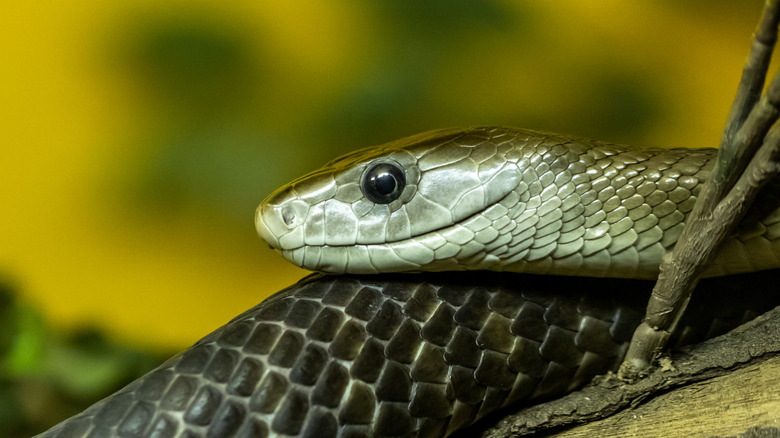
Left untreated, a bite from a black mamba is virtually 100% fatal. However, it's unknown how many people die per year from its bite, since record-keeping in the black mamba's native range of southern Africa is lacking. But deaths do occur. In 2022, a man died in Zimbabwe's Gwanda Provincial Hospital because the hospital didn't have antivenom on hand. Hospital staff had been preparing to transport him to a hospital that did have antivenom, but the venom was simply too fast-acting. Indeed, black mambas possess one of the fastest-killing venoms in the animal kingdom, as it relies on a highly effective chemical attack that wreaks havoc on the nervous system.
To take down prey as quickly as possible, the black mamba's venom launches a two-pronged attack. One class of neurotoxins, alpha-neurotoxins, block nerve signaling between the brain and the muscles, causing rapid paralysis of the victim. When used on the black mamba's typical prey, such as small mammals and birds, these alpha-neurotoxins can cause complete paralysis in just a few seconds. In adult humans, a widespread loss of motor function typically occurs within 30 minutes to four hours of the bite, though bites near the head or chest can prove fatal within minutes.
Simultaneously, black mamba venom attacks the nervous system with another class of neurotoxins called dendrotoxins and fasciculins. These peptides (not to be confused with the popular synthetic "research peptides") over-stimulate nerve endings, causing strange rolling muscle spasms and violent twitching. Thus, the two-pronged attack of black mamba venom disrupts nerve signaling while also lighting up muscle fibers at random. Survivors describe the sensation as severe pins and needles and pure fear as they lose complete control of their body.
Black mamba venom isn't the most painful, but it might be the most terrifying
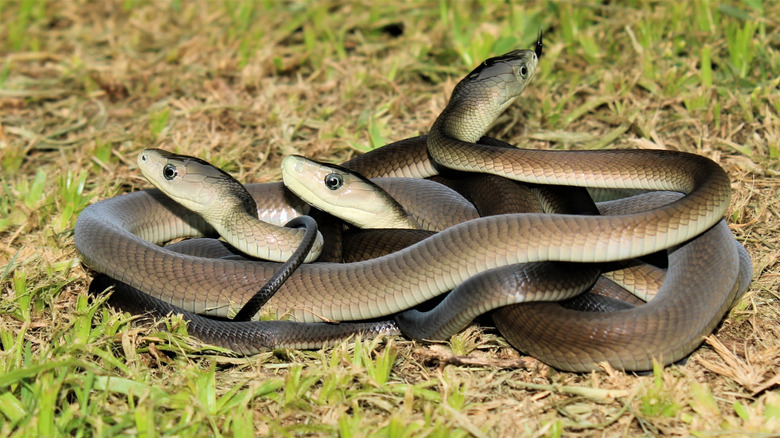
Because a black mamba's strike is so fast and its fangs are so sharp, many victims don't even realize they've been bitten at first. In one case study from 2017, a snake breeder only became aware that his black mamba had envenomated him when he noticed, "a tiny bloody mark on his forearm and [...] a slight tingling of his lips." But the initial lack of pain can be deceiving. Within five minutes, the man was experiencing a growing tightness in his chest, pins and needles over his whole body, and spontaneous muscle twitching. Fortunately, the man was given antivenom 70 minutes after the bite and survived.
Not all venoms are the same. The venom of the Brazilian wandering spider contains peptides that activate pain receptors, inflicting an agonizing pain that only grows with time. Then, there's the world's longest venomous snake, the king cobra, whose venom contains a mix of neurotoxins and cytotoxins. Cytotoxins destroy cells, causing an intense localized pain as tissues necrotize, blister, and inflame. But the black mamba's venom is adapted to focusing its destruction almost entirely on the nervous system.
Thus, it may not be fair to say black mamba bites are painful. In fact, its venom is virtually free of cytotoxins, the bite itself feels like a pinprick, and pain receptors are blocked rather than activated. The experience, however, must be one of the most terrifying ways to die. While paralysis works its way from the extremities to the chest, victims experience a suffocating sensation. In most cases, death by black mamba comes in the form of respiratory failure, as the breathing muscles slow to a stop. It's a scary way to go.