

Noise Has An Unexpected Effect On A Spider Web
We may receive a commission on purchases made from links.
Many of us have formed habits to navigate existence near particularly noisy neighbors: white noise machines, noise-canceling headphones, sealing windows, etc. But our noises don't only affect us. As urbanization expands to accommodate people, many small creatures continue to live among us, and sometimes the tiniest of those creatures learn to thrive in crowded environments. Research published in Current Biology revealed that spiders build their webs differently based on whether they are from a quiet, rural area or a loud city. As it turns out, spiders might be trying to adjust to their noisy neighbors too.
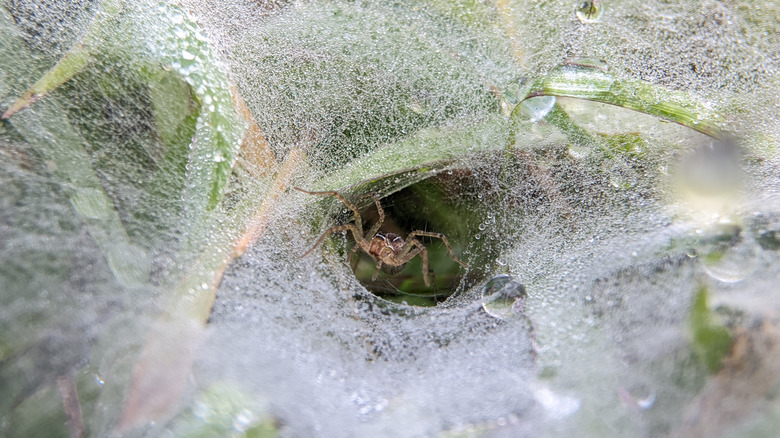
Hearing is most likely not the first sense that jumps to mind for an arthropod, such as a spider. But spiders rely on small vibrations to sense their prey, and sound waves can alter how those are perceived, essentially creating interference. The Pennsylvania grass spider (Agelenopsis pennsylvanica) weaves a web that looks like a sheet upon first glance but has a funnel off to the side. This provides a net with which to catch prey and a hideaway to evade predators. Because grass spiders spend so much time burrowing in the tunnels they've built, sensory information is vital in alerting them to prey that have landed, almost like a delivery notification. However, because their nets do not cause prey to stick, they must move very quickly, So, any tampering with that pertinent information is risky to the spider's quality of life. Luckily, spider adaptations have appeared to allow them to thrive in different environments.
New web, who's this?
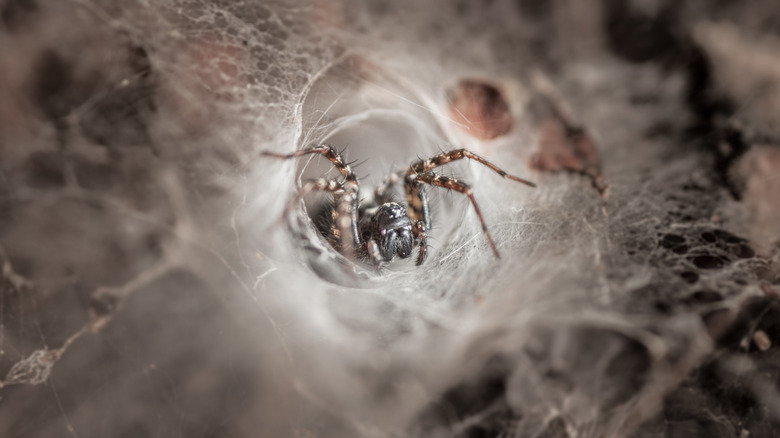
Hebets's lab, led by Eileen A. Hebets, at the University of Nebraska studies communication and sensory signaling in arachnids (spiders). A Ph.D. student in the lab, Brandi J. Pessman, studies the vibratory channel of communication, which is largely understudied, analyzing how some species respond to interfering sensory content in their habitat. Large cities tend to generate a lot of vibratory content, from loud noises to extensive traffic. By comparing spiders from rural and urban environments, Pessman and Hebets were able to analyze what adaptations to such disruptions grass spiders might have developed.
Spiders collected from disparately populated environments were placed in containers and played sounds that were either loud or quiet. After analyzing their webs, Pessman and Hebets found something very interesting. Just like insulating your walls can lessen the noise leaking into your space from your neighbors, Pennsylvania grass spiders from urban areas designed their webs to reduce energy spread across the web, basically soundproofing their homes and minimizing noise pollution. While vibratory information was dampened within the city spiders' webs under loud conditions, the rural spiders appeared to take a completely different approach, essentially making their webs more sensitive. The authors suggest that the spiders unaccustomed to the cacophony of urban life were attempting to fine-tune their webs in order to catch prey and potential mates through the humdrum. The exact ways that these spiders alter their webs to produce such effects are unknown, and future studies are required to provide insight.