

The Body Part That Explains Why Humans Get Ear Infections

Ear infections are a common cause of pain, tears, and sleepless nights for children and their caregivers. In many cases infections of the middle ear, the air-filled space behind the eardrum, resolves on their own with little more than rest and pain relief. However, some infections are serious enough to need antibiotics to avoid complications. While the infection is inside the ear, the body part that explains why it happens is hidden away. The culprit is a pair of bone and cartilage passages, known as the eustachian tubes, that connect the nose and throat to the middle ear.
Eustachian tubes work to protect the middle ear. First, they equalize air pressure between the middle ear and the outside world. Anyone who's flown on a plane, driven in the mountains, or perhaps ridden a really fast elevator has experienced the sensation of their ears popping. The eustachian tubes open when you swallow, chew, or yawn, letting air in and out of the middle ear so the eardrum can work properly. The second role of the eustachian tubes is to allow fluid to drain from the inner ear. Fluid not draining from the middle ear due to a blocked eustachian tube is a common cause of ear infections. Aside from when regulating pressure or draining fluid, eustachian tubes stay shut to keep germs like cold viruses out of the middle ear.
Eustachian tube anatomy, function, and dysfunction
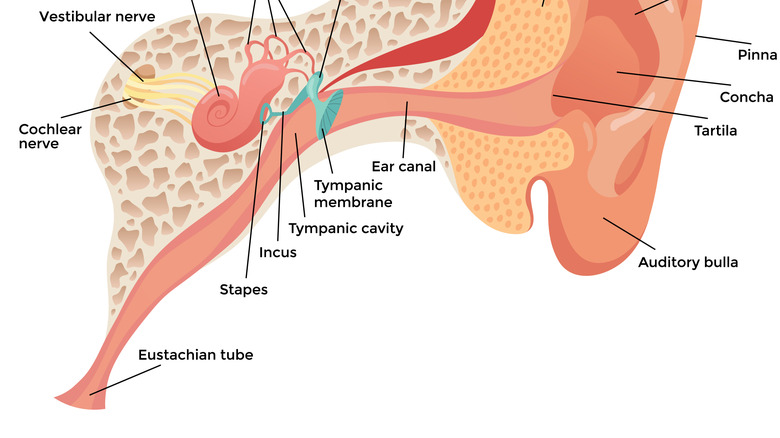
The eustachian tubes lie on each side of the face, connecting the nose and throat to the middle ears. Each tube is made up of two sections. The section closest to the middle ear averages about half an inch long and roughly one-eighth of an inch in diameter. Connecting this section to the nose and throat is the second portion of the eustachian tube, an approximately one inch long segment of cartilage. Eustachian tubes are shorter and straighter in children than in adults, which is the main reason they get blocked more often and why children are far more likely to get ear infections than adults.
However, around 1% of adults experience eustachian tube dysfunction, a condition where the eustachian tubes don't open and close like they're supposed to. In some cases the tubes stay open all the time, which causes sound to travel from your nasal cavity to your ears. Another type of dysfunction is where the eustachian tubes don't open at all. People with this form of dysfunction will have fluid buildup and uncomfortable changes in pressure in the middle ear. A third type of eustachian tube dysfunction is experienced when a person changes altitude and their tubes don't open to regulate pressure. People experiencing eustachian tube dysfunction will most often have muffled hearing, a feeling of fullness in their ears, or ear pain.
Caring for your eustachian tubes

Ear infections and eustachian tube dysfunction will often go away on their own. But in rare cases these conditions can lead to ear damage and hearing loss, so it's important to get medical care if symptoms are severe or last more than two weeks. Chronic problems may need surgery to fix. Some surgeries create an incision in the eardrum to help equalize pressure. Other procedures use a balloon that's inserted into the eustachian tube and inflated to expand narrow tubes.
There are a few ways to prevent and manage eustachian tube dysfunction. Swallowing, yawning, and chewing on gum are common methods for helping the eustachian tubes open. If these methods don't work, people can try swallowing with their nose pinched shut, which will move muscles that can help open the eustachian tubes. It's also possible to pinch the nose shut and gently blow through it without letting air exit; however, too much pressure can damage the eardrums so it's important to be gentle. Staying hydrated and managing symptoms during cold season and allergy season are a few ways to prevent eustachian tube dysfunction. Other methods include keeping nasal passages clear by gently blowing your nose and sleeping with your head elevated to allow better fluid drainage.
Ear infections can be a miserable experience for both patient and caregivers. However with some preventive care people young and old can improve the chances of their eustachian tubes working as they should.