

Why Death By A Saw-Scaled Viper Is One Of The Worst Ways To Die
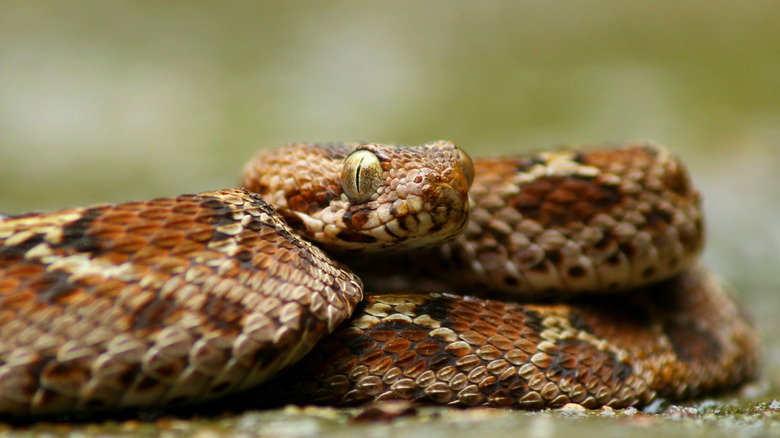
Every species of venomous animal produces its own unique chemical cocktail of toxins. Some venoms rely heavily on neurotoxins to disrupt nervous systems and paralyze prey, such as that of the deadly "banana spider." Others lean on cytotoxins, which dismantle all animal cells they encounter and cause necrosis of the tissues, such as those found in the world's few venomous frog species. The venom of the saw-scaled viper, however, is predominantly hemotoxic, which means it attacks the circulatory system. Its hemotoxic enzymes destroy red blood cells and disrupt blood clotting. The result of severe envenomation by the saw-scaled viper is death by massive hemorrhaging, as your body fails to stop the internal bleeding.
Saw-scaled vipers inhabit a wide range, spanning northern Africa, Arabia, southwestern Asia, and, most notably, India. In fact, the Indian saw-scaled viper is one of India's "Big Four" snakes which are responsible for over 50,000 deaths per year. Due to its small size, aggressive nature, and quick envenomation, most bites occur from unexpected encounters rather than mishandling or provocation. And without quick access to medical treatment or antivenom, the prognosis for a person bitten is grim.
Within the first seconds of a bite, burning pain begins radiating from the bite site as the venom spreads through tissues. By the one-hour mark, the hemotoxins finish exhausting the body's clotting factors, resulting in a condition called venom-induced consumption coagulopathy (VICC). Essentially, VICC occurs when venom over-activates the body's blood-clotting system by mimicking coagulants to exhaust supplies. This results in spontaneous bleeding throughout the body. Over the next several hours, victims' may bleed from their gums and noses, bruises may appear randomly on the skin, and they may even vomit blood.
Saw-scaled viper venom kills small prey in seconds and humans in days
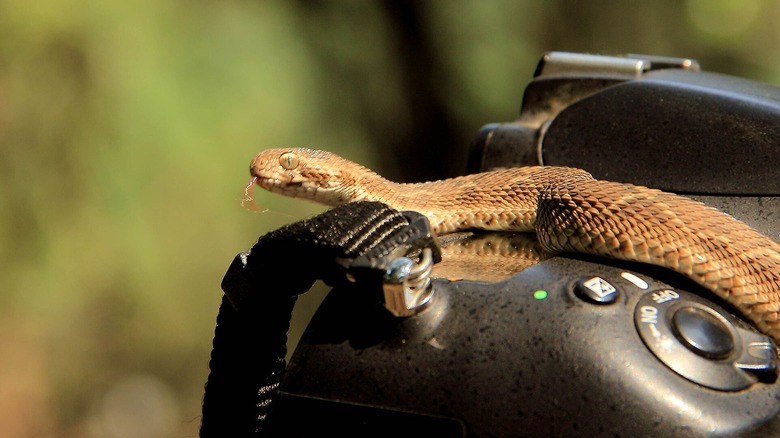
There are eight species of saw-scaled vipers, and they're all expert ambush predators by the time they reach adulthood. The saw-scaled viper hunts by sitting perfectly still, camouflaged against light-colored rocks and brush, as it waits for prey to pass by. Almost any small-sized animal is a potential meal, including mammals, lizards, amphibians, invertebrates, and birds.
Because surprise is the key to their hunting strategy, saw-scaled vipers strike in a fraction of a second. Small animals don't stand a chance, as the viper's powerful hemotoxic venom disrupts their circulatory systems within a few seconds or minutes, killing them from internal hemorrhaging. But even if their victims don't die right away, the saw-scaled viper only needs to wait until their prey stops kicking to move in for mealtime.
Human beings are much larger than the saw-scaled viper's standard fare, so it takes a longer time for its venom to kill. Unlike the venomous animals that can kill you within minutes, the venom of the saw-scaled viper offers human beings several hours or even days to get to a hospital before it's too late. Many hospitals within its native range carry saw-scaled-viper antivenom, and those that don't may use polyvalent antivenoms that cover a range of snake bites. Still, bites often result in lifelong injuries and illnesses.
Many survivors suffer from chronic kidney problems and renal impairment. Some bites lead to necrosis of the tissues that leaves a scarred hole around the bite site, muscle weakness, and mobility issues. In severe cases, amputation is necessary to curb the spread of the necrosis. Needless to say, surviving a saw-scaled viper bite isn't something you walk away from.