

Scientists Say This Annoying Reflex Could Be An Evolutionary Leftover From Our Aquatic Ancestors
We've all experienced it. You're sitting there, just minding your own business, when you hear and feel the dreaded hic. For the next few minutes the hiccups take center stage. When people get the hiccups they have all sorts of remedies to try: drinking cold water, holding their breath, having someone try to scare the hiccups out of them. Hiccups are a reflex, meaning you have no conscious control over them. This reflex is annoying and appears to serve no clear purpose in humans, but scientists think hiccups are a remnant of the deep past that was useful for our aquatic ancestors.
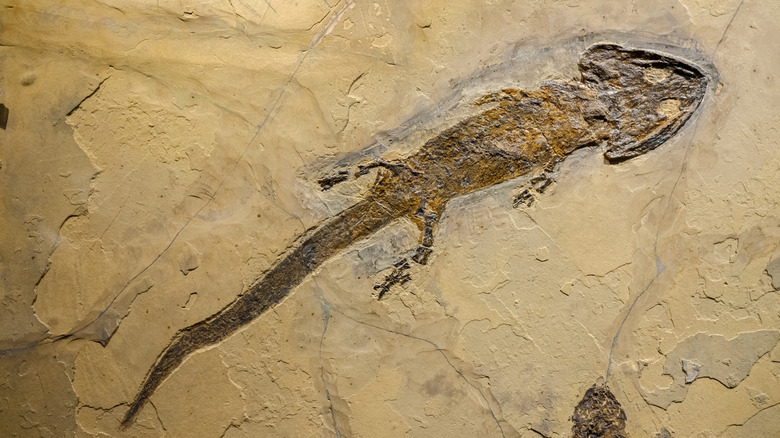
Even though they serve no known purpose, humans can still get the hiccups because of the way evolution works. Traits that help with survival and reproduction get passed along, but so do traits that are not harmful but also not particularly useful. This means that terrestrial and aquatic animals can have similar biological structures. One example of this is a 375-million-year-old fossil of a large fish found in Nunavut, Canada, in 2004. The fossil had scales and fins as well as bones that resemble upper arm, forearm, and wrist bones in humans. Along with these structural similarities, there are parallels in the way nerves and muscles responsible for breathing, and by extension hiccupping, work across species.
A long and winding neural road
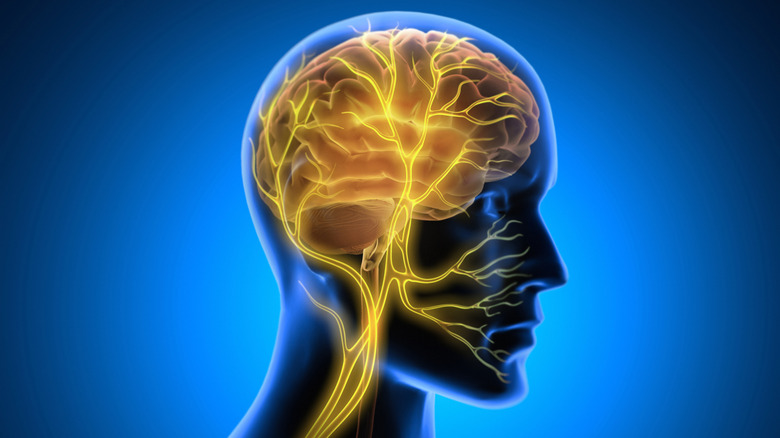
During a hiccup, the diaphragm spasms and muscles in the chest wall activate at the same time. A fraction of a second later the glottis, a flap that covers the vocal cords, rapidly closes. It's this rapid closing of the glottis that gives the hiccup its distinct sound. This entire process, like many other reflexes, is managed by the brain stem and involves multiple nervous system structures like the phrenic and vagus nerves, the medulla oblongata, and the hypothalamic reticular formation. The phrenic nerve in particular controls the diaphragm, and when it gets irritated it causes the spasm we know as a hiccup.
These structures are found in other vertebrates as well, though their layout makes more sense in fish than humans. In fish, the phrenic nerve controls the gills, which are right next to the skull. In humans, the phrenic nerve runs all the way through the chest cavity from the base of the skull to the diaphragm. It's this long and winding path that increases the chances of the phrenic nerve getting irritated, for example by an overly full stomach or inflamed esophagus, leading to a bout of hiccups.
Annoying for humans but useful for tadpoles
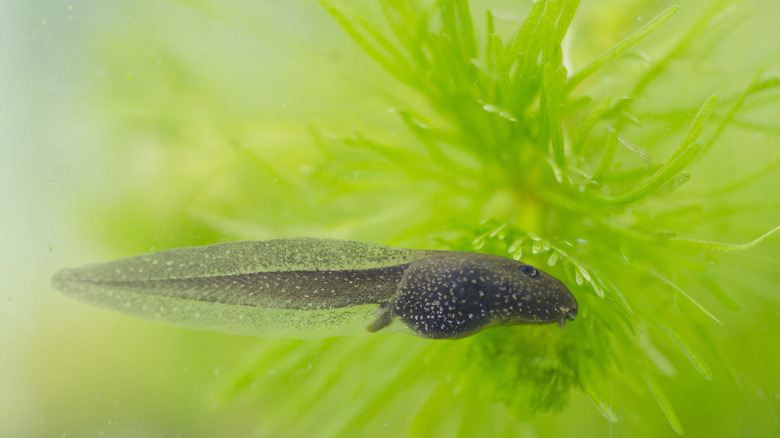
While annoying for humans, the hiccup reflex is highly beneficial in amphibians. Breathing is important for all organisms, and the nerve and muscle activity in a human with hiccups is similar to that in tadpoles when they breathe through their gills. Tadpoles get oxygen from water through gills like fish, but grow lungs as they develop into adult frogs. When breathing, tadpoles contract muscles to quickly draw water across their gills while closing the glottis to keep water out of their lungs, much in the way the human glottis snaps shut during a hiccup.
Scientists have found that this reflex in both humans and tadpoles can be blunted by increasing levels of carbon dioxide in the blood. This response to carbon dioxide is the reason why holding one's breath can sometimes stop an episode of hiccups. These similarities point to a possible common origin.
Another competing explanation states that hiccups are a useful reflex in newborn mammals that is retained into adulthood. The idea is that hiccups push out air that gets trapped in the stomach while nursing. The high frequency of hiccups in infants helps support this notion. It may also be possible that hiccups are the remnant of an ancient reflex that has proven useful in newborn mammals. However, regardless of their origin, hiccups show how evolution plays the long game.