

Scientists Reconstructed A 3.7 Million-Year-Old Face. What They Saw Raises A Big Question
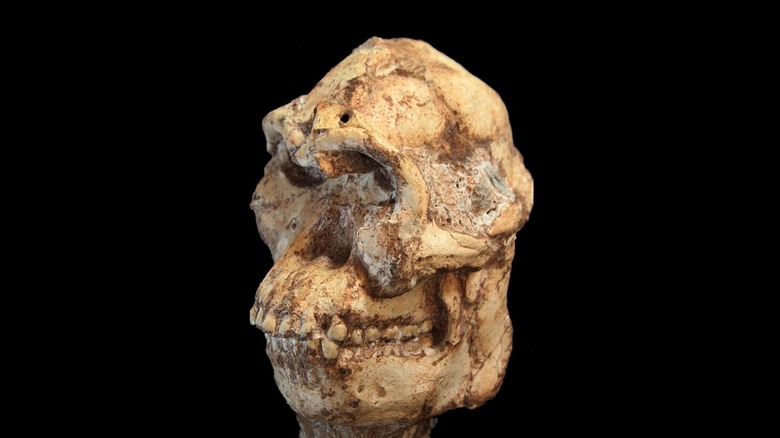
Ancient hominid fossils are the best evidence we have for tracking the evolution of humankind, but with all the gaps that still exist in our knowledge, placing these fossils at the right points on a timeline can be extraordinarily challenging. Even fossils that scientists think they have identified can require recategorizing later on, and that appears to be the case with one of the most famous hominid fossils ever discovered. Little Foot (not to be confused with the protagonist of "The Land Before Time") is a fossil of the Australopithicus genus, known as one of the most complete ancient human skeletons ever discovered. Since the first pieces of the skeleton were excavated in South Africa in 1994, anthropologists have argued over which Austrolopithecus species it belongs to, but a recent effort to reconstruct the specimen's face suggests that it's one we've never identified before.
Little Foot's skull was crushed from the pressure of spending roughly 3.67 million years buried underground, and it wasn't until this year that scientists finally made strides towards reconstructing it. The results, published in the French journal Comptes Rendus Palevol, present a digital reconstruction of Little Foot's eye region, showing massive orbital sockets unlike anything seen in other hominins. It also provides a blueprint for rebuilding the rest of Little Foot's skull in the near future, and hopefully gaining insights into what its brain may have looked like. For now though, it's a mystery as to what human ancestor Little Foot actually represents.
What Little Foot's face reveals
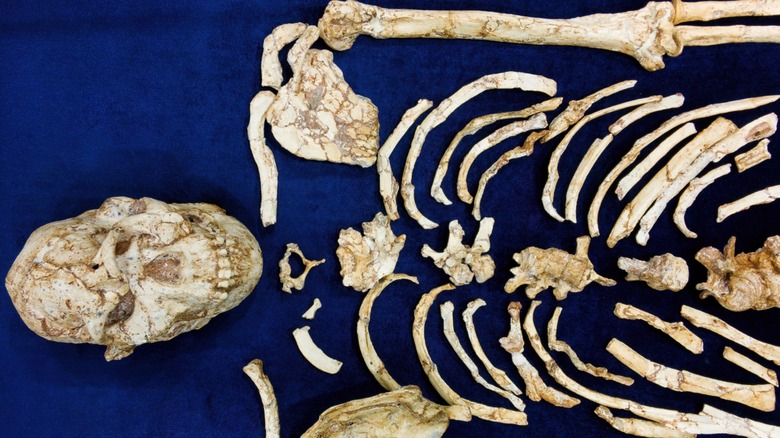
Despite being one of the most complete skeletons of an extinct human species ever discovered, there has always been an issue with Little Foot's face. The top of the skull is caved in, the eye sockets crumpled against the cheekbones, obscuring most of the face. Digitally reconstructing the skull was therefore a monumental task. The process, undertaken at the Laboratory Paleontology Evolution Paleoecosystems Paleoprimatology (PALEVOPRIM) in France, has taken five years to complete, and there are still parts of the skull that need reassembling before a full picture of the face can be made out.
What researchers have pieced together so far reveals a very distinct feature: namely the eyes. Once reconstructed, Little Foot's orbital bones were revealed to be extraordinarily large for a hominin. An additional study, conducted in 2019 and published in the Journal of Human Evolution suggests that its visual cortex was likely more complex than that of modern humans as well, with a better developed sense of sight than we have. It is also notable that these massive eye sockets are only comparable to a select number of Australopithecus species found elsewhere in eastern Africa. This suggests that Little Foot's lineage could be traced further north on the African continent than where the specimen was discovered.
Other evidence supports the theory that Little Foot is a new species
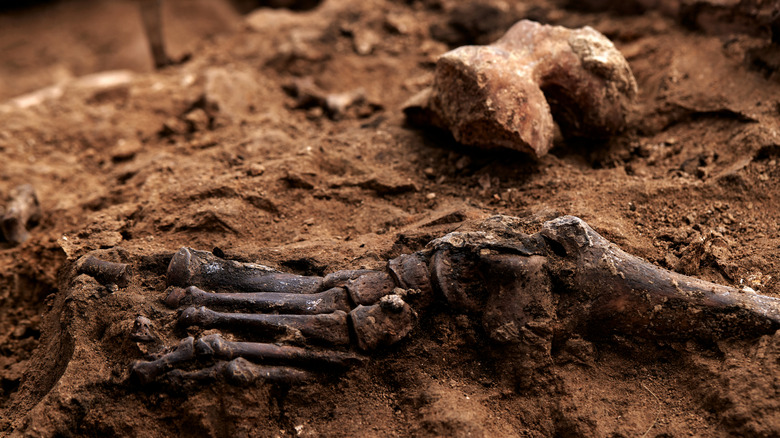
The recent reconstruction of Little Foot's face is not the first piece of research to suggest that the iconic skeleton may represent a heretofore undiscovered species of ancient hominin. Nobody has ever been able to agree on what specific Australopithecus species Little Foot belonged to, although the leading suspects since its discovery have been A. prometheus and A. africanus, known from other fossils in the same region. The reconstruction of Little Foot's face doesn't align with either species though, and other comparisons between fossil specimens have arrived at the same conclusion.
Last year, a study was published in the American Journal of Anthropology, comparing Little Foot to other specimens identified as A. prometheus and A. africanus. There are substantial differences between Little Foot and the other specimens of both species, including having a smaller braincase, a bony ridge along the top, and a longer nuchal plane, the surface of the lower back of the skull. These observations support the conclusion that Little Foot is not just among the most complete hominin skeletons ever found, but is in fact an entirely newly discovered species. The only question is, what? That's a question that will likely take years, and many more studies, to find an answer for.