

Scientists Still Can't Explain The Reasons Behind The 'Cheerleader Effect'
If you've found yourself single and ready to mingle in the 21st century, there's a high likelihood you've turned to dating apps. From the earliest days of Match.com to the modern era of Hinge, dating online has been the ultimate test of snapshot first impressions, and if you've ever made a profile of your own, you know that few things are more intimidating than picking the right photos (or planning the first date). One piece of wisdom you've no doubt heard is to include a picture of yourself in a group. It shows off your social side and community connection, but that's not all. A growing body of research suggests that people appear more attractive in groups than individually, and the phenomenon has been dubbed "the cheerleader effect." Studies have consistently illustrated the effect, but despite this, scientists haven't concluded just why it works.
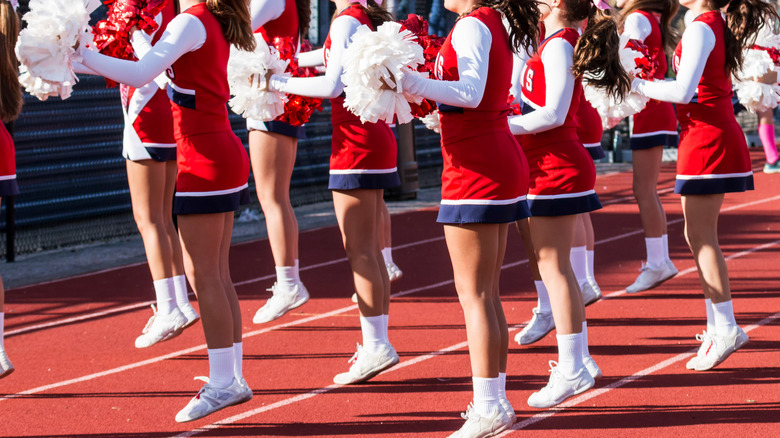
You probably wouldn't expect a sound scientific hypothesis to arise from a sitcom, but that's exactly the case with the cheerleader effect. The term was originally coined in a 2008 episode of "How I Met Your Mother" in which Neil Patrick Harris's Barney Stinson posits that members of a cheerleading team cease to be attractive when seen alone. It was only intended as a joke, but in 2013, researchers at the University of California, San Diego, published a paper in Psychological Science that gave it real credit. More research soon followed, and the effect appears to be very sound. Researchers just aren't sure why, but there are several theories afloat.
Proving the cheerleader effect

The UC San Diego research team set up a simple experiment to test the cheerleader effect. They selected 100 group photographs, cropping each to show exactly three people of the same gender, for a total of 300 faces. They also cropped out each face individually. The team then showed the images to a group of 25 people, with all of the individual and group photos appearing in a completely randomized order. The participants were asked to rate the attractiveness of each face they saw, and the results showed that faces in group photos consistently scored higher than those exact same faces individually. The same proved to be the case when the researchers stitched together trios of individual portraits.
This was the first study to test the cheerleader effect, but more have followed. In 2020, researchers at Flinders University in Australia published a study in the Quarterly Journal of Experimental Psychology that provided more evidence, but with some twists. They tested participants' reactions to body images, not just faces, and found that the cheerleader effect is even more profound on bodies than faces. They also ran a test in which participants were given a short time to look at a photo, then had that photo taken away and were asked to rate its subject's attractiveness. The cheerleader effect was observed strongly in this case, suggesting it may have more to do with how we remember people looking than how they really look. You can even test the cheerleader effect yourself.
There are many theories behind the cheerleader effect

Researchers can't agree on what exactly causes the cheerleader effect, but they have come up with several theories. Drew Walker and Edward Vul, the researchers behind the 2013 UC San Diego study, have suggested that it's all about balance. When we look at an image of one person, we see all the details about them isolated, including their flaws. However, when we see a group photo, our eyes process the average of everyone involved, each person's positive traits balancing out the others' perceived flaws.
There is interesting support for this theory in a study that was published in Psychological Science back in 1990, two decades before Barney Stinson first put a name to the cheerleader effect. In this study, participants were shown portraits of individual people, as well as composite photos made by blending multiple faces in one photo. The composite images were consistently ranked as more attractive, suggesting the ideal image is actually an average one. Walker and Vul posit that group photos average out the individuals in them.
There's one issue with this theory. If it were true, then it would logically follow that the larger the group in a photo is, the more attractive its members will be seen as. However, when Walker and Vul tested photos with different group sizes, their results didn't change. It appears we have more to uncover, but fortunately, there's more to attractiveness than looks.