

Not BMI, Not Blood Pressure: This Health Metric Is A Strong Indicator Of How Long You'll Live

We may receive a commission on purchases made from links.
One of the biggest trends in the health and wellness space lately is longevity. People are becoming increasingly focused on living longer and healthier lives. A large part of this is monitoring metrics that can yield insights about health, wellbeing, and ultimately how long someone will live. Body mass index, blood pressure, and resting heart rate are long-accepted indicators of health; but there's another metric, VO2 max, that is grabbing attention as an indicator of how long you'll live.
VO2 max is essentially a measurement of how well your body uses oxygen. It measures the amount of oxygen your body uses while exercising: the maximum oxygen volume (hence the term VO2 max). Muscles use adenosine triphosphate (ATP) as their main energy source. Cells use oxygen to produce ATP, meaning that as energy demands increase during exercise, so does the need for oxygen, which is why you breathe faster when exercising.
A higher VO2 max score means that the body is supplying blood to muscles more effectively and that muscles are using oxygen in the blood more efficiently. Thus a high VO2 max score translates to greater physical fitness. However, VO2 max typically declines by about 10% per decade as we age, reaching around 20% per decade in older adults.
How to calculate VO2 max
For a long time the people most interested in VO2 max scores were high-level athletes like competitive cyclists. But now this metric is gaining traction with the population at large. Wearable devices like the Apple Watch (which has legitimate medical applications) can give its wearers an estimated VO2 max score, and it's possible to estimate your VO2 max with nothing more than a stopwatch and an online calculator. That method involves measuring how long it takes to walk one mile at top speed and plugging that time and your heart rate afterward into the calculator.
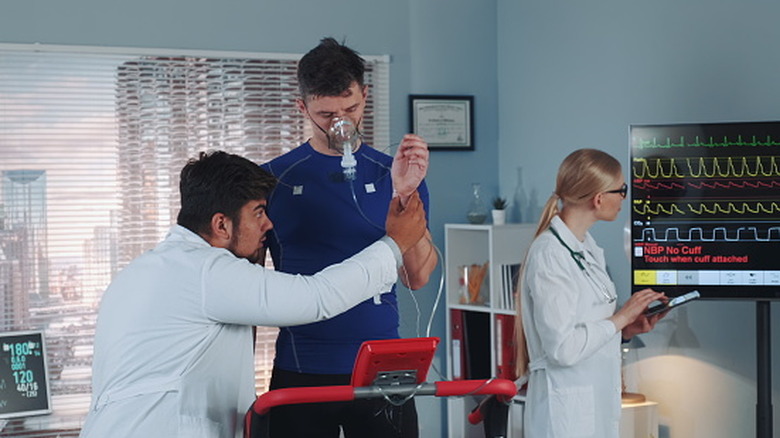
Wearables and online calculators can give a good approximation of VO2 max, though some wearable devices are more accurate than others. But getting a true reading of VO2 max is something typically done in a clinical setting using a cardiopulmonary exercise test. In that test, a subject will exercise on a treadmill, stationary bike, or other piece of equipment while wearing a heart rate monitor and a mask that records oxygen and carbon dioxide levels from breathing. The test starts at low intensity and slowly increases to maximum intensity over a 10 to 20 minute period.
Beating your high score

Whether its from a clinical test, a wearable device, or an online calculator, a VO2 max score gives a view of overall fitness and a starting point for improvement. VO2 max depends on factors like age, gender, and activity levels. So the most straightforward way to improve VO2 max is by becoming more active. Most people can do this simply by following expert recommendations of 150 minutes a week of moderate intensity exercise. People who are not currently active can meet these recommendations by taking a brisk, 30-minute walk five days a week.
Further improvement of VO2 max scores simply requires ramping up the intensity. For example, walking farther or faster; walking on hills or an inclined treadmill; or jogging, biking, or swimming. Interval training, where you perform short bursts of intense exercise separated by lower intensity active recovery can also be helpful at improving VO2 max. Experts also recommend changing up exercises from time to time, for instance swimming if you mostly jog, to get your body to work harder to adapt.
However, even people who can't do intense exercise would benefit from more moderate increases in activity. Small improvements in VO2 max from moderate exercise can dramatically reduce mortality risks. VO2 max is a good metric for longevity, but improving BMI, blood pressure, and other metrics are also important. VO2 max is an increasingly important measure, but it's only one piece of the overall longevity puzzle.