

Not The Arms, Not The Legs: This Body Part Has The Fastest-Moving Muscle

Every few years, we get to watch top performers reach peaks of human achievement at the Olympics. Watching a sprinter explode off of the blocks or seeing a volleyball player drive the winning point over the net is exciting. But while impressive, the body part with the fastest-moving muscles isn't the arms or legs, it's the eye.
While small, the human eye depends on several muscles for its function and protection. Muscles control the opening and closing of the eyelid, movement of the eye as it looks around, and even the release of tears that keep the eye clean and moist. These muscles differ greatly from those in our arms and legs in that they are continually in motion and never get tired. And while they aren't close to the strongest muscles in your body, they are the fastest. The muscles that control where they eye points can move up to 900 degrees per second and move even when you're asleep, while the muscles responsible for closing your eyelid can snap the eye shut in a fraction of a second, literally the blink of an eye.
Always in motion
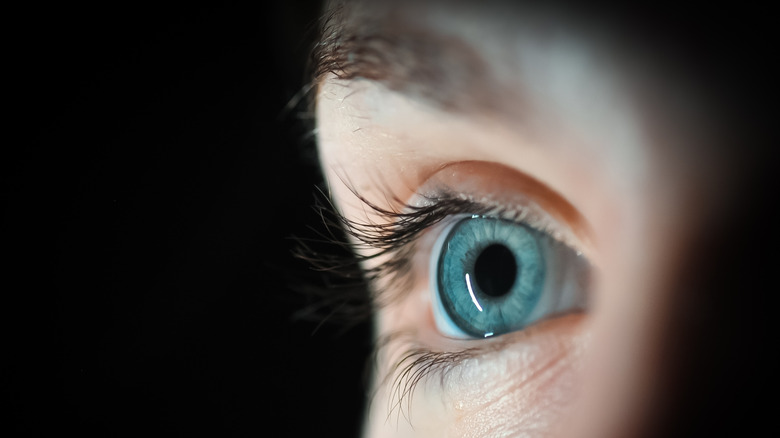
Even when you think you're sitting perfectly still, your eyes are moving. The movement of your eyes is controlled by six muscles, known as extraocular muscles or EOMs, that surround your eyes. EOMs work in three axes: the vertical axis, the horizontal axis, and the rotational axis. Each axis is handled by a pair of muscles, one on each side of the eye. When your eye moves up or down, side to side, or rotates, the corresponding pair of muscles fire. One muscle in the pair will push and the other one will pull. This results in a smooth movement. Your EOMs are constantly at work, even while you sleep, something observed during rapid eye movement, or REM, during dreams.
Because of their constant need to move, EOMs are different from skeletal muscles like the biceps or quadriceps in their structure and the way they use energy. Skeletal muscles hold glycogen, a carbohydrate molecule that acts as energy storage. Depleting this store of energy is what leaves people feeling fatigued during exercise. However, the muscles around the eye don't store glycogen and instead get the energy they need directly from glucose in circulating blood. This means these muscles are incredibly resistant to fatigue. EOMs are also resistant to conditions that cause skeletal muscles to lose function like muscular dystrophy.
Rapid protection
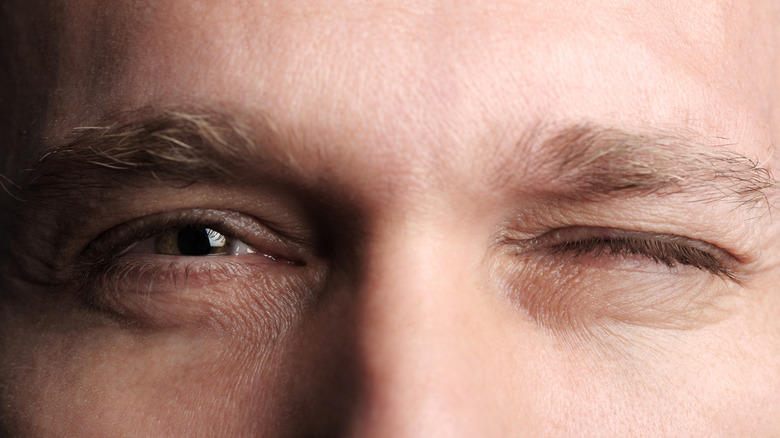
While EOMs handle eye movement, there's another fast-moving muscle that is responsible for protecting the eye. The orbicularis oculi is a ring-shaped muscle that circles the eye socket. This muscle is what controls the opening and closing of the eyelid. The orbicularis oculi fires in response to the corneal reflex, an automatic reaction to something contacting the surface of the eye, closing the eyelid in less than 100 milliseconds.
The orbicularis oculi also protects the eye by facilitating tear production. Tears help keep the surface of the eye moist and wash away dirt and debris. Deeper fibers in the orbicularis oculi help pump tears from the tear glands into the tear ducts with each blink.
Like the EOMs, the orbicularis oculi is incredibly fast and fatigue resistant. The vast majority of the muscle fibers in the orbicularis oculi are fast-twitch fibers that make the rapid movement of the corneal reflex possible, while the remaining slow-twitch fibers are responsible for slower actions like keeping your eyelids shut while you sleep.
The EOMs and orbicularis oculi are what allow you to see the world around you. These muscles are dramatically different from those in your arms and legs in their structure and function. And while they not close to being the strongest muscles in the body, these muscles are by far the fastest.