

This Body Part Is 'Useless' But Scientists Still Want To Understand It

Bodily functions are one of those things that many of us have a strange curiosity for, and in humans, there are plenty of diverse ones to ponder. One body part goes pretty much unnoticed, however, even though it is right in the middle of our face — the philtrum. Also known as a medial cleft, the philtrum is the little groove at the top of the mouth, just below the nose.
It seems crazy to think that a feature of your face could be almost unnoticeable, and in fact, scientists consider it to be pretty useless to modern humans. In other members of the animal kingdom, however, it does have a specific purpose. In dogs, for example, tiny drops of saliva collect in the groove and keep the dog's nose wet throughout the day. This contributes to the dog's ability to smell, and it's one of the reasons their sense of smell is far superior to ours.
In humans, however, the purpose of the philtrum is less obvious. While it functions perfectly well as part of the face, being affected by nearby muscles and experiencing sensation and pain, it doesn't appear to have a specific purpose. The significance of it in dogs prompts speculation that perhaps it had a similar use for our prehistoric ancestors at a time when hunting was a main source of food, and therefore an increase in smelling ability would have been a big advantage. In spite of its apparent lack of use today, the philtrum is still intriguing to scientists for the information it could provide about the development of the face in the womb.
The philtrum provides useful information about the formation of the face
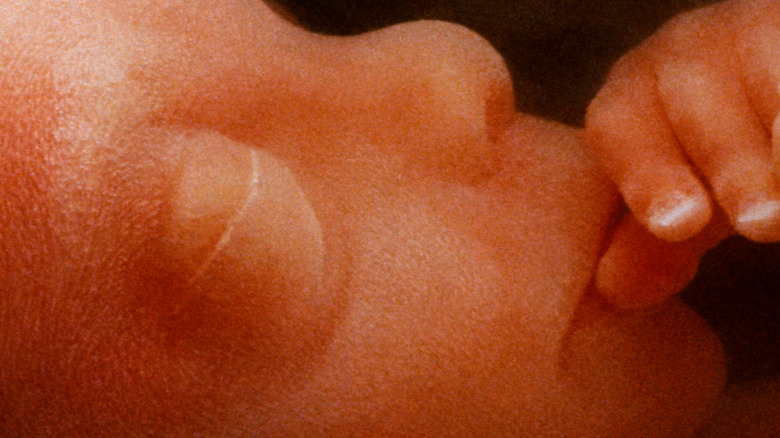
Although its function, if it has one, is a bit of a mystery to scientists, the philtrum actually tells part of the story about our time spent in utero. In a fascinating Youtube clip from BBC's "Inside The Human Body," presented by Michael Mosley, he shows that during months two and three of pregnancy, the face begins to form, finally coming together in the middle, and leaving the philtrum as the "join" that completes the puzzle. "The three main sections of the puzzle meet in the middle of your top lip, creating the groove that is your philtrum," he explains.
If this process does not happen as it should in the womb, the philtrum can be incomplete or misshapen, as in the case of a cleft lip. This can leave a gap where the philtrum should be, and in some cases can affect the palate, too. The philtrum therefore gives scientists crucial information about facial formation in utero, and how the face joins up during those early weeks, meaning it does, at least, have a use in scientific research.
The philtrum could be an evolutionary leftover

Just because the philtrum doesn't have an obvious use for modern humans, that doesn't mean it never did. There are a number of features of the human body that are essentially evolutionary leftovers, meaning they had a function for our ancestors that we no longer require. They are known as vestigial structures, and include the coccyx — no longer needed since we don't have tails — and wisdom teeth, the "useless" body part that can cause more harm than good have become unnecessary over the last few millennia as our diets switched to soft foods.
It is possible that the philtrum is a vestigial structure, too, serving a purpose long ago that is no longer relevant. Even if it is, it does not make it an insignificant part of the human body, but rather serves as a reminder of our ancestors from thousands of years ago. Perhaps as our other senses developed and evolved, the need for super-smelling abilities decreased, and with it, the purpose of the philtrum was lost. Whatever the original use for the groove under our noses, it is still visually a significant part of the human face, and a fascinating insight into our development during the early stages of human reproduction.