

As Record Heatwaves Hit Around The Globe, Here's How 1 Country Is Keeping Cool
For those who need to see it to believe it, evidence of climate change is all over the world. In 2026 alone, historic wildfires have raged out of control in North America and Europe, the United States hit the hottest July on record, and deadly flash floods have washed over Japan as the country hits "cruel," record-breaking temperatures. Such events are consequences of global warming and environmental destruction, and the world is on track to keep getting hotter. The immediate risk of heatwaves is heatstroke, so Japanese engineers are working on a way to cool people off with stainless-steel "human refrigerators."
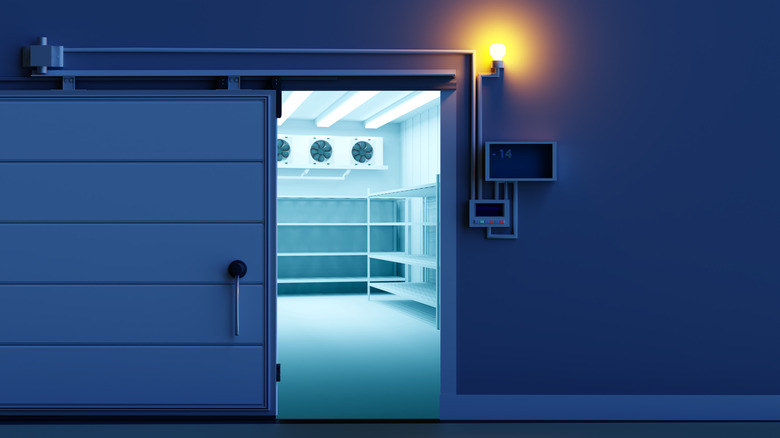
In a clever reappropriation of design, the Japanese vending-machine manufacturer SDRS is developing "personal cooling booths" to serve as emergency shelter from extreme heat. Called the Do Hiemon Box, which translates roughly to "The Great Freezer Boy," the machine is essentially a small walk-in freezer on wheels. The company claims their Do Hiemon Box can cool an overheated adult to a safe body temperature within about 10 minutes and heat stroke victims within about 20 minutes. And thanks to the wheels, the booths can be moved to and set up in environments where heat stroke is a serious danger, such as construction sites, factories, and outdoor festivals. Unsurprisingly, the company envisions these booths installed in busy urban spaces and public areas, just like their standalone vending machines.
There is irony in a "human fridge." Refrigeration accounts for about 7.8% of all global greenhouse gas emissions due to its electricity demands and chemical refrigerant leaks. And as the planet heats up, that percentage is expected to rise within the next quarter-century. The more we use air conditioning and refrigeration, the more greenhouse gases we release, and the hotter the planet gets.
The environmental consequences of human refrigeration
According to the human fridge's distributor, Trusco Nakayama, the Do Hiemon Box uses about half as much energy as a conventional portable air conditioner. It consumes roughly 0.51 kWh on a 100V outlet, and reportedly costs about a dime per hour in electricity costs. That's comparable to the power consumption of a standard washing machine or an in-window air conditioner running on its lowest setting. Compared to the rest of the world's power consumption, that's not too bad — in the United States, for instance, clothes driers consume about double the energy per hour that a small air conditioner does.
Yet, the global refrigeration and cooling industry is scrambling to make refrigeration more sustainable, with limited success. In North America, Europe, and Asia, large-scale centralized chillers employ the high heat capacity of water to transfer heat through the lengthy HVAC systems efficiently. In Europe and Asia, advances in Variable Refrigerant Flow (VRF) systems, which calibrate the most efficient operating flow of their refrigerants, have also made strides in improving energy efficiency. And in a perfect world, such electric refrigerators could be run entirely off renewable energy.
Of course, it's not a perfect world, and refrigerators leak a lot of greenhouse gases, regardless of their power efficiency. Climate scientists estimate that about 27 to 30% of the cooling industry's carbon footprint is due to the accidental leakage of hydrofluorocarbons (HFC), which are the primary gases used in refrigerants and hundreds to thousands of times more potent greenhouse gases than carbon dioxide. Fortunately, new strides in HFC-free refrigeration technology may change the way refrigerators work forever, making cooling off a greenhouse-gas-free experience in the future. For now, short-term solutions like the Do Hiemon Box will have to suffice.