

Not Black Holes, Not Dark Matter: Scientists Say This Mystery Is Even Stranger
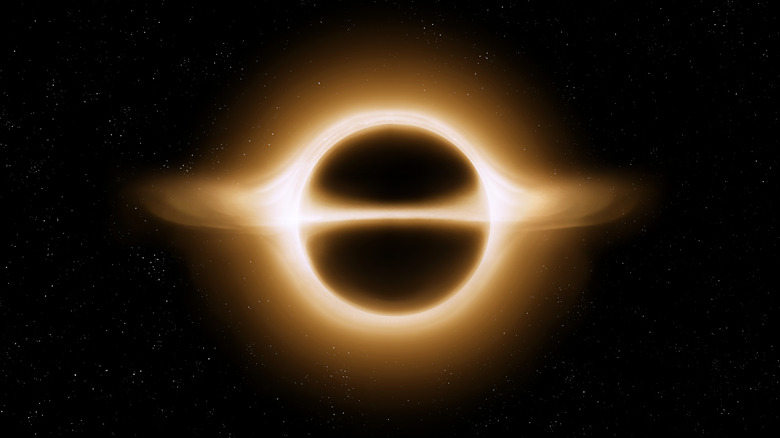
Famed author Douglas Adams described space as being "vastly, hugely, mind-bogglingly big." Space is also mind-bogglingly strange and mysterious. The cosmos is filled with unusual phenomena that humanity is just barely beginning to understand. Black holes and dark matter are two examples of space mysteries, but there's one mystery that scientists say is even stranger: white holes.
A white hole is a theoretical phenomenon that is in many ways the reverse of a black hole. While a black hole pulls matter into its center, never to escape, a while hole continuously ejects matter and can never be entered. White holes are a feature of the same mathematical equations that theorized the existence of black holes; however, while there is ample evidence supporting the existence of black holes, including direct images of one, there is as yet no evidence that white holes exist. Similarly, we understand how black holes form, but scientists have not found a process that could produce a white hole. However, this hasn't kept scientists from trying to find and understand white holes.
Can time go backward?

The heart of the concept of a white hole is equations from the theory of general relativity, one of Albert Einstein's major breakthroughs from 1915. Those equations described the force of gravity and demonstrated how space and time are influenced by mass. That is, planets and stars can bend spacetime, with larger masses having a greater influence. Later work by scientist Karl Schwarzschild calculated exactly how spacetime curves around a given mass, leading to the concept of a singularity. That is, a point in space so dense that space itself bends around it and seals it off from the rest of the universe. This is what we now refer to as a black hole.
However, the equations that describe this warping of space have a quality known as time symmetry. In other words, any process that runs forward in time could have a counterpart that runs in the opposite direction. But even though the equations are symmetric, the universe is asymmetric. The dominant idea is that the universe started with the Big Bang and will continue expanding forever rather than reversing into a so-called Big Crunch. This would mean that time would run in only one direction, making black holes, but not white holes, possible.
How would a white hole form?
Even overlooking this asymmetry, another factor scientists point to as being against the existence of white holes is that there's no clear mechanism for their formation. Black holes are formed when large stars, those at least 20 times the mass of the sun, run out of fuel and collapse in on themselves. Eventually this point in space becomes so dense that its gravity becomes strong enough to keep even light from escaping.
Although there is no clear physical process for forming white holes, some researchers think that black holes could transition into a white hole. In the 1970s, physicist Stephen Hawking noted that black holes emit radiation over time, causing them to slowly lose mass. Some scientists think a black hole could reach a point where it becomes a white hole, though this might take longer than the current age of the universe.
Over the past 100 years, scientists have shown that black holes exist and how they form. However, questions about white holes remain unanswered. Research into concepts like quantum gravity, an incomplete theory that unifies Einstein's theories of relativity and quantum physics, may yield more understanding into these mysteries. But for now, white holes only exist in the realm of science fiction.