

Scientists Were Testing Nuclear Weapons In '54, Then Something Went Very Wrong
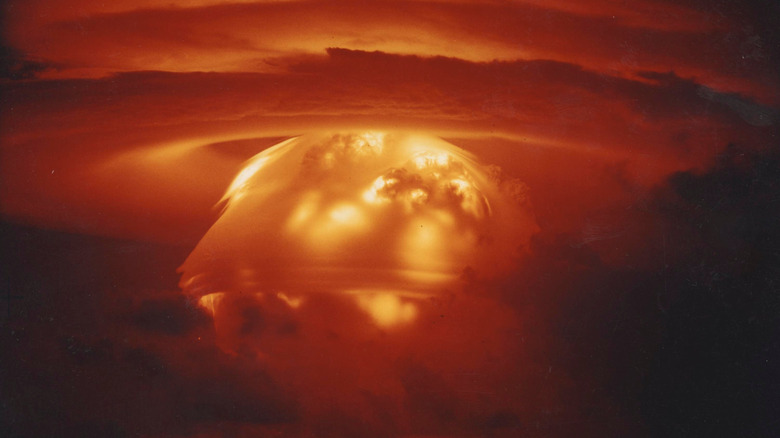
On March 1, 1954, the United States detonated a bomb over a tiny Pacific island that was 1,000 times more powerful than that which devastated Hiroshima. In less than 10 minutes, the mushroom cloud extended 130,000 feet in the air and spread over 4 miles wide. The creators of the bomb made a significant miscalculation, and the result led to widespread environmental damage and detrimental health problems for hundreds of people. The Castle Bravo test constitutes the largest nuclear test in U.S. history, and the U.S. went on to perform 55 more nuclear tests in the same island region. A lack of proper evacuation of nearby residents, errors in judgement, and a refusal to alter plans in the face of weather that carried the nuclear fallout even farther made this test not only a disaster, but one which could have been entirely avoided.
During the Cold War, fears were heightened surrounding nuclear weapons. The United States and Soviet Union were engaged in an arms race, and the U.S. military put extensive resources towards weapons development. While designs could be made, the U.S. had to find somewhere to test these enormously catastrophic weapons.
The Marshall Islands are composed of 29 coral atolls and more than 1,200 islands and islets. Previously a Japanese territory, the United States had seized control of the islands by the end of World War II. Seeing an opportunity, the United States decided to use Bikini Atoll as a testing site for nuclear weapons.
Castle Bravo nuclear test
In 1946, the residents of Bikini Atoll were relocated to an uninhabited island 125 miles east of their homeland called Rongerik Atoll. The land area was one-sixth the size of Bikini Atoll and lacked adequate food resources and potable water. An article from The Guardian cites that the Bikinians had been told that their relocation was for "the good of mankind and to end all wars." By 1947, they were starving.
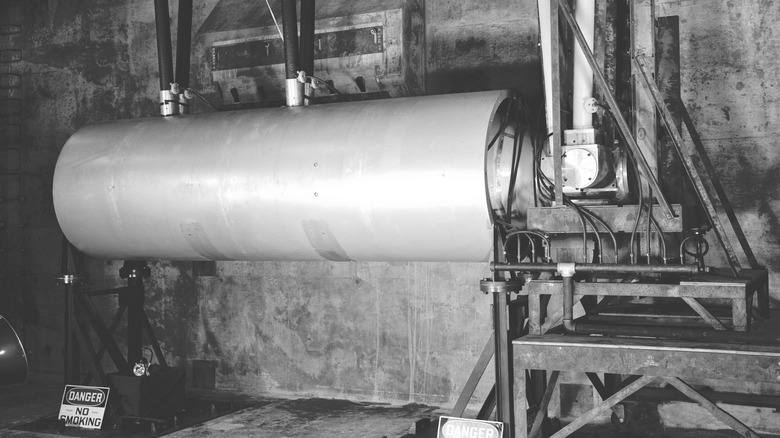
Meanwhile, nuclear testing began on Bikini Atoll that led to years of detrimental radiation levels. The Castle series of bomb tests had the specific goal of assessing the effectiveness of lithium deuteride in the fuel. A previously tested thermonuclear device relied on a complicated cooling mechanism to maintain cryogenic liquid deuterium. The use of lithium deuteride in Castle Bravo erased the need for the elaborate cooling system, as it remains solid at room temperature. This also made it easier to transport.
Naturally occurring lithium is composed of two different isotopes: Li-6 and Li-7, of which Li-7 is significantly more abundant. The assumption made by researchers was that Li-7 would be inert. Therefore, they used enriched lithium, which was made up of approximately 40% Li-6. Initially, the explosive yield was predicted to be 6 megatons (the energetic equivalent of 6 million tons of TNT). But Li-7 is not inert and produced a fusion fuel called tritium. The explosive yield ended up being 15 megatons. For perspective, the nuclear bomb detonated on Hiroshima was just 0.015 megatons.
The aftermath of a catastrophic miscalculation
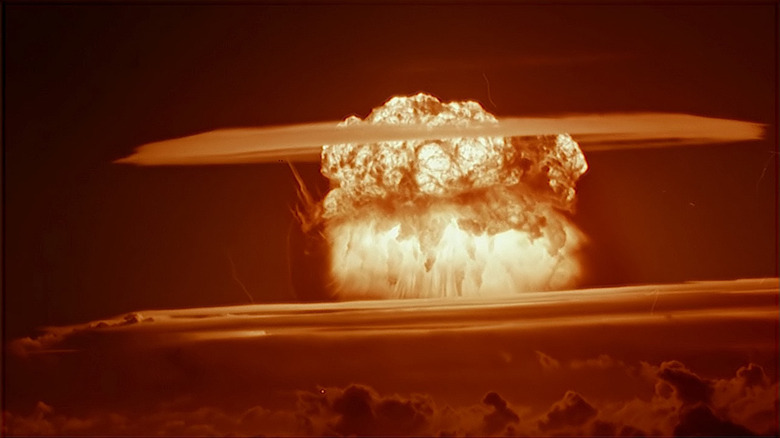
The effects of a hydrogen bomb are widespread and long-lasting. Castle Bravo's fallout of highly radioactive debris looked like snow. Residents of Rongelap Atoll, 110 miles from the bomb site, were unaware that any testing was occurring, and children began to play in the ash. A day after the explosion, two U.S. citizens inspected the atoll for damage and left without warning the Rongelapese people about any radioactivity.
Future estimations would suggest the adults on the atoll experienced a radiation intake of 60 to 300 rem. For comparison, a CT scan provides 1 rem. According to the Centers for Disease Control and Prevention, the relocation threshold is 2 rem, 50 rem causes blood cell damage, and 100 rem can lead to acute radiation syndrome and increases the risk of fatal cancer.
Two days after the test, the residents of Rongelap Atoll were evacuated, but radiation poisoning had already occurred. For decades, the Marshallese experienced significant birth defects, growth abnormalities, and thyroid tumors. Another unsuspecting group of people affected were Japanese fishermen on a boat called the Daigo Fukuryu Maru (Lucky Dragon), 86 miles away. One crew member died, and several others experienced detrimental health effects.
Additionally, biodiversity was severely impacted, with 28 local coral species becoming extinct. Although coral in the area has bloomed to its levels from before the bomb, a lot of the area still faces radioactive contamination. Much of the damage from this ill-conceived test will never be undone.