

Scientists Say This Is The Reason You Hate The Sound Of Your Own Voice

If you cringe every time you hear your own voice on a recording, you are not alone. So many people are horrified when they hear themselves, and are baffled by those around them reacting as though the sound were perfectly normal. The fact is that our voices sound different to others than in our own head, and no matter how long you have spent talking aloud, hearing it back will likely always be an uncomfortable experience.
The first reason that your voice sounds so different in your own head is that when you talk, you hear your own voice in two different ways,with the sound traveling through two different materials. As well as the noise traveling through your ears as it does for everyone else, the vibrations from your voice also travel through the bones in your head. Everyone else hears only the pure sound waves that travel through the air, which then enter their ears and cause their eardrums to vibrate. This is air conduction, and it's how you hear everyone else's voice, as well as other sounds.
The voice in your head, however, is a mixture of the same sound that everyone else hears, coupled with the vibrations traveling through your skull as you speak, known as bone conduction. This distorts your impression of your voice, giving your brain a different idea of how you sound than the people you are talking to. Many people describe the "other" version of their voice as having a higher pitch, though it can be different in a variety of ways.
Why hearing our own voice bothers us so much
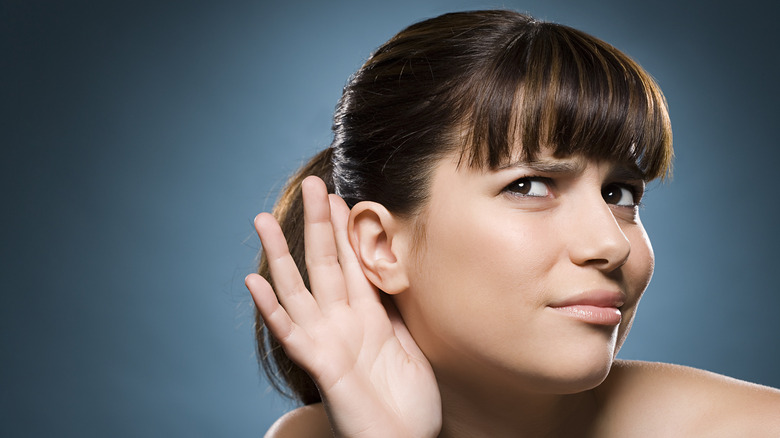
Even though the difference between air conduction and bone conduction explains the discrepancy between what others hear and our own perceptions, it doesn't really explain why the vast majority of us are horrified at the sound of our own voice. When was the last time you heard someone say, "Wow, my voice sounds so fantastic on that answerphone message!?" The answer likely comes down to familiarity.
According to Dr. Silke Paulmann, a psychologist at the University of Essex, your voice feels like a part of your identity, and hearing it sounding so foreign can be disconcerting. "I would speculate that the fact that we sound more high-pitched than what we think we should leads us to cringe as it doesn't meet our internal expectations," he says. "Our voice plays a massive role in forming our identity and I guess no one likes to realise that you're not really who you think you are."
Interestingly, a study published in Perception in 2013 by Hughes and Harrison suggests that our hatred from our own voice may be a self-deprecating put-down. When participants were asked to rate voices and were unaware that their own voice would be included, they rated their own more highly than would be expected. This research suggests that the dislike you have for your own dulcet tones may not be based on the voice itself, but rather the jarring disconnect between what you are expecting to hear, and what actually presents itself.
You can train yourself to like your voice over time

There is good news in the ongoing battle we have with our internal voice situation — it is possible to get used to hearing your own voice. Since unfamiliarity seems to be a factor in how awful it sounds, the more often you are exposed to it, it seems that it may become more bearable to accept how your voice sounds.
A study carried out in 2024 by Thomas et al. showed that participants who regularly recorded voice notes and listened back to their own voices were less likely to dislike their voice than those who didn't. This means that getting over the mental hurdle of hating your own voice could be as simple as exposing yourself to it more often, so that it sounds less strange.
Another study from 2023 by Orepic et al. mimicked the bone conduction effect and asked participants to pick out their own voice. The results showed that the added vibrations made it easier to identify their self-voice than familiar-other voices. This is evidence that the brain is relying on the bone conduction vibrations to confirm self-voice, rather than the air conduction sounds alone. So while listening to a recording of yourself feel like torture for most of us, if you are determined to overcome your self-voice loathing, it could be the key to making your own voice more familiar to your brain.