

What Scientists Know About Megalodon Has Changed Dramatically Since The '90s
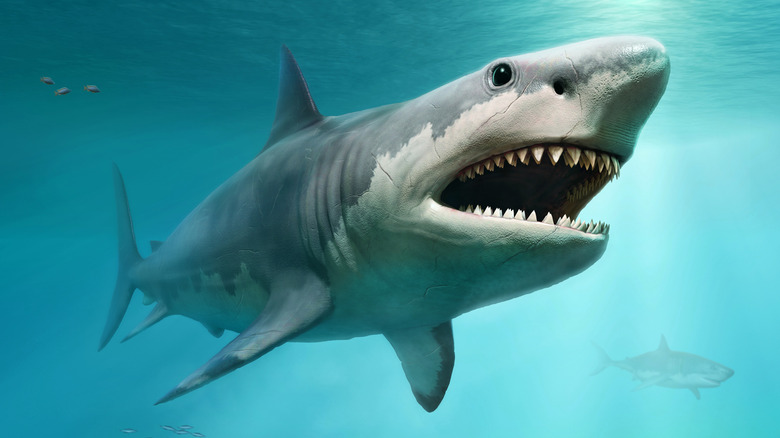
The Otodus megalodon has been a great source of public fascination. The fear of sharks has been culturally elevated since "Jaws" hit theaters in 1975. The megalodon compels us to imagine what an enormous shark would have looked like, and movies like "The Meg" from 2018 have displayed these imaginings on the big screen. Many of these depictions have been based on estimates of this giant shark's body mass from the 1990s. But more recent data have suggested that these estimates could be really far off, and the truth might be even scarier. It appears that the megalodon was even bigger than we had thought.
Previous calculations of megalodon's size are based on a misconception that plagued the paleontological community for many, many decades. These estimates were conducted by examining fossilized teeth and comparing those to the existing tooth-to-body size ratio of the great white shark. Carcharodon carcharias (great white sharks) were thought to be a direct descendant of the megalodon. In 1835, researchers who examined megalodon fossilized teeth noticed the similarities to the teeth of a great white shark. Both were large, triangular, and serrated, causing early paleontologists to categorize the megalodon within the Carcharodon genus. This phylogenetic classification was maintained for a very long time, with some debate arising within the paleontology community. However, it wasn't until the 1990s that this taxonomy would be officially altered, and the megalodon was placed under the genus Carcharocles. Eventually, evolutionary traces would lead to the official genus used today: Otodus.
Bigger, stronger, faster
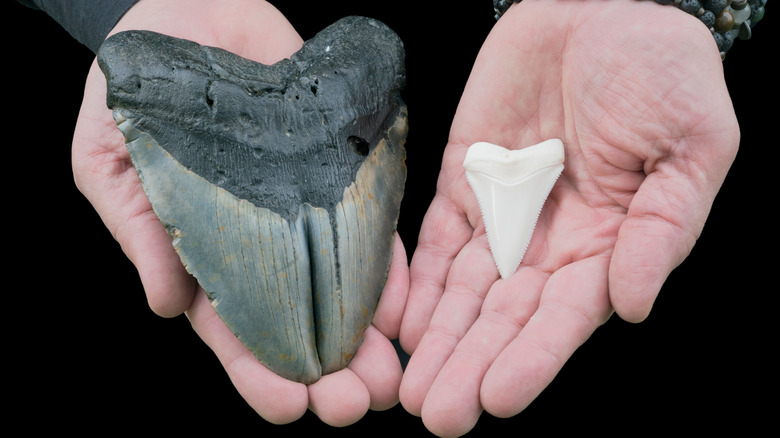
The taxonomic updates would lead researchers to question how accurate previous estimates of the megalodon's size were, since they were based on the now debunked belief that megalodons and great whites were so closely related. However, revising these calculations would be a difficult task, as very few fossils exist. That's because its skeleton — as with the sharks that exist today — is cartilaginous. Much of our animal fossil record stems from bone, as it is a very tough, durable tissue. On the other hand, cartilage is softer and more flexible, meaning that it does not fossilize well. So, while we can find fossilized skeletal structures of dinosaurs that provide strong indications of their form, ancient sharks are not so easy.
That being said, great advancements have been made in the field of 3-D modeling, which have allowed for some remarkable investigations. A study published in Science Advances used a preserved vertebral column first discovered in the 1860s and 3-D modeling to provide new calculations for the evasive megalodon. While previous estimates suggested its length to be between 14.2 and 15.3 meters (approximately 46.6 and 50.2 feet, respectively) at max, these new results put the megalodon's total length at 15.9 meters (roughly 52.2 feet). At 61,560 kilograms (135,915 pounds), the estimated mass was also significantly greater than previous length-matched models would have suggested.
Superpredator
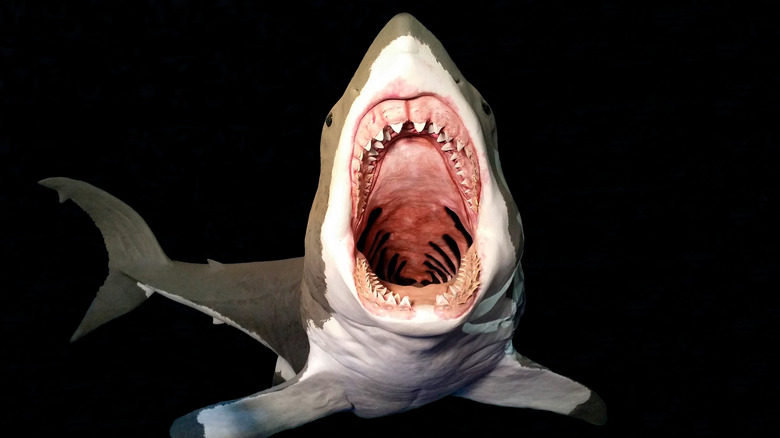
An updated model also presents more information on things like swim speed and metabolic needs. The authors of the Science Advances paper discovered that their megalodon model would require 98,175 kilocalories a day. For reference, an adult great white shark needs 4,871 kilocalories daily. That means that the megalodon would have needed roughly 20 times more calories than a great white. Theoretically, the megalodon would have been able to consume certain apex predators of today's oceans, making the species a superpredator.
To get that many calories would require a pretty large amount of prey to be consumed regularly. Fortunately, the researchers' model indicated that the megalodon's cruising speed is higher than any other existing related species. However, the authors also point out that their estimates were based on the megalodon having been an ectothermic species, meaning that it relied on heat supplied from external sources. Some data has pointed towards the megalodon being a mesothermic species instead, which are generally even faster. Therefore, the paper's estimated average cruising speed of 5 kilometers per hour (about 3.2 miles per hour) might have actually been on the lower end of the megalodon's capabilities.
The research efforts that have led to improved taxonomic identification as well as those that facilitated such advanced modeling systems have been able to cross a research gap that has persisted for many, many years. Such work highlights the importance of basic science research and cross-disciplinary collaboration. Perhaps in the coming decades, we will know even more.