

In The '90s, Scientists Launched A Probe To Saturn's Moon; What They Found Was Unexpected
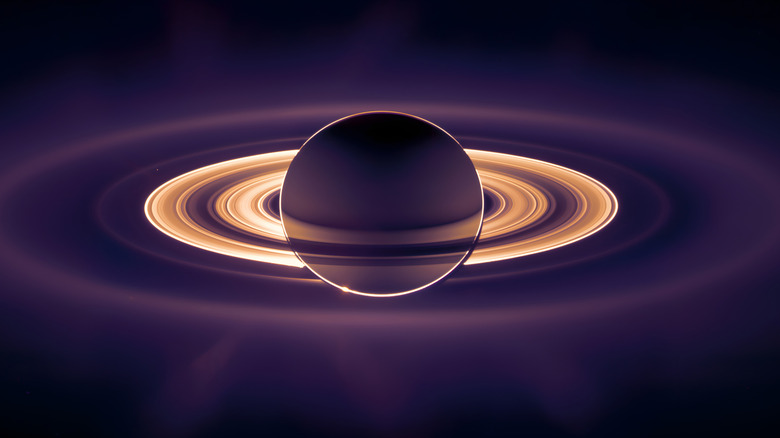
Saturn has more moons than any other planet in our solar system with a stunning 293 confirmed satellites. Some of them, such as Prometheus and Telesto, are relatively small rocks, with uneven shapes that hardly resemble what we expect of a moon. However, Saturn has one moon that is more fascinating than any other we know of: the great Titan. Titan is the second largest moon in the solar system, after Jupiter's Ganymede, but it has something that even Ganymede doesn't. Titan is the only moon with a substantial atmosphere, which makes it a better contender for extraterrestrial life than arguably any other body in the solar system. This has naturally made Titan a subject of fascination for scientists, and in 1997, NASA partnered with the European Space Agency and Italian Space Agency to send a probe there for a closer look.
The mission involved two craft: the Cassini space probe (named after the Italian scientist Jean-Dominique Cassini, who discovered three of Saturn's moons), and the Huygens lander (named after Christiaan Huygens, the Dutch scientist who discovered Saturn's rings as well as Titan). They launched Cassini-Huygens on October 15, 1997, but because of the vast distance between planets, it didn't reach its destination for several years. Huygens touched down on Titan's surface on January 14, 2005, while Cassini remained in orbit around the planet until 2017. Together, they recorded unprecedented data about Titan, and revealed some potential ingredients for life.
What the Cassini-Huygens mission found
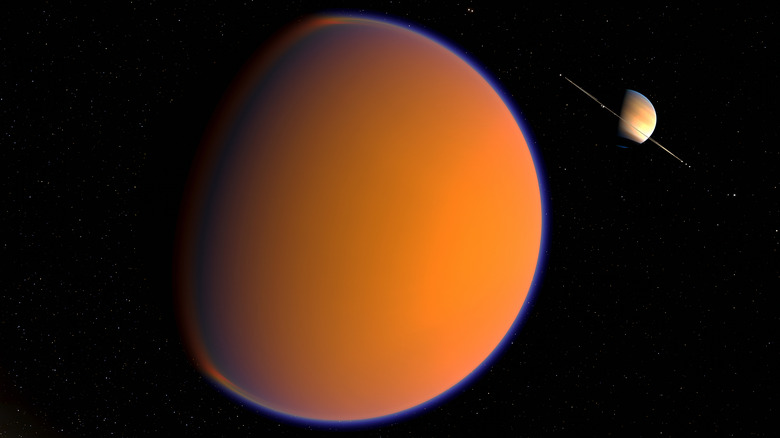
When Huygens landed, it officially became the first craft to touch down in the outer solar system. Huygens was equipped with several technical instruments. The Huygens Atmospheric Structure Instrument was designed to measure the properties of Titan's atmosphere, including its density. Since Titan's atmosphere is so thick as to obscure the planet's surface, scientists were flying in blind, and they had to equip Huygens for a landing on either solid ground or liquid just in case. What they found was ground, and on the way down, an acoustic sensor measured the distance to the surface. At the same time, Huygens used sound waves to record information on atmospheric density and temperature. The lander operated for about 72 hours before going silent.
Huygens' observations revealed that nearly 2% of Titan is covered by liquid, but it isn't water. There are lakes, and even seas, of liquid methane all over the moon's surface. The largest of these, Kraken Mare, is more than 700 miles wide. The atmosphere of Titan is also predominantly made of methane, which slowly degrades from exposure to the sun. The fact that Titan hasn't lost its atmosphere entirely indicates that it is regenerating the atmosphere just as quickly as it loses it. Scientists suspect this is due to methane gas erupting from volcanoes on the surface, but they aren't certain. As exciting as these findings are, there was something even more incredible for Cassini-Huygens to discover.
Titan may have water under its surface

Cassini took measurements of Titan's gravity and found that its surface actually distorts in the same way that tidal forces pull on Earth's oceans. This has led scientists to the conclusion that right below Titan's crust, there is a layer of water, creating a moon-wide subterranean ocean. It is impossible to know for certain just how large this layer is, but computer models suggest it could be over 150 miles deep. That's more than 20 times deeper than the deepest point in Earth's ocean, the Mariana Trench. Titan's ocean lies underneath an ice cap that could be as much as 30 miles thick, making the moon a true water world.
This underground ocean could potentially hold the answer to why Titan's methane atmosphere is able to regenerate itself so readily. Oceans can act as reservoirs for greenhouse gases like methane and carbon dioxide. Just as Earth's oceans and forests act as "carbon sinks," Titan's ocean could act as a methane sink, storing huge quantities of methane that slowly escape to the surface to replenish the atmosphere.
The big question is whether Titan could be home to life. The ocean below its surface could indeed harbor some life forms akin to what we find on Earth. The more interesting possibility is life on Titan's surface. Respiring methane rather than oxygen, it would be unlike anything we've ever seen before, but we'll need more missions like Cassini-Huygens to find out.