

Scientists Explained The Mystery Behind Why Music Gets Stuck In Your Head

Music can have powerful effects on the human mind. For some people, music can cause goosebumps and chills to ripple down their spine due to its emotional, somatic response. Even more common, however, is the experience of getting a song stuck in one's head. Up to 90% of people experience this peculiar phenomenon, including folks among the 50% of the population who lack an internal monologue. But as annoying and uncontrollable as the phenomenon may be, it reveals a universal characteristic of the human mind that suggests music may be more beneficial than we thought — even when that music drives us nuts.
The word "earworm" originates from the German word "ohrwurm," a term that has become a colloquialism to mean "a song repeating in one's head." It's an apt term, since attempts to mute or change the song playing in your mind are often futile, as if an independently minded musical worm had wriggled its way into your brain and took over your internal monologue. But psychologists have a different explanation for the phenomenon.
The part of the brain responsible for short-term storage forms something called the phonological loop, which essentially serves as a temporary logbook of incoming auditory sensations. These few recorded seconds give the brain time to analyze the meaning of the sensation. For example, the phonological loop lets our minds hold the vocalization of a phone number in our minds for a few seconds while we write it down. However, emotional triggers, such as stress, can recall long-term memories, such as musical melodies or verses. Should these song snippets get recorded to the phonological loop, our minds enter a "rehearsal cycle" that leaves the song clip looping in our minds. This explains why only the catchiest, earwormiest parts of songs get stuck in our heads, since they draw upon our long-term memories.
Music is an age-old trick for memorization
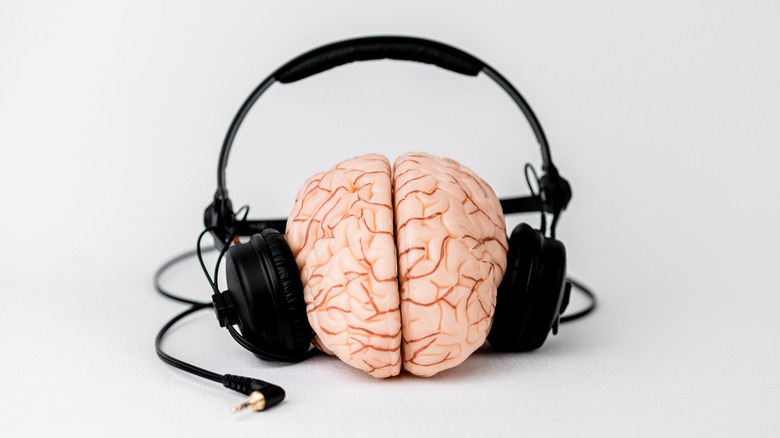
According to Dr. David Silbersweig of Harvard Medical School, music may also stick in our minds due to its importance as a memory tool. Along with Samata R. Sharma of Brigham and Women's Hospital, Silbersweig co-authored the 2018 paper on "The Neurobiological Effects of Music on the Brain," which explores the varied ways music changes brain structure. In regards to "earworms" getting stuck in your head, Silbersweig points to the structural and functional changes music has on our brains' emotional and memory networking.
Indeed, music can connect our short-term and long-term memory, and there may be an evolutionary reason behind it. Music, with its rhyming words, rhythmic structure, and memorable melodies, makes oral stories easier to commit to memory. This in turn allowed pre-literate societies to transmit their complex histories and knowledge.
Perhaps the greatest example of this is the Homeric epic poems, The Odyssey and The Iliad. Before Homer wrote them down, historians believe these incredibly lengthy poems were memorized and orated by traveling bards. It's likely that stringed instruments and vocal melodies were also used to help jog their memories. But these illiterate bards didn't exactly memorize the thousands of lines of their stories word-for-word. Instead, they likely drew from musical motifs to fill in the gaps of their memory, improvising the details but successfully recalling the overall stories.
We've inherited this music-memory connection from our preliterate ancestors. There are other evolutionary benefits to music, as well. These benefits include group bonding, signaling physical fitness through dance, and even providing mnemonic devices to help us identify dangers, such as distinguishing between deadly snakes that could kill you in seconds and their non-deadly lookalikes. Today, "earworms" may be an irritating consequence, but they represent the powerful connection our brains have with music.