

The Eye Health Myth That's Been Debunked By Science
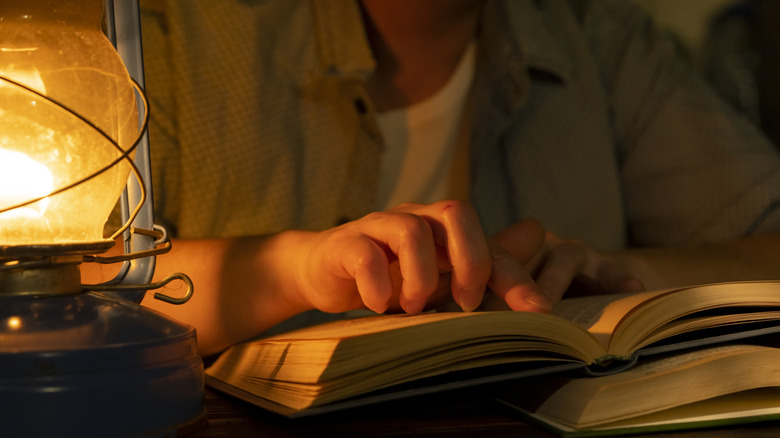
If you remember being told as a child not to read under the covers or in a dark room because it would damage your eyes, you are not alone. Many people believe that reading in anything but a brightly lit room will have dire consequences for your eyesight, but it has been shown to be a myth. While some people may find it more difficult to read in dimly lit areas, there is no evidence to suggest that it can have a negative long-term impact.
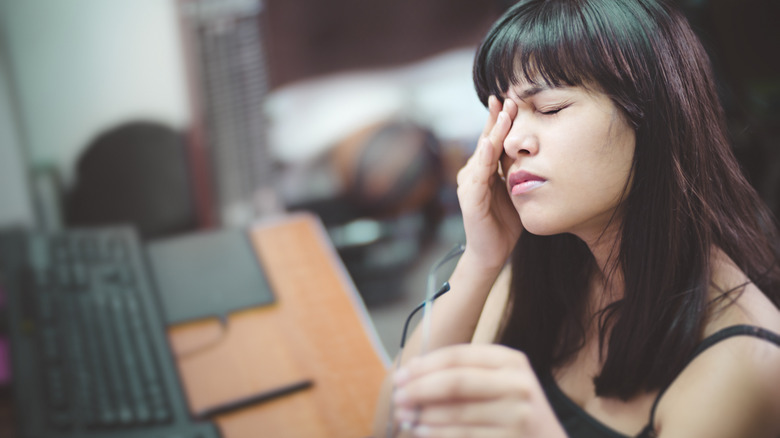
A 2007 article in The BMJ explains that the myth surrounding eyesight damage likely stems from the eye strain that can be experienced when lighting environments are not optimal. While this can be annoying and lead to other temporary symptoms such as headaches, itchy eyes, and even blurred vision, the effects are temporary and will not have a lasting impact on the eyes. The same article also states that blinking decreases in low light, meaning that the eyes can dry out, increasing the feeling of discomfort.
These symptoms stem from the fact that your eyes are working harder if there is less light available, but this is not equivalent to causing damage that will last. Sure, your eyes are likely to feel tired more quickly if the lights are low, but there is no need to worry about permanent damage.
Temporary discomfort does not mean long-term damage
Although there is no need to panic if you have spent time reading in sub-optimal light, turning a lamp on could still be beneficial to how you feel. When there is a low level of light available to your eyes, your iris causes the pupil to dilate to allow more light in. If you have ever turned a bright light on after being in the dark, you will know how jarring it is, as so much light passes through the eye with a pupil that is larger than usual. Dilated pupils are your body's way of counteracting the low light, allowing your eyes to continue to see in the dark.
Seeing and reading are not the same, however, and making out every word on the page will become more difficult as the light dims. While you may clearly see a person sitting beside you by the glow of a candle, proofreading your 20,000 word dissertation printed in a small font is going to prove a lot more challenging.
According to Eye Clinic London, reading in low light may require you to hold the book closer to your eyes, or your reading speed may decrease compared to a well-lit room. However, the article reassures that once you put the book down and return to distance work or move to a brighter space, the symptoms should disappear fairly quickly, suggesting that the discomfort is short-lived.
Bright light could be crucial for the development of children's eyes

Even though the idea that reading in dim light causes eyesight damage has been proven to be untrue, there is thought to be a link between overall exposure to bright light and the way that children's eyes develop. In a study published in Graefe's Archive for Clinical and Experimental Ophthalmology, researchers found that children who spent less time in well-lit environments were more likely to develop myopia (shortsightedness) in childhood than those who were exposed to more light.
The study also looked at the activities children participated in, including near-vision activities. They found that sustained periods of time partaking in near-vision activities contributed to a rise in myopia rates. Given that many children in the Western world spend hours every day indoors using computers, doing close-vision reading and written work, and fixing their eyes on handheld devices, the findings suggest that modern environments could be putting their eyes at risk long-term.
Although reading occasionally in the dark is totally fine, especially for adults, recent research suggests that well-lit environments are an ideal environment for growing bodies to keep eye health optimal. Since it will also reduce eye strain and the temporary symptoms associated with it, reading outdoors or turning on an extra lamp can be a good way to keep everyone's eyes happy.