

What Scientists Know About Spinosaurus Has Changed Dramatically Since The 1900s
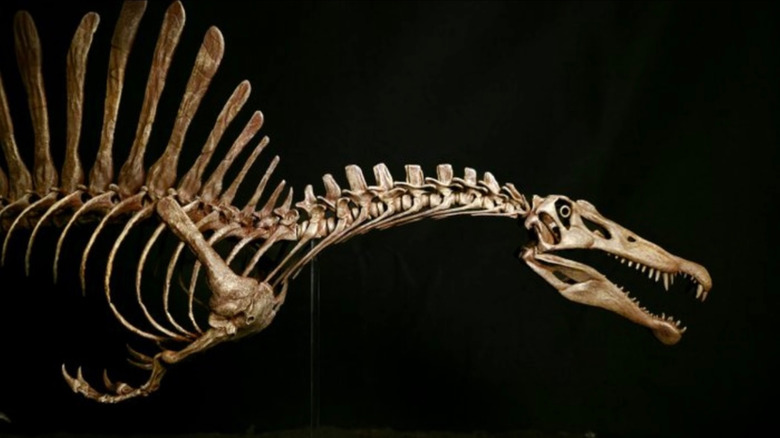
With the striking spiny sail along its back, the Spinosaurus has been a perennial favorite of dinosaur fans of all ages for decades. First discovered more than 100 years ago, this prehistoric giant has gone through several dramatic changes, going from being depicted walking awkwardly on its hind legs, to a fearsome predator in the 2001 film "Jurassic Park 3," to recent revelations that the Spinosaurus was a semiaquatic giant with more in common than modern crocodiles than the Tyrannosaurus rex.
The Spinosaurus lived in what is now North Africa around 95 million years ago. The first Spinosaurus fossils were found in Egypt in 1912, consisting of a lower jaw, teeth, and several vertebrae with spines measuring up to six feet long. In 1915, German paleontologist Ernst Stromer gave the dinosaur its name. However, with a limited number of recovered bones, how the Spinosaurus looked and lived was unclear. Understanding of the dinosaur's anatomy was further complicated by the destruction of the only known fossils during World War II. Based on the information Stromer had on the dinosaur's anatomy, he depicted the Spinosaurus as walking on its hind limbs.
Slowly painting a picture of the Spinosaurus
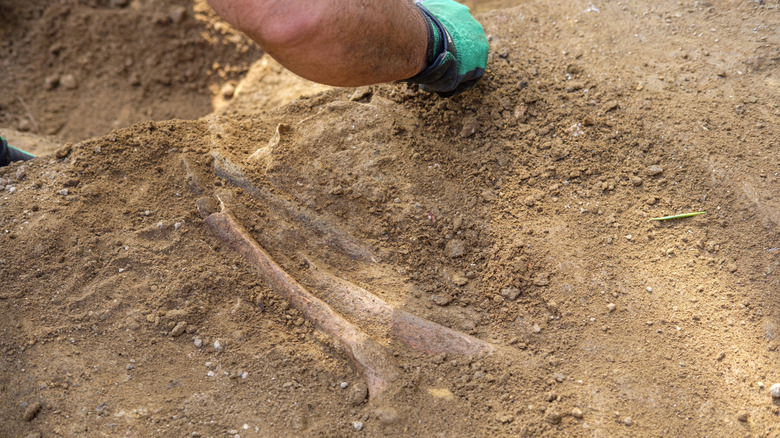
New fossil evidence can tell the truth about what dinosaurs really looked like. Over the ensuing decades, scientists found fossils of other, closely related dinosaurs, which led to changes in the consensus of how the Spinosaurus lived. One such change was a shift in the dinosaur's posture, having it move about on all four legs. Researchers also noted how fossilized teeth and skull bones of relatives of the Spinosaurus hinted at the dinosaurs primarily consuming fish. Additionally, scientists have discovered several non-dinosaur reptiles that had evolved to live in the water like the ichthyosaur, plesiosaur, and the mosasaur, sometimes called the T. rex of the ocean.
Until fairly recently the consensus was that the Spinosaurus was a land-dweller with a long, narrowing tail. However, that began to change in the 2010s with the discovery of more Spinosaurus fossils in Morocco. Locals found bones that resembled those of the Spinosaurus, and a later search of the rock formation where they had been found turned up parts of a new skeleton. Later digs found even more bones, including skull fragments, more vertebrae, parts of the pelvis, and front and back legs. With more bones, scientists could build a more complete understanding of the Spinosaurus and soon found that the giant predator may have been semiaquatic.
An ancient river monster
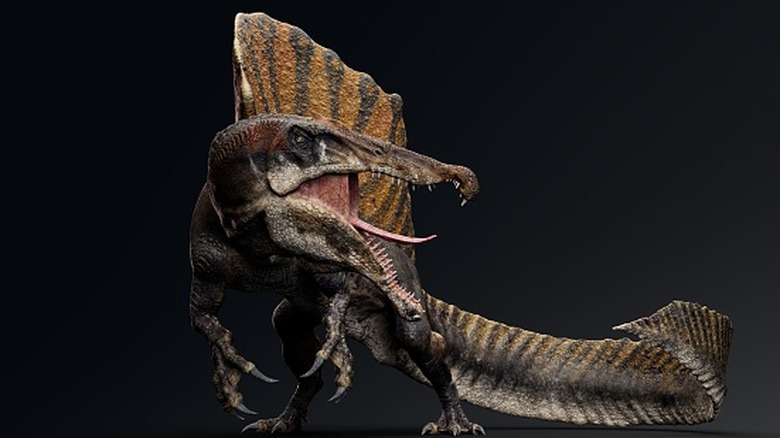
The Spinosaurus had small nostrils in the middle of the skull, which would allow the creature to breathe while partially submerged in water. Scientists also found openings in the end of the snout similar to those found in crocodiles and alligators that enable them to detect motion in water. The Spinosaurus's large interlocking teeth and curved claws would also be helpful for catching and eating fish. However, until recently it wasn't clear how the Spinosaurus moved around in water.
Scientists observed struts in several of the tail vertebrae, giving Spinosaurus a tail that more closely resembled a paddle than the long, narrow tail it was long thought to have. Further investigation found that the vertebrae toward the end of the tail could freely move back and forth in a way that could propel it through the water. Researchers built robotic models of different shapes of tails and found that the Spinosaurus could move through the water with its tail much like living aquatic animals.
New discoveries over the years have painted a clearer picture of the Spinosaurus, though it has retained the spiny sail on its back. Going from awkward land-dwelling giant, to fierce predator, to semiaquatic hunter, the Spinosaurus has changed dramatically since the 1900s.