

Scientists Say These Ancient Teeth Can Explain Why Humans Are So Hesitant To Eat Bugs
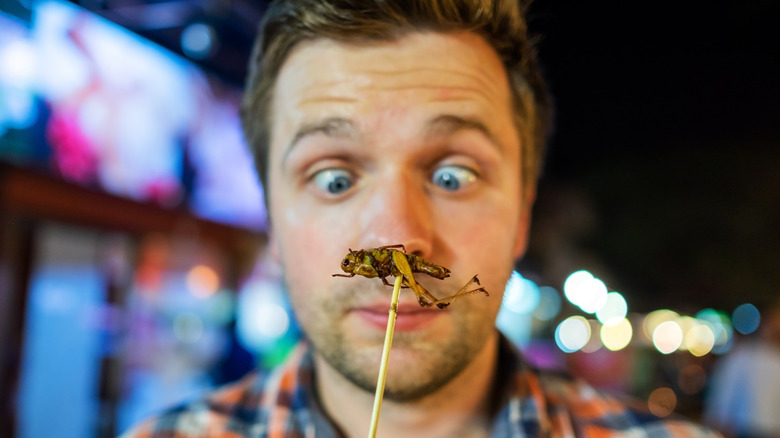
Many of us imagine our early ancestors as naked apes who survived by eating whatever food stuff they could find. It's a fair assumption, since humans had no domesticated plants and animals to rely on. And because many edible insects provide more protein than animal meat, it's also fair to assume that our ancient ancestors feasted on grubs, ants, grasshoppers, and even the mosquitoes that were brutally killing us since time immemorial. However, recent research suggests that some prehistoric ancestors were pickier eaters than previously believed — at least when it came to bugs.
According to a 2026 research study published in Science Advances, ancient Europeans didn't eat insects, though our Neanderthal cousins appear to have consumed them regularly. The researchers, from Catalonia, Spain, had access to the fossilized teeth of 745 ancient modern humans, from the Upper Paleolithic period to with some coming from as far back as 33,000 years ago.
When teeth fossilize, their plaque fossilizes with them, which contains signatures of the foods their owners ate before their deaths. The researchers analyzed the DNA and chemical compositions of these preserved plaques, and found that Neanderthals had remnants of bugs in their teeth, while Homo sapiens had nearly none.
The process of extracting food remnants from fossilized teeth is surprisingly accurate, albeit meticulous. Dental plaque traps bacteria, cell debris from the host's mouth, and food particles in a film, preserving its contents for tens of thousands of years. Through discovery by destruction, scientists can blend all the fossilized plaque material into a soup of fragmented genes and piece them together using powerful computers. This process provides scientists with the richest source of ancient DNA available, allowing them to map the genetic code of ancient lineages and study our genetic relationships with other, now-extinct human species.
The proof is in the DNA: Prehistoric Europeans didn't typically eat insects
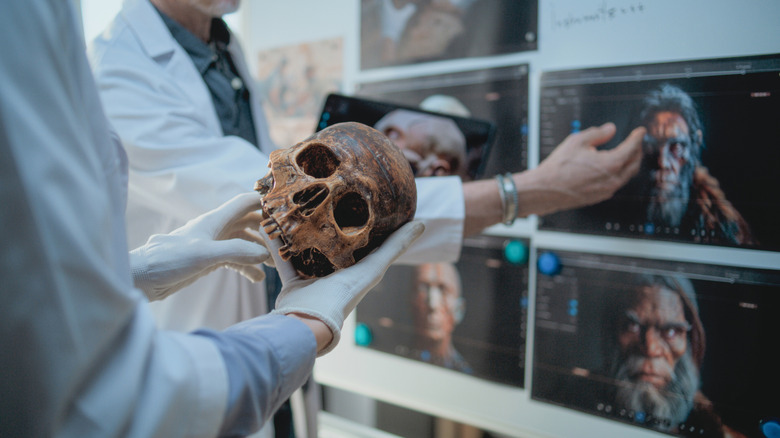
The fossil record demonstrates that prehistoric Homo sapiens and Neanderthals' co-existed, competed, and mated in Eurasia between 250,000 and 40,000 years ago (our relationship having ended with the extinction of homo neanderthalensis). This coexistence resulted in a transfer of Neanderthal DNA into our modern human genome, and it also catalyzed adaptation via competition in the wild natural landscapes of prehistoric Eurasia. In those days, human species were primarily hunter-gatherers, whose diets were largely composed of whatever familiar, edible plants, animals, and fungi were at hand. Thus, it would seem surprising that prehistoric Europeans would have eschewed insects as a source of energy.
But the evidence paints a different picture. The Spanish researchers found two strong signs that prehistoric European Homo sapiens avoided eating bugs. First, they searched the scraps of DNA found in the fossilized dental plaque for insect DNA. Significant amounts of insect DNA was found in the teeth of the 18 Neanderthals; only trace amounts were found in the teeth of the 745 Homo sapiens.
Then, they looked at the human DNA itself. Human species possess "chitinase genes," which code for the digestion of the chitin-based exoskeletons of insects. The researchers found that prehistoric European Homo sapiens had weaker chitinase genes, especially in areas farther from the equator where edible insects were only abundantly available a few months out of the year.
Thus, it appears that an aversion to entomophagy, the practice of eating bugs, may be inherited from European populations of ancient humans. Why the aversion developed is up for debate. The wider fossil record suggests that insects have always been on the menu for humans and our ancestors. After all, we eat animals with four legs — what difference does an extra pair of legs make?