

Scientists Drilled The Deepest Hole Ever. They Didn't Expect What Happened Next
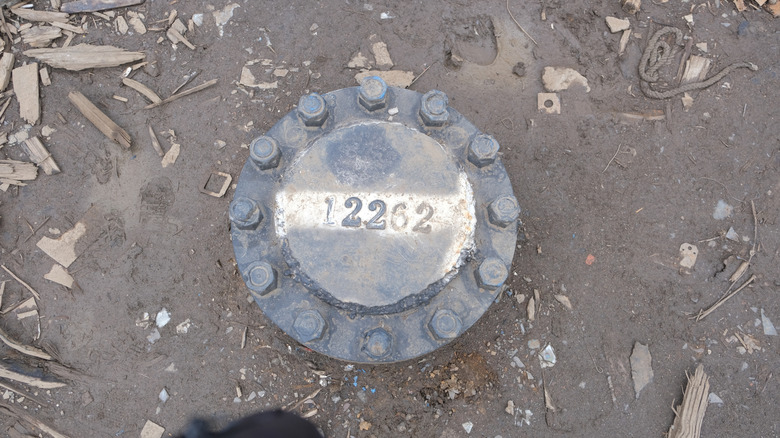
For ages humanity has peered into the night sky and plumbed the depths of the ocean searching for knowledge about the world around us. However, while humans have flown in space and explored the seafloor, Earth's interior has stayed largely hidden. In the 1970s, scientists in the Soviet Union attempted to drill deep beneath the surface to expand our understanding of the ground beneath our feet. However, the scientists found that the layers of rock deep below us behaved in unexpected ways.
In 1970, geologists and engineers in the Soviet Union launched a project known as the Kola Superdeep Borehole. The goal was to reach the Mohorovičić discontinuity, or Moho, a boundary that separates Earth's crust from the mantle beneath. The team drilled a hole in the ground in the Kola Peninsula, a land feature in northwestern Russia just inside of the Arctic Circle that consists of granite and metamorphic rocks that are more than half a billion years old. Before drilling, the reigning thought was that the Moho marked a transition between granite and denser rock like basalt, both of which form when lava cools.
Drilling the deepest hole in human history
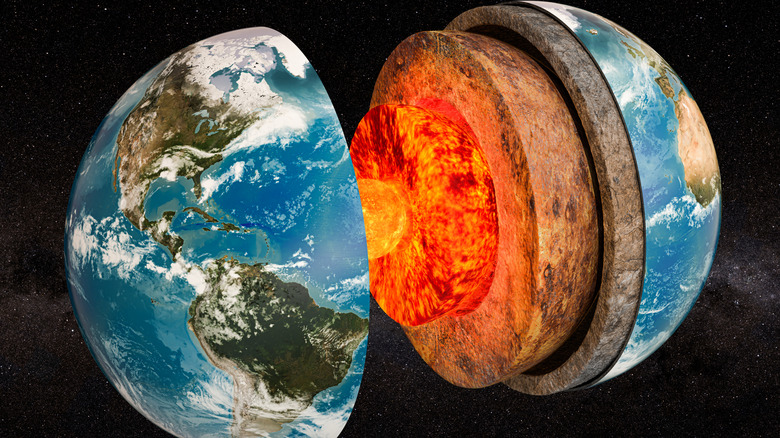
Most of the knowledge we've gained on Earth's interior has come from the study of how seismic waves move underground. During seismic surveys in the early 1900s, scientists observed that seismic waves accelerated at a certain point beneath the surface. This change in velocity indicates a change in density, which was interpreted as a change in rock type. However, scientists wanted to gather more direct data, something that boreholes can provide.
The Kola borehole team never reached their target depth of nearly 50,000 feet, but they did reach the deepest point humanity has ever drilled at 40,230 feet beneath the surface. What scientists did and didn't find while drilling the borehole added to humanity's understanding of Earth's inner workings. For one thing, they never found basalt during their drilling work, only granite and metamorphic rocks (formed from granite transformed by heat and pressure). What was thought of as a change in rock type was really just a change in how rocks behaved under the high temperature and pressure far beneath the surface. Scientists found that temperatures at the deepest part of the Kola borehole were around 350 degrees Fahrenheit, almost twice as hot as predicted. They also found that rock behaved in unexpected ways deep beneath the surface
Unexpected findings followed by major setbacks
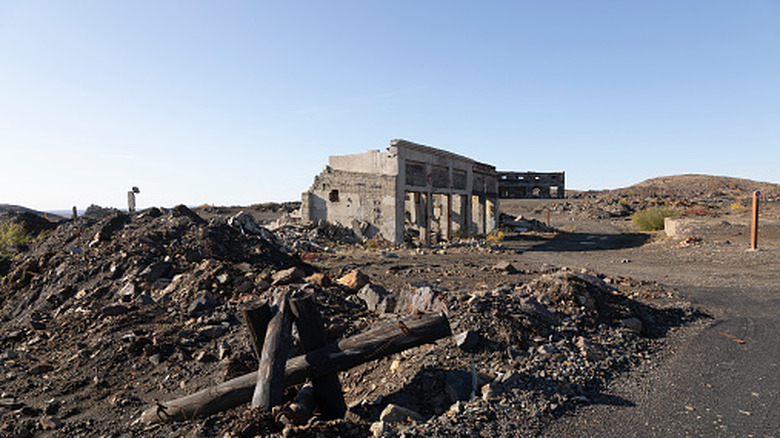
At the surface, granite is a hard, crystalline rock that shatters when you hit it with a hammer. At 40,000 feet below the surface, heat and pressure turn granite into something that behaves more like a stiff plastic that deforms instead of breaking. The depths above this also held surprises for scientists. Between 16,000 and 23,000 feet beneath the surface the Kola team found saline water that flowed through cracks in the rocks. However, this wasn't groundwater or surface water that had seeped down through the borehole, it was water released when heat and pressure acted on the rocks. They also found evidence of chemical reactions between water and rocks deep underground.
In 1984, Kola project scientists presented their accomplishments at the 27th International Geological Congress, which was held in Moscow. However, a few weeks after the meeting the drill malfunctioned and the only option the Kola team had was to pull their drill back up to 23,000 feet and drill back down through a different path. Five years later they reached the depth they had hit in 1984, but the Kola project ended shortly after, one year after the 1991 fall of the Soviet Union.
Although the Kola Superdeep Borehole project didn't reach its original goals, the project made many achievements. The project still holds the record for deepest point ever drilled, and the unexpected discoveries made during the project have helped scientists build a more accurate understanding of Earth's inner workings.